

2.1.5 Relation to the Thermodynamics
and Conservation Laws
“In modern physics, the laws of conservation of momentum, energy, and angular
momentum are of more general validity than Newton’s laws, since they apply to both
light and matter and to both classical and nonclassical physics. Because force is the
time derivative of momentum, the concept of force is redundant and subordinate to
the conservation of momentum and is not used in fundamental theories (e.g.,
quantum mechanics, quantum electrodynamics, general relativity, etc.). Other
forces, such as gravity, also arise from the momentum conservation. Newton stated
the third law within a worldview that assumed instantaneous action at a distance
between material particles. However, he was prepared for philosophical criticism of
this action at a distance, and it was in this context that he stated the famous phrase ‘I
feign no hypotheses.’ The discovery of the second law of thermodynamics in the
nineteenth century showed that not every physical quantity is conserved over time,
thus disproving the validity of inducing the opposite metaphysical view from
Newton’s laws. Hence, a ‘steady-state’ worldview based solely on Newton’s laws
and the conservation laws do not take entropy into account” (Anon 2020).
That brings us to the main topic of this book. In unified mechanics theory, entropy
generation is incorporated into Newton’s universal laws of motion.
2.2 Stress
2.2.1 Definitions of Stress and Traction
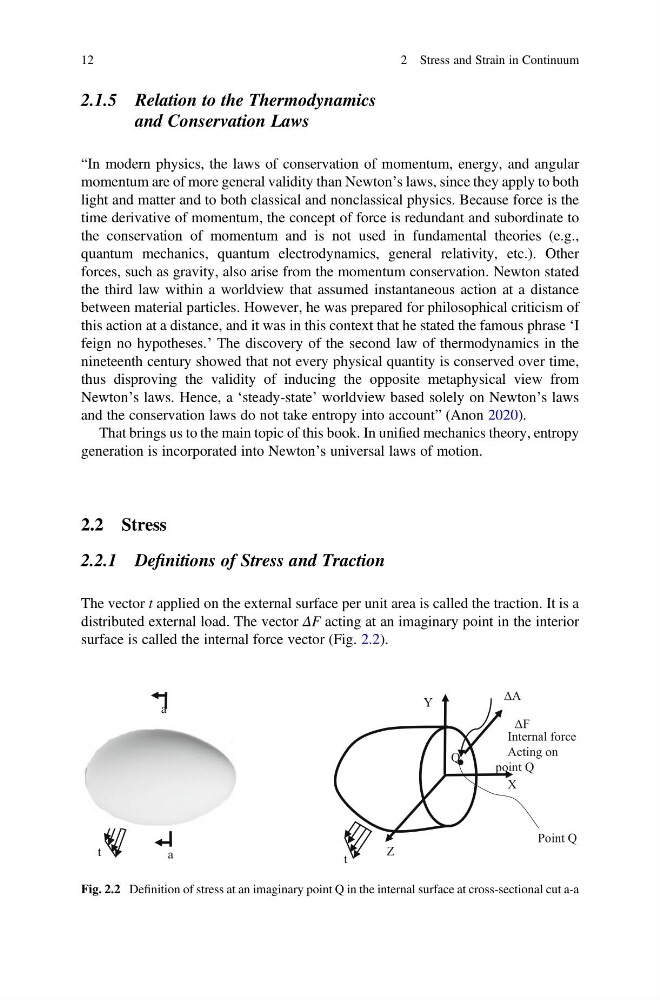
The vector t applied on the external surface per unit area is called the traction. It is a
distributed external load. The vector ΔF acting at an imaginary point in the interior
surface is called the internal force vector (Fig. 2.2).
t
Z
Y
X
Q
ΔF
Internal force
Acting on
point Q
Point Q
ΔA
t
a
a
Fig. 2.2 Definition of stress at an imaginary point Q in the internal surface at cross-sectional cut a-a
12
2 Stress and Strain in Continuum
and Conservation Laws
“In modern physics, the laws of conservation of momentum, energy, and angular
momentum are of more general validity than Newton’s laws, since they apply to both
light and matter and to both classical and nonclassical physics. Because force is the
time derivative of momentum, the concept of force is redundant and subordinate to
the conservation of momentum and is not used in fundamental theories (e.g.,
quantum mechanics, quantum electrodynamics, general relativity, etc.). Other
forces, such as gravity, also arise from the momentum conservation. Newton stated
the third law within a worldview that assumed instantaneous action at a distance
between material particles. However, he was prepared for philosophical criticism of
this action at a distance, and it was in this context that he stated the famous phrase ‘I
feign no hypotheses.’ The discovery of the second law of thermodynamics in the
nineteenth century showed that not every physical quantity is conserved over time,
thus disproving the validity of inducing the opposite metaphysical view from
Newton’s laws. Hence, a ‘steady-state’ worldview based solely on Newton’s laws
and the conservation laws do not take entropy into account” (Anon 2020).
That brings us to the main topic of this book. In unified mechanics theory, entropy
generation is incorporated into Newton’s universal laws of motion.
2.2 Stress
2.2.1 Definitions of Stress and Traction
The vector t applied on the external surface per unit area is called the traction. It is a
distributed external load. The vector ΔF acting at an imaginary point in the interior
surface is called the internal force vector (Fig. 2.2).
t
Z
Y
X
Q
ΔF
Internal force
Acting on
point Q
Point Q
ΔA
t
a
a
Fig. 2.2 Definition of stress at an imaginary point Q in the internal surface at cross-sectional cut a-a
12
2 Stress and Strain in Continuum