

E
2
¼
2
3
ε
0
ij ε
0
ij þ c 1 η
0
iik η
0
jjk þ c 2 η
0
ijk η
0
ijk þ c 3 η
0
ijk η
0
kij
ð5:140Þ
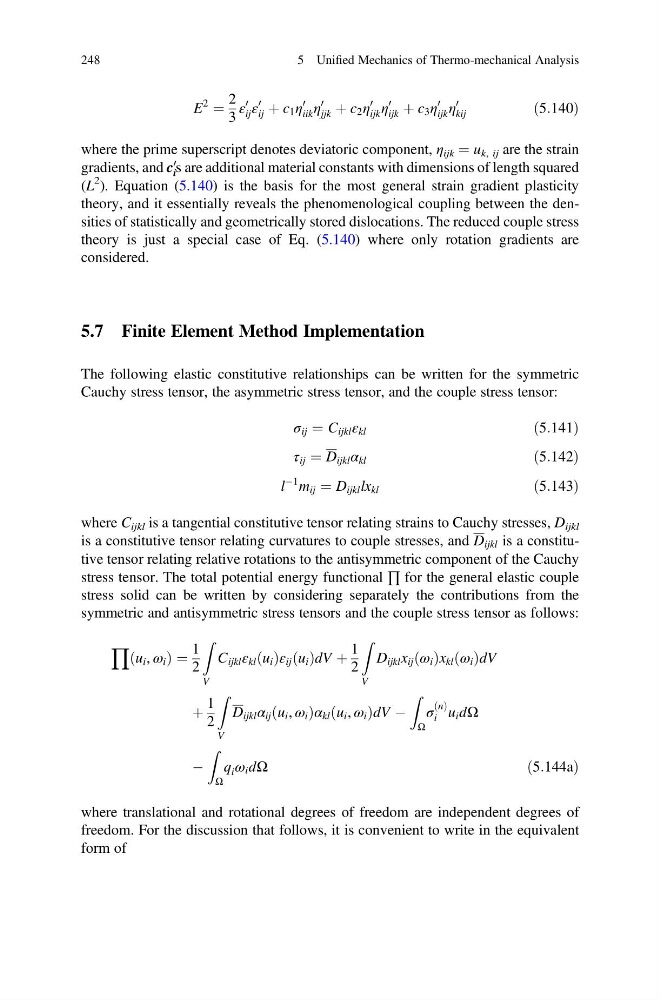
where the prime superscript denotes deviatoric component, η ijk ¼ u k, ij are the strain
gradients, and c
0
i s are additional material constants with dimensions of length squared
(L
2 ). Equation (5.140) is the basis for the most general strain gradient plasticity
theory, and it essentially reveals the phenomenological coupling between the densities of statistically and geometrically stored dislocations. The reduced couple stress
theory is just a special case of Eq. (5.140) where only rotation gradients are
considered.
5.7 Finite Element Method Implementation
The following elastic constitutive relationships can be written for the symmetric
Cauchy stress tensor, the asymmetric stress tensor, and the couple stress tensor:
σ ij ¼ C ijkl ε kl
ð5:141Þ
τ ij ¼ D ijkl α kl
ð5:142Þ
l
À1 m ij ¼ D ijkl lx kl
ð5:143Þ
where C ijkl is a tangential constitutive tensor relating strains to Cauchy stresses, D ijkl
is a constitutive tensor relating curvatures to couple stresses, and D ijkl is a constitutive tensor relating relative rotations to the antisymmetric component of the Cauchy
stress tensor. The total potential energy functional ∏ for the general elastic couple
stress solid can be written by considering separately the contributions from the
symmetric and antisymmetric stress tensors and the couple stress tensor as follows:
Y
u i , ω i
ð
Þ¼
1
2
Z
V
C ijkl ε kl u i
ð Þε ij u i
ð ÞdV þ
1
2
Z
V
D ijkl x ij ω i
ð Þx kl ω i
ð ÞdV
þ
1
2
Z
V
D ijkl α ij u i , ω i
ð
Þα kl u i , ω i
ð
ÞdV À
Z
Ω
σ
n
ð Þ
i u i dΩ
À
Z
Ω
q i ω i dΩ
ð5:144aÞ
where translational and rotational degrees of freedom are independent degrees of
freedom. For the discussion that follows, it is convenient to write in the equivalent
form of
248
5 Unified Mechanics of Thermo-mechanical Analysis
2
¼
2
3
ε
0
ij ε
0
ij þ c 1 η
0
iik η
0
jjk þ c 2 η
0
ijk η
0
ijk þ c 3 η
0
ijk η
0
kij
ð5:140Þ
where the prime superscript denotes deviatoric component, η ijk ¼ u k, ij are the strain
gradients, and c
0
i s are additional material constants with dimensions of length squared
(L
2 ). Equation (5.140) is the basis for the most general strain gradient plasticity
theory, and it essentially reveals the phenomenological coupling between the densities of statistically and geometrically stored dislocations. The reduced couple stress
theory is just a special case of Eq. (5.140) where only rotation gradients are
considered.
5.7 Finite Element Method Implementation
The following elastic constitutive relationships can be written for the symmetric
Cauchy stress tensor, the asymmetric stress tensor, and the couple stress tensor:
σ ij ¼ C ijkl ε kl
ð5:141Þ
τ ij ¼ D ijkl α kl
ð5:142Þ
l
À1 m ij ¼ D ijkl lx kl
ð5:143Þ
where C ijkl is a tangential constitutive tensor relating strains to Cauchy stresses, D ijkl
is a constitutive tensor relating curvatures to couple stresses, and D ijkl is a constitutive tensor relating relative rotations to the antisymmetric component of the Cauchy
stress tensor. The total potential energy functional ∏ for the general elastic couple
stress solid can be written by considering separately the contributions from the
symmetric and antisymmetric stress tensors and the couple stress tensor as follows:
Y
u i , ω i
ð
Þ¼
1
2
Z
V
C ijkl ε kl u i
ð Þε ij u i
ð ÞdV þ
1
2
Z
V
D ijkl x ij ω i
ð Þx kl ω i
ð ÞdV
þ
1
2
Z
V
D ijkl α ij u i , ω i
ð
Þα kl u i , ω i
ð
ÞdV À
Z
Ω
σ
n
ð Þ
i u i dΩ
À
Z
Ω
q i ω i dΩ
ð5:144aÞ
where translational and rotational degrees of freedom are independent degrees of
freedom. For the discussion that follows, it is convenient to write in the equivalent
form of
248
5 Unified Mechanics of Thermo-mechanical Analysis