

ZZZ
V
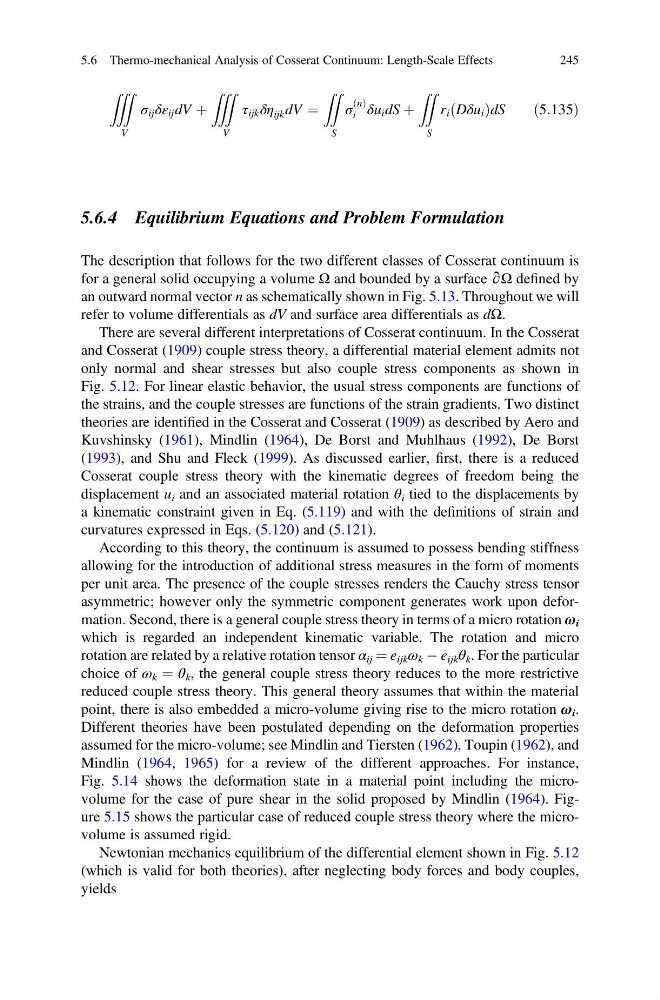
σ ij δε ij dV þ
ZZZ
V
τ ijk δη ijk dV ¼
ZZ
S
σ
n
ð Þ
i δu i dS þ
ZZ
S
r i Dδu i
ð
ÞdS
ð5:135Þ
5.6.4 Equilibrium Equations and Problem Formulation
The description that follows for the two different classes of Cosserat continuum is
for a general solid occupying a volume Ω and bounded by a surface ∂Ω defined by
an outward normal vector n as schematically shown in Fig. 5.13. Throughout we will
refer to volume differentials as dV and surface area differentials as dΩ.
There are several different interpretations of Cosserat continuum. In the Cosserat
and Cosserat (1909) couple stress theory, a differential material element admits not
only normal and shear stresses but also couple stress components as shown in
Fig. 5.12. For linear elastic behavior, the usual stress components are functions of
the strains, and the couple stresses are functions of the strain gradients. Two distinct
theories are identified in the Cosserat and Cosserat (1909) as described by Aero and
Kuvshinsky (1961), Mindlin (1964), De Borst and Muhlhaus (1992), De Borst
(1993), and Shu and Fleck (1999). As discussed earlier, first, there is a reduced
Cosserat couple stress theory with the kinematic degrees of freedom being the
displacement u i and an associated material rotation θ i tied to the displacements by
a kinematic constraint given in Eq. (5.119) and with the definitions of strain and
curvatures expressed in Eqs. (5.120) and (5.121).
According to this theory, the continuum is assumed to possess bending stiffness
allowing for the introduction of additional stress measures in the form of moments
per unit area. The presence of the couple stresses renders the Cauchy stress tensor
asymmetric; however only the symmetric component generates work upon deformation. Second, there is a general couple stress theory in terms of a micro rotation ω i
which is regarded an independent kinematic variable. The rotation and micro
rotation are related by a relative rotation tensor α ij ¼ e ijk ω k À e ijk θ k . For the particular
choice of ω k ¼ θ k , the general couple stress theory reduces to the more restrictive
reduced couple stress theory. This general theory assumes that within the material
point, there is also embedded a micro-volume giving rise to the micro rotation ω i .
Different theories have been postulated depending on the deformation properties
assumed for the micro-volume; see Mindlin and Tiersten (1962), Toupin (1962), and
Mindlin (1964, 1965) for a review of the different approaches. For instance,
Fig. 5.14 shows the deformation state in a material point including the microvolume for the case of pure shear in the solid proposed by Mindlin (1964). Figure 5.15 shows the particular case of reduced couple stress theory where the microvolume is assumed rigid.
Newtonian mechanics equilibrium of the differential element shown in Fig. 5.12
(which is valid for both theories), after neglecting body forces and body couples,
yields
5.6 Thermo-mechanical Analysis of Cosserat Continuum: Length-Scale Effects
245
V
σ ij δε ij dV þ
ZZZ
V
τ ijk δη ijk dV ¼
ZZ
S
σ
n
ð Þ
i δu i dS þ
ZZ
S
r i Dδu i
ð
ÞdS
ð5:135Þ
5.6.4 Equilibrium Equations and Problem Formulation
The description that follows for the two different classes of Cosserat continuum is
for a general solid occupying a volume Ω and bounded by a surface ∂Ω defined by
an outward normal vector n as schematically shown in Fig. 5.13. Throughout we will
refer to volume differentials as dV and surface area differentials as dΩ.
There are several different interpretations of Cosserat continuum. In the Cosserat
and Cosserat (1909) couple stress theory, a differential material element admits not
only normal and shear stresses but also couple stress components as shown in
Fig. 5.12. For linear elastic behavior, the usual stress components are functions of
the strains, and the couple stresses are functions of the strain gradients. Two distinct
theories are identified in the Cosserat and Cosserat (1909) as described by Aero and
Kuvshinsky (1961), Mindlin (1964), De Borst and Muhlhaus (1992), De Borst
(1993), and Shu and Fleck (1999). As discussed earlier, first, there is a reduced
Cosserat couple stress theory with the kinematic degrees of freedom being the
displacement u i and an associated material rotation θ i tied to the displacements by
a kinematic constraint given in Eq. (5.119) and with the definitions of strain and
curvatures expressed in Eqs. (5.120) and (5.121).
According to this theory, the continuum is assumed to possess bending stiffness
allowing for the introduction of additional stress measures in the form of moments
per unit area. The presence of the couple stresses renders the Cauchy stress tensor
asymmetric; however only the symmetric component generates work upon deformation. Second, there is a general couple stress theory in terms of a micro rotation ω i
which is regarded an independent kinematic variable. The rotation and micro
rotation are related by a relative rotation tensor α ij ¼ e ijk ω k À e ijk θ k . For the particular
choice of ω k ¼ θ k , the general couple stress theory reduces to the more restrictive
reduced couple stress theory. This general theory assumes that within the material
point, there is also embedded a micro-volume giving rise to the micro rotation ω i .
Different theories have been postulated depending on the deformation properties
assumed for the micro-volume; see Mindlin and Tiersten (1962), Toupin (1962), and
Mindlin (1964, 1965) for a review of the different approaches. For instance,
Fig. 5.14 shows the deformation state in a material point including the microvolume for the case of pure shear in the solid proposed by Mindlin (1964). Figure 5.15 shows the particular case of reduced couple stress theory where the microvolume is assumed rigid.
Newtonian mechanics equilibrium of the differential element shown in Fig. 5.12
(which is valid for both theories), after neglecting body forces and body couples,
yields
5.6 Thermo-mechanical Analysis of Cosserat Continuum: Length-Scale Effects
245