

σ ik,i À τ ijk,ij ¼ 0
ð5:130Þ
where σ ij is now the symmetric Cauchy stress tensor and τ ijk is the higher-order stress
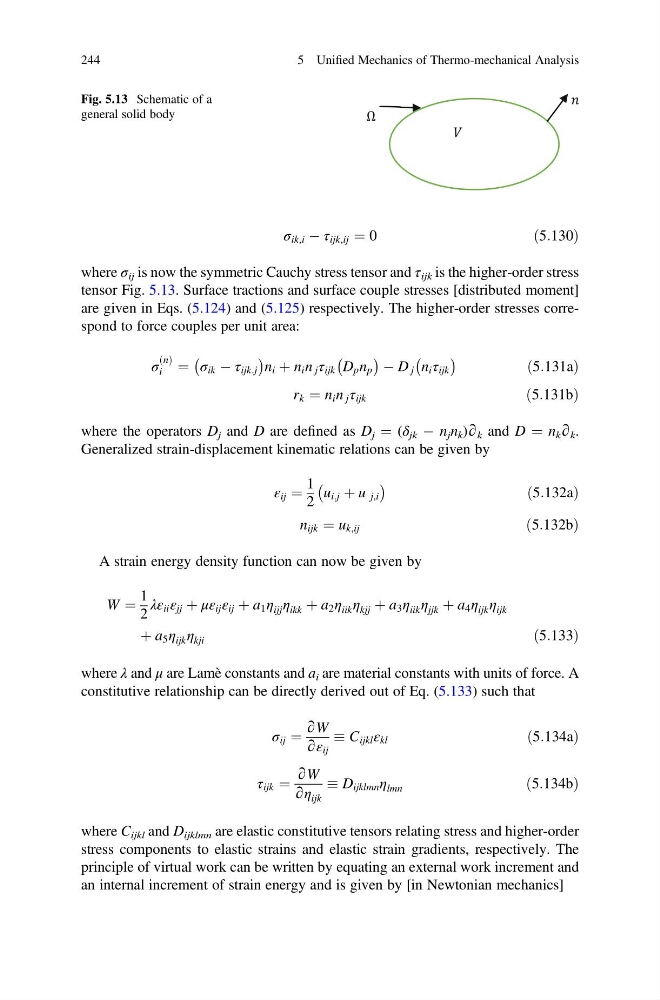
tensor Fig. 5.13. Surface tractions and surface couple stresses [distributed moment]
are given in Eqs. (5.124) and (5.125) respectively. The higher-order stresses correspond to force couples per unit area:
σ
n
ð Þ
i ¼ σ ik À τ ijk:j
À
Á
n i þ n i n j τ ijk D p n p
À
Á À D j n i τ ijk
À
Á
ð5:131aÞ
r k ¼ n i n j τ ijk
ð5:131bÞ
where the operators D j and D are defined as D j ¼ (δ jk À n j n k )∂ k and D ¼ n k ∂ k .
Generalized strain-displacement kinematic relations can be given by
ε ij ¼
1
2
u i:j þ u j,i
À
Á
ð5:132aÞ
n ijk ¼ u k,ij
ð5:132bÞ
A strain energy density function can now be given by
W ¼
1
2
λε ii ε jj þ με ij ε ij þ a 1 η ijj η ikk þ a 2 η iik η kjj þ a 3 η iik η jjk þ a 4 η ijk η ijk
þ a 5 η ijk η kji
ð5:133Þ
where λ and μ are Lamè constants and a i are material constants with units of force. A
constitutive relationship can be directly derived out of Eq. (5.133) such that
σ ij ¼
∂W
∂ε ij
C ijkl ε kl
ð5:134aÞ
τ ijk ¼
∂W
∂η ijk
D ijklmn η lmn
ð5:134bÞ
where C ijkl and D ijklmn are elastic constitutive tensors relating stress and higher-order
stress components to elastic strains and elastic strain gradients, respectively. The
principle of virtual work can be written by equating an external work increment and
an internal increment of strain energy and is given by [in Newtonian mechanics]
Ω
Fig. 5.13 Schematic of a
general solid body
244
5 Unified Mechanics of Thermo-mechanical Analysis
ð5:130Þ
where σ ij is now the symmetric Cauchy stress tensor and τ ijk is the higher-order stress
tensor Fig. 5.13. Surface tractions and surface couple stresses [distributed moment]
are given in Eqs. (5.124) and (5.125) respectively. The higher-order stresses correspond to force couples per unit area:
σ
n
ð Þ
i ¼ σ ik À τ ijk:j
À
Á
n i þ n i n j τ ijk D p n p
À
Á À D j n i τ ijk
À
Á
ð5:131aÞ
r k ¼ n i n j τ ijk
ð5:131bÞ
where the operators D j and D are defined as D j ¼ (δ jk À n j n k )∂ k and D ¼ n k ∂ k .
Generalized strain-displacement kinematic relations can be given by
ε ij ¼
1
2
u i:j þ u j,i
À
Á
ð5:132aÞ
n ijk ¼ u k,ij
ð5:132bÞ
A strain energy density function can now be given by
W ¼
1
2
λε ii ε jj þ με ij ε ij þ a 1 η ijj η ikk þ a 2 η iik η kjj þ a 3 η iik η jjk þ a 4 η ijk η ijk
þ a 5 η ijk η kji
ð5:133Þ
where λ and μ are Lamè constants and a i are material constants with units of force. A
constitutive relationship can be directly derived out of Eq. (5.133) such that
σ ij ¼
∂W
∂ε ij
C ijkl ε kl
ð5:134aÞ
τ ijk ¼
∂W
∂η ijk
D ijklmn η lmn
ð5:134bÞ
where C ijkl and D ijklmn are elastic constitutive tensors relating stress and higher-order
stress components to elastic strains and elastic strain gradients, respectively. The
principle of virtual work can be written by equating an external work increment and
an internal increment of strain energy and is given by [in Newtonian mechanics]
Ω
Fig. 5.13 Schematic of a
general solid body
244
5 Unified Mechanics of Thermo-mechanical Analysis