

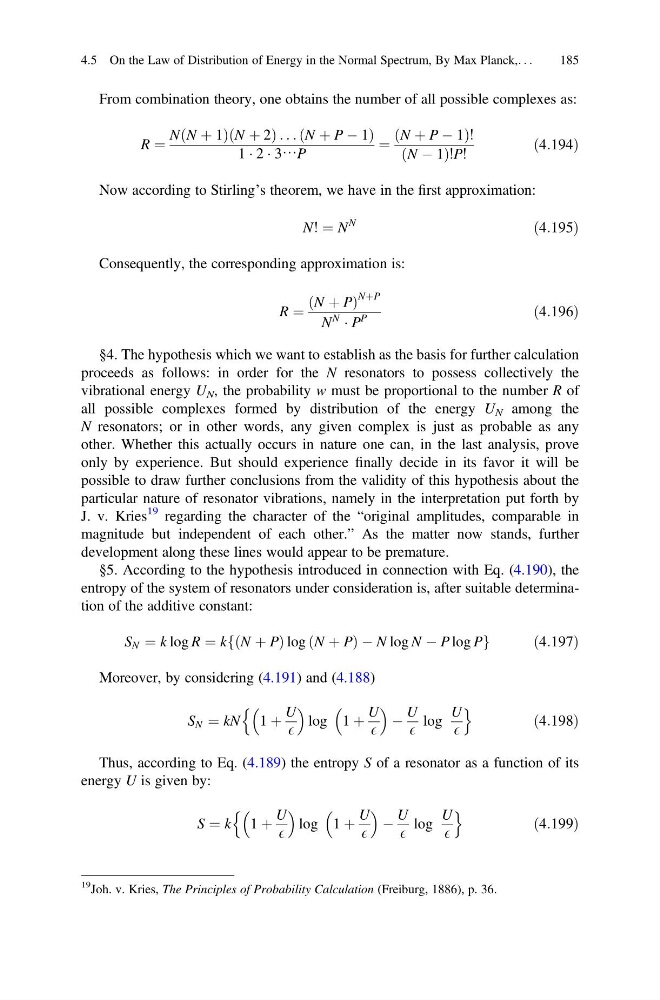
From combination theory, one obtains the number of all possible complexes as:
R ¼
N N þ 1
ð
Þ N þ 2
ð
Þ. . . N þ P À 1
ð
Þ
1 Á 2 Á 3⋯P
¼
N þ P À 1
ð
Þ !
N À 1
ð
Þ!P!
ð4:194Þ
Now according to Stirling’s theorem, we have in the first approximation:
N! ¼ N
N
ð4:195Þ
Consequently, the corresponding approximation is:
R ¼
N þ P
ð
Þ
NþP
N
N
Á P
P
ð4:196Þ
§4. The hypothesis which we want to establish as the basis for further calculation
proceeds as follows: in order for the N resonators to possess collectively the
vibrational energy U N , the probability w must be proportional to the number R of
all possible complexes formed by distribution of the energy U N among the
N resonators; or in other words, any given complex is just as probable as any
other. Whether this actually occurs in nature one can, in the last analysis, prove
only by experience. But should experience finally decide in its favor it will be
possible to draw further conclusions from the validity of this hypothesis about the
particular nature of resonator vibrations, namely in the interpretation put forth by
J. v. Kries
19 regarding the character of the “original amplitudes, comparable in
magnitude but independent of each other.” As the matter now stands, further
development along these lines would appear to be premature.
§5. According to the hypothesis introduced in connection with Eq. (4.190), the
entropy of the system of resonators under consideration is, after suitable determination of the additive constant:
S N ¼ k log R ¼ k N þ P
ð
Þlog N þ P
ð
ÞÀN log N À P log P
f
g
ð4:197Þ
Moreover, by considering (4.191) and (4.188)
S N ¼ kN 1 þ
U
E
log 1 þ
U
E
À
U
E
log
U
E
n
o
ð4:198Þ
Thus, according to Eq. (4.189) the entropy S of a resonator as a function of its
energy U is given by:
S ¼ k 1 þ
U
E
log 1 þ
U
E
À
U
E
log
U
E
n
o
ð4:199Þ
19 Joh. v. Kries, The Principles of Probability Calculation (Freiburg, 1886), p. 36.
4.5 On the Law of Distribution of Energy in the Normal Spectrum, By Max Planck,. . .
185
R ¼
N N þ 1
ð
Þ N þ 2
ð
Þ. . . N þ P À 1
ð
Þ
1 Á 2 Á 3⋯P
¼
N þ P À 1
ð
Þ !
N À 1
ð
Þ!P!
ð4:194Þ
Now according to Stirling’s theorem, we have in the first approximation:
N! ¼ N
N
ð4:195Þ
Consequently, the corresponding approximation is:
R ¼
N þ P
ð
Þ
NþP
N
N
Á P
P
ð4:196Þ
§4. The hypothesis which we want to establish as the basis for further calculation
proceeds as follows: in order for the N resonators to possess collectively the
vibrational energy U N , the probability w must be proportional to the number R of
all possible complexes formed by distribution of the energy U N among the
N resonators; or in other words, any given complex is just as probable as any
other. Whether this actually occurs in nature one can, in the last analysis, prove
only by experience. But should experience finally decide in its favor it will be
possible to draw further conclusions from the validity of this hypothesis about the
particular nature of resonator vibrations, namely in the interpretation put forth by
J. v. Kries
19 regarding the character of the “original amplitudes, comparable in
magnitude but independent of each other.” As the matter now stands, further
development along these lines would appear to be premature.
§5. According to the hypothesis introduced in connection with Eq. (4.190), the
entropy of the system of resonators under consideration is, after suitable determination of the additive constant:
S N ¼ k log R ¼ k N þ P
ð
Þlog N þ P
ð
ÞÀN log N À P log P
f
g
ð4:197Þ
Moreover, by considering (4.191) and (4.188)
S N ¼ kN 1 þ
U
E
log 1 þ
U
E
À
U
E
log
U
E
n
o
ð4:198Þ
Thus, according to Eq. (4.189) the entropy S of a resonator as a function of its
energy U is given by:
S ¼ k 1 þ
U
E
log 1 þ
U
E
À
U
E
log
U
E
n
o
ð4:199Þ
19 Joh. v. Kries, The Principles of Probability Calculation (Freiburg, 1886), p. 36.
4.5 On the Law of Distribution of Energy in the Normal Spectrum, By Max Planck,. . .
185