

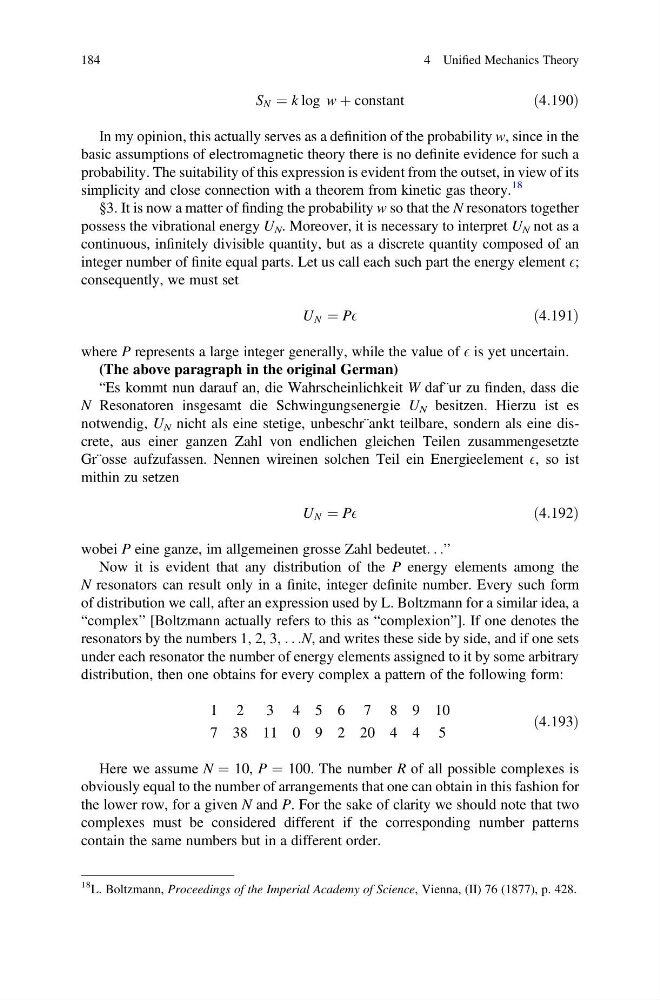
S N ¼ k log w þ constant
ð4:190Þ
In my opinion, this actually serves as a definition of the probability w, since in the
basic assumptions of electromagnetic theory there is no definite evidence for such a
probability. The suitability of this expression is evident from the outset, in view of its
simplicity and close connection with a theorem from kinetic gas theory.
18
§3. It is now a matter of finding the probability w so that the N resonators together
possess the vibrational energy U N . Moreover, it is necessary to interpret U N not as a
continuous, infinitely divisible quantity, but as a discrete quantity composed of an
integer number of finite equal parts. Let us call each such part the energy element E;
consequently, we must set
U N ¼ PE
ð4:191Þ
where P represents a large integer generally, while the value of E is yet uncertain.
(The above paragraph in the original German)
“Es kommt nun darauf an, die Wahrscheinlichkeit W daf¨ur zu finden, dass die
N Resonatoren insgesamt die Schwingungsenergie U N besitzen. Hierzu ist es
notwendig, U N nicht als eine stetige, unbeschr¨ankt teilbare, sondern als eine discrete, aus einer ganzen Zahl von endlichen gleichen Teilen zusammengesetzte
Gr¨osse aufzufassen. Nennen wireinen solchen Teil ein Energieelement E, so ist
mithin zu setzen
U N ¼ PE
ð4:192Þ
wobei P eine ganze, im allgemeinen grosse Zahl bedeutet. . .”
Now it is evident that any distribution of the P energy elements among the
N resonators can result only in a finite, integer definite number. Every such form
of distribution we call, after an expression used by L. Boltzmann for a similar idea, a
“complex” [Boltzmann actually refers to this as “complexion”]. If one denotes the
resonators by the numbers 1, 2, 3, . . .N, and writes these side by side, and if one sets
under each resonator the number of energy elements assigned to it by some arbitrary
distribution, then one obtains for every complex a pattern of the following form:
1 2
3 4 5 6 7 8 9 10
7 38 11 0 9 2 20 4 4 5
ð4:193Þ
Here we assume N ¼ 10, P ¼ 100. The number R of all possible complexes is
obviously equal to the number of arrangements that one can obtain in this fashion for
the lower row, for a given N and P. For the sake of clarity we should note that two
complexes must be considered different if the corresponding number patterns
contain the same numbers but in a different order.
18 L. Boltzmann, Proceedings of the Imperial Academy of Science, Vienna, (II) 76 (1877), p. 428.
184
4 Unified Mechanics Theory
ð4:190Þ
In my opinion, this actually serves as a definition of the probability w, since in the
basic assumptions of electromagnetic theory there is no definite evidence for such a
probability. The suitability of this expression is evident from the outset, in view of its
simplicity and close connection with a theorem from kinetic gas theory.
18
§3. It is now a matter of finding the probability w so that the N resonators together
possess the vibrational energy U N . Moreover, it is necessary to interpret U N not as a
continuous, infinitely divisible quantity, but as a discrete quantity composed of an
integer number of finite equal parts. Let us call each such part the energy element E;
consequently, we must set
U N ¼ PE
ð4:191Þ
where P represents a large integer generally, while the value of E is yet uncertain.
(The above paragraph in the original German)
“Es kommt nun darauf an, die Wahrscheinlichkeit W daf¨ur zu finden, dass die
N Resonatoren insgesamt die Schwingungsenergie U N besitzen. Hierzu ist es
notwendig, U N nicht als eine stetige, unbeschr¨ankt teilbare, sondern als eine discrete, aus einer ganzen Zahl von endlichen gleichen Teilen zusammengesetzte
Gr¨osse aufzufassen. Nennen wireinen solchen Teil ein Energieelement E, so ist
mithin zu setzen
U N ¼ PE
ð4:192Þ
wobei P eine ganze, im allgemeinen grosse Zahl bedeutet. . .”
Now it is evident that any distribution of the P energy elements among the
N resonators can result only in a finite, integer definite number. Every such form
of distribution we call, after an expression used by L. Boltzmann for a similar idea, a
“complex” [Boltzmann actually refers to this as “complexion”]. If one denotes the
resonators by the numbers 1, 2, 3, . . .N, and writes these side by side, and if one sets
under each resonator the number of energy elements assigned to it by some arbitrary
distribution, then one obtains for every complex a pattern of the following form:
1 2
3 4 5 6 7 8 9 10
7 38 11 0 9 2 20 4 4 5
ð4:193Þ
Here we assume N ¼ 10, P ¼ 100. The number R of all possible complexes is
obviously equal to the number of arrangements that one can obtain in this fashion for
the lower row, for a given N and P. For the sake of clarity we should note that two
complexes must be considered different if the corresponding number patterns
contain the same numbers but in a different order.
18 L. Boltzmann, Proceedings of the Imperial Academy of Science, Vienna, (II) 76 (1877), p. 428.
184
4 Unified Mechanics Theory