

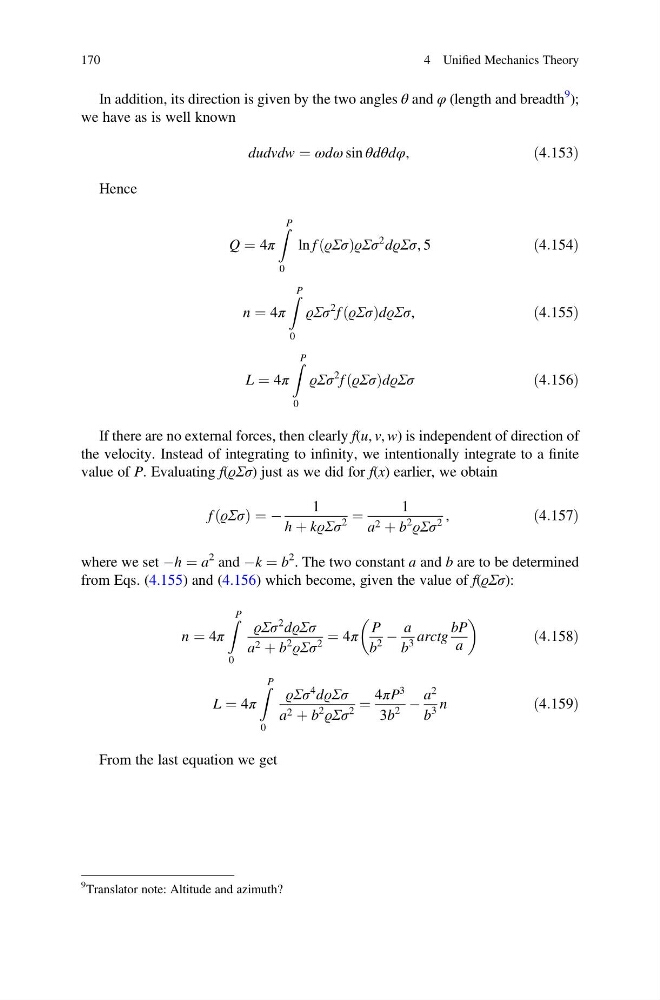
In addition, its direction is given by the two angles θ and φ (length and breadth
9
);
we have as is well known
dudvdw ¼ ωdω sin θdθdφ,
ð4:153Þ
Hence
Q ¼ 4π
Z P
0
ln f ϱΣσ
ð
ÞϱΣσ
2 dϱΣσ, 5
ð4:154Þ
n ¼ 4π
Z P
0
ϱΣσ
2 f ϱΣσ
ð
ÞdϱΣσ,
ð4:155Þ
L ¼ 4π
Z P
0
ϱΣσ
2 f ϱΣσ
ð
ÞdϱΣσ
ð4:156Þ
If there are no external forces, then clearly f(u, v, w) is independent of direction of
the velocity. Instead of integrating to infinity, we intentionally integrate to a finite
value of P. Evaluating f(ϱΣσ) just as we did for f(x) earlier, we obtain
f ϱΣσ
ð
Þ ¼ À
1
h þ kϱΣσ
2
¼
1
a 2 þ b
2
ϱΣσ
2
,
ð4:157Þ
where we set Àh ¼ a
2 and Àk ¼ b
2 . The two constant a and b are to be determined
from Eqs. (4.155) and (4.156) which become, given the value of f(ϱΣσ):
n ¼ 4π
Z P
0
ϱΣσ
2 dϱΣσ
a 2 þ b
2
ϱΣσ
2
¼ 4π
P
b
2
À
a
b
3
arctg
bP
a
ð4:158Þ
L ¼ 4π
Z P
0
ϱΣσ
4 dϱΣσ
a 2 þ b
2
ϱΣσ
2
¼
4πP
3
3b
2
À
a
2
b
3
n
ð4:159Þ
From the last equation we get
9 Translator note: Altitude and azimuth?
170
4 Unified Mechanics Theory
9
);
we have as is well known
dudvdw ¼ ωdω sin θdθdφ,
ð4:153Þ
Hence
Q ¼ 4π
Z P
0
ln f ϱΣσ
ð
ÞϱΣσ
2 dϱΣσ, 5
ð4:154Þ
n ¼ 4π
Z P
0
ϱΣσ
2 f ϱΣσ
ð
ÞdϱΣσ,
ð4:155Þ
L ¼ 4π
Z P
0
ϱΣσ
2 f ϱΣσ
ð
ÞdϱΣσ
ð4:156Þ
If there are no external forces, then clearly f(u, v, w) is independent of direction of
the velocity. Instead of integrating to infinity, we intentionally integrate to a finite
value of P. Evaluating f(ϱΣσ) just as we did for f(x) earlier, we obtain
f ϱΣσ
ð
Þ ¼ À
1
h þ kϱΣσ
2
¼
1
a 2 þ b
2
ϱΣσ
2
,
ð4:157Þ
where we set Àh ¼ a
2 and Àk ¼ b
2 . The two constant a and b are to be determined
from Eqs. (4.155) and (4.156) which become, given the value of f(ϱΣσ):
n ¼ 4π
Z P
0
ϱΣσ
2 dϱΣσ
a 2 þ b
2
ϱΣσ
2
¼ 4π
P
b
2
À
a
b
3
arctg
bP
a
ð4:158Þ
L ¼ 4π
Z P
0
ϱΣσ
4 dϱΣσ
a 2 þ b
2
ϱΣσ
2
¼
4πP
3
3b
2
À
a
2
b
3
n
ð4:159Þ
From the last equation we get
9 Translator note: Altitude and azimuth?
170
4 Unified Mechanics Theory