

ln P ¼ n þ
1
2
ln n þ
1
12n
þ ⋯ À p þ q þ r þ 1
ð
Þ ln 2π À
X
a¼þp
a¼Àp
X
b¼þq
b¼Àq
Â
X
c¼þr
c¼Àr
w abc þ
1
2
ln w abc þ
1
12w abc
þ ⋯
!
ð4:114Þ
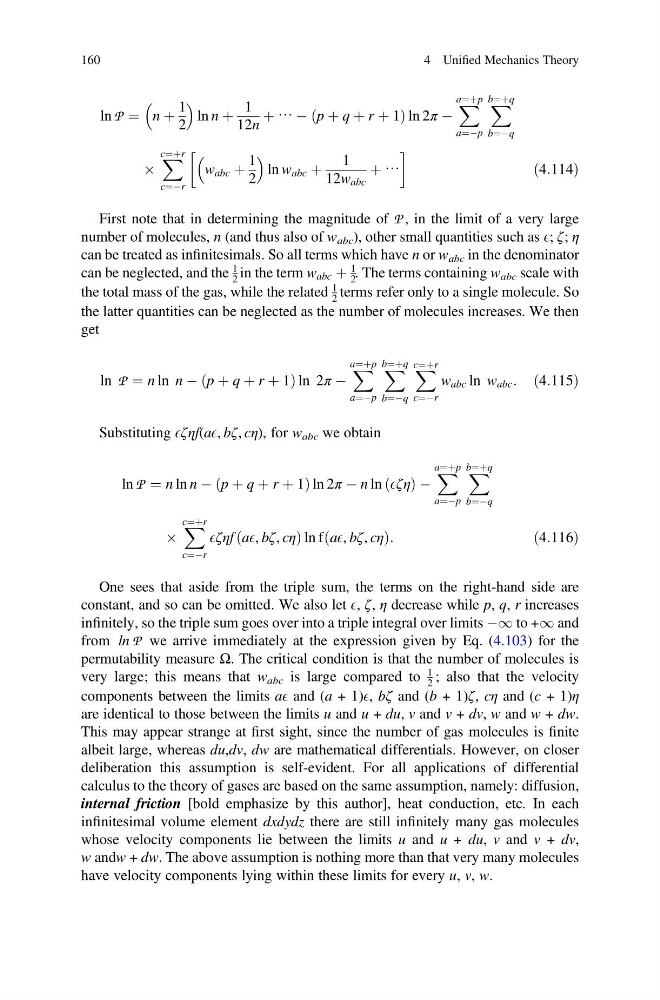
First note that in determining the magnitude of P , in the limit of a very large
number of molecules, n (and thus also of w abc ), other small quantities such as E; ζ; η
can be treated as infinitesimals. So all terms which have n or w abc in the denominator
can be neglected, and the
1
2 in the term w abc þ
1
2 . The terms containing w abc scale with
the total mass of the gas, while the related
1
2 terms refer only to a single molecule. So
the latter quantities can be neglected as the number of molecules increases. We then
get
ln P ¼ n ln n À p þ q þ r þ 1
ð
Þ ln 2π À
X
a¼þp
a¼Àp
X
b¼þq
b¼Àq
X
c¼þr
c¼Àr
w abc ln w abc : ð4:115Þ
Substituting Eζηf(aE, bζ, cη), for w abc we obtain
ln P ¼ n ln n À p þ q þ r þ 1
ð
Þ ln 2π À n ln Eζη
ð ÞÀ
X
a¼þp
a¼Àp
X
b¼þq
b¼Àq
Â
X
c¼þr
c¼Àr
Eζηf aE, bζ, cη
ð
Þln f aE, bζ, cη
ð
Þ :
ð4:116Þ
One sees that aside from the triple sum, the terms on the right-hand side are
constant, and so can be omitted. We also let E, ζ, η decrease while p, q, r increases
infinitely, so the triple sum goes over into a triple integral over limits À1 to +1 and
from ln P we arrive immediately at the expression given by Eq. (4.103) for the
permutability measure Ω. The critical condition is that the number of molecules is
very large; this means that w abc is large compared to
1
2 ; also that the velocity
components between the limits aE and (a + 1)E, bζ and (b + 1)ζ, cη and (c + 1)η
are identical to those between the limits u and u + du, v and v + dv, w and w + dw.
This may appear strange at first sight, since the number of gas molecules is finite
albeit large, whereas du,dv, dw are mathematical differentials. However, on closer
deliberation this assumption is self-evident. For all applications of differential
calculus to the theory of gases are based on the same assumption, namely: diffusion,
internal friction [bold emphasize by this author], heat conduction, etc. In each
infinitesimal volume element dxdydz there are still infinitely many gas molecules
whose velocity components lie between the limits u and u + du, v and v + dv,
w andw + dw. The above assumption is nothing more than that very many molecules
have velocity components lying within these limits for every u, v, w.
160
4 Unified Mechanics Theory
1
2
ln n þ
1
12n
þ ⋯ À p þ q þ r þ 1
ð
Þ ln 2π À
X
a¼þp
a¼Àp
X
b¼þq
b¼Àq
Â
X
c¼þr
c¼Àr
w abc þ
1
2
ln w abc þ
1
12w abc
þ ⋯
!
ð4:114Þ
First note that in determining the magnitude of P , in the limit of a very large
number of molecules, n (and thus also of w abc ), other small quantities such as E; ζ; η
can be treated as infinitesimals. So all terms which have n or w abc in the denominator
can be neglected, and the
1
2 in the term w abc þ
1
2 . The terms containing w abc scale with
the total mass of the gas, while the related
1
2 terms refer only to a single molecule. So
the latter quantities can be neglected as the number of molecules increases. We then
get
ln P ¼ n ln n À p þ q þ r þ 1
ð
Þ ln 2π À
X
a¼þp
a¼Àp
X
b¼þq
b¼Àq
X
c¼þr
c¼Àr
w abc ln w abc : ð4:115Þ
Substituting Eζηf(aE, bζ, cη), for w abc we obtain
ln P ¼ n ln n À p þ q þ r þ 1
ð
Þ ln 2π À n ln Eζη
ð ÞÀ
X
a¼þp
a¼Àp
X
b¼þq
b¼Àq
Â
X
c¼þr
c¼Àr
Eζηf aE, bζ, cη
ð
Þln f aE, bζ, cη
ð
Þ :
ð4:116Þ
One sees that aside from the triple sum, the terms on the right-hand side are
constant, and so can be omitted. We also let E, ζ, η decrease while p, q, r increases
infinitely, so the triple sum goes over into a triple integral over limits À1 to +1 and
from ln P we arrive immediately at the expression given by Eq. (4.103) for the
permutability measure Ω. The critical condition is that the number of molecules is
very large; this means that w abc is large compared to
1
2 ; also that the velocity
components between the limits aE and (a + 1)E, bζ and (b + 1)ζ, cη and (c + 1)η
are identical to those between the limits u and u + du, v and v + dv, w and w + dw.
This may appear strange at first sight, since the number of gas molecules is finite
albeit large, whereas du,dv, dw are mathematical differentials. However, on closer
deliberation this assumption is self-evident. For all applications of differential
calculus to the theory of gases are based on the same assumption, namely: diffusion,
internal friction [bold emphasize by this author], heat conduction, etc. In each
infinitesimal volume element dxdydz there are still infinitely many gas molecules
whose velocity components lie between the limits u and u + du, v and v + dv,
w andw + dw. The above assumption is nothing more than that very many molecules
have velocity components lying within these limits for every u, v, w.
160
4 Unified Mechanics Theory