

Dissipation Potential
In Newtonian mechanics, based on constitutive modeling, a phenomenological
dissipation potential is defined (Malvern 1969). This is also the basis for yield
surface or plastic potential used in the theory of plasticity. Lemaitre and Chaboche
(1990) indicate correctly that the whole problem of modeling a phenomenon [material] lies in the determination of the analytical expressions for the thermodynamic
potential Ψ and dissipation potential φ or its dual φ
à and their identification in
characteristic experiments. Therefore, constitutive modeling of Newtonian mechanics of materials is a phenomenological process.
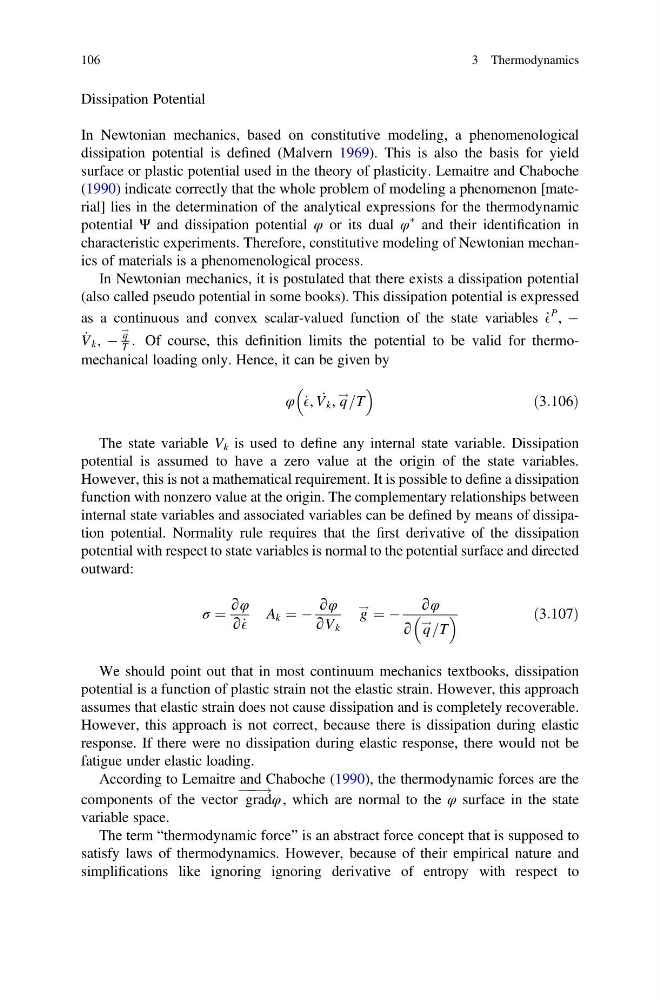
In Newtonian mechanics, it is postulated that there exists a dissipation potential
(also called pseudo potential in some books). This dissipation potential is expressed
as a continuous and convex scalar-valued function of the state variables _
E
P , À
_
V k , À
q
!
T : Of course, this definition limits the potential to be valid for thermomechanical loading only. Hence, it can be given by
φ _
E, _
V k , q
! =T
ð3:106Þ
The state variable V k is used to define any internal state variable. Dissipation
potential is assumed to have a zero value at the origin of the state variables.
However, this is not a mathematical requirement. It is possible to define a dissipation
function with nonzero value at the origin. The complementary relationships between
internal state variables and associated variables can be defined by means of dissipation potential. Normality rule requires that the first derivative of the dissipation
potential with respect to state variables is normal to the potential surface and directed
outward:
σ ¼
∂φ
∂_ E
A k ¼ À
∂φ
∂V k
g
! ¼ À
∂φ
∂ q
! =T
ð3:107Þ
We should point out that in most continuum mechanics textbooks, dissipation
potential is a function of plastic strain not the elastic strain. However, this approach
assumes that elastic strain does not cause dissipation and is completely recoverable.
However, this approach is not correct, because there is dissipation during elastic
response. If there were no dissipation during elastic response, there would not be
fatigue under elastic loading.
According to Lemaitre and Chaboche (1990), the thermodynamic forces are the
components of the vector grad
! φ , which are normal to the φ surface in the state
variable space.
The term “thermodynamic force” is an abstract force concept that is supposed to
satisfy laws of thermodynamics. However, because of their empirical nature and
simplifications like ignoring ignoring derivative of entropy with respect to
106
3 Thermodynamics
In Newtonian mechanics, based on constitutive modeling, a phenomenological
dissipation potential is defined (Malvern 1969). This is also the basis for yield
surface or plastic potential used in the theory of plasticity. Lemaitre and Chaboche
(1990) indicate correctly that the whole problem of modeling a phenomenon [material] lies in the determination of the analytical expressions for the thermodynamic
potential Ψ and dissipation potential φ or its dual φ
à and their identification in
characteristic experiments. Therefore, constitutive modeling of Newtonian mechanics of materials is a phenomenological process.
In Newtonian mechanics, it is postulated that there exists a dissipation potential
(also called pseudo potential in some books). This dissipation potential is expressed
as a continuous and convex scalar-valued function of the state variables _
E
P , À
_
V k , À
q
!
T : Of course, this definition limits the potential to be valid for thermomechanical loading only. Hence, it can be given by
φ _
E, _
V k , q
! =T
ð3:106Þ
The state variable V k is used to define any internal state variable. Dissipation
potential is assumed to have a zero value at the origin of the state variables.
However, this is not a mathematical requirement. It is possible to define a dissipation
function with nonzero value at the origin. The complementary relationships between
internal state variables and associated variables can be defined by means of dissipation potential. Normality rule requires that the first derivative of the dissipation
potential with respect to state variables is normal to the potential surface and directed
outward:
σ ¼
∂φ
∂_ E
A k ¼ À
∂φ
∂V k
g
! ¼ À
∂φ
∂ q
! =T
ð3:107Þ
We should point out that in most continuum mechanics textbooks, dissipation
potential is a function of plastic strain not the elastic strain. However, this approach
assumes that elastic strain does not cause dissipation and is completely recoverable.
However, this approach is not correct, because there is dissipation during elastic
response. If there were no dissipation during elastic response, there would not be
fatigue under elastic loading.
According to Lemaitre and Chaboche (1990), the thermodynamic forces are the
components of the vector grad
! φ , which are normal to the φ surface in the state
variable space.
The term “thermodynamic force” is an abstract force concept that is supposed to
satisfy laws of thermodynamics. However, because of their empirical nature and
simplifications like ignoring ignoring derivative of entropy with respect to
106
3 Thermodynamics