

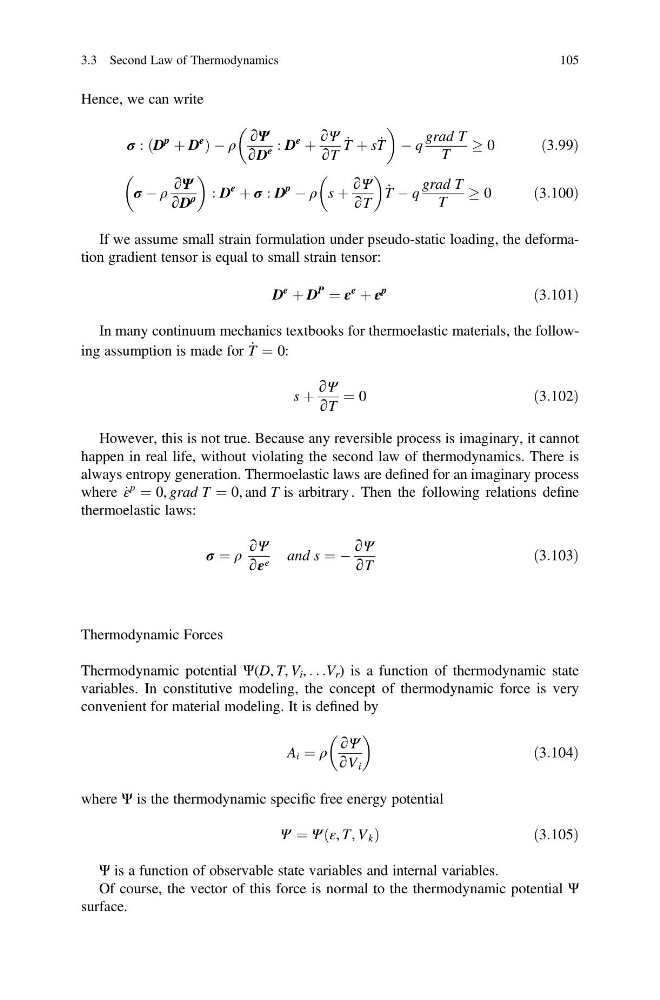
Hence, we can write
σ : D
p
þ D
e
ð
ÞÀρ
∂Ψ
∂D
e : D
e
þ
∂Ψ
∂T
_
T þ s _
T
À q
grad T
T
! 0
ð3:99Þ
σ À ρ
∂Ψ
∂D
ρ
: D
e
þ σ : D
p
À ρ s þ
∂Ψ
∂T
_
T À q
grad T
T
! 0
ð3:100Þ
If we assume small strain formulation under pseudo-static loading, the deformation gradient tensor is equal to small strain tensor:
D
e
þ D
P
¼ ε
e
þ ε
p
ð3:101Þ
In many continuum mechanics textbooks for thermoelastic materials, the following assumption is made for _
T ¼ 0:
s þ
∂Ψ
∂T
¼ 0
ð3:102Þ
However, this is not true. Because any reversible process is imaginary, it cannot
happen in real life, without violating the second law of thermodynamics. There is
always entropy generation. Thermoelastic laws are defined for an imaginary process
where _
ε
p
¼ 0, grad T ¼ 0, and T is arbitrary . Then the following relations define
thermoelastic laws:
σ ¼ ρ
∂Ψ
∂ε e and s ¼ À
∂Ψ
∂T
ð3:103Þ
Thermodynamic Forces
Thermodynamic potential Ψ(D, T, V i , . . .V r ) is a function of thermodynamic state
variables. In constitutive modeling, the concept of thermodynamic force is very
convenient for material modeling. It is defined by
A i ¼ ρ
∂Ψ
∂V i
ð3:104Þ
where Ψ is the thermodynamic specific free energy potential
Ψ ¼ Ψ ε, T, V k
ð
Þ
ð3:105Þ
Ψ is a function of observable state variables and internal variables.
Of course, the vector of this force is normal to the thermodynamic potential Ψ
surface.
3.3 Second Law of Thermodynamics
105
σ : D
p
þ D
e
ð
ÞÀρ
∂Ψ
∂D
e : D
e
þ
∂Ψ
∂T
_
T þ s _
T
À q
grad T
T
! 0
ð3:99Þ
σ À ρ
∂Ψ
∂D
ρ
: D
e
þ σ : D
p
À ρ s þ
∂Ψ
∂T
_
T À q
grad T
T
! 0
ð3:100Þ
If we assume small strain formulation under pseudo-static loading, the deformation gradient tensor is equal to small strain tensor:
D
e
þ D
P
¼ ε
e
þ ε
p
ð3:101Þ
In many continuum mechanics textbooks for thermoelastic materials, the following assumption is made for _
T ¼ 0:
s þ
∂Ψ
∂T
¼ 0
ð3:102Þ
However, this is not true. Because any reversible process is imaginary, it cannot
happen in real life, without violating the second law of thermodynamics. There is
always entropy generation. Thermoelastic laws are defined for an imaginary process
where _
ε
p
¼ 0, grad T ¼ 0, and T is arbitrary . Then the following relations define
thermoelastic laws:
σ ¼ ρ
∂Ψ
∂ε e and s ¼ À
∂Ψ
∂T
ð3:103Þ
Thermodynamic Forces
Thermodynamic potential Ψ(D, T, V i , . . .V r ) is a function of thermodynamic state
variables. In constitutive modeling, the concept of thermodynamic force is very
convenient for material modeling. It is defined by
A i ¼ ρ
∂Ψ
∂V i
ð3:104Þ
where Ψ is the thermodynamic specific free energy potential
Ψ ¼ Ψ ε, T, V k
ð
Þ
ð3:105Þ
Ψ is a function of observable state variables and internal variables.
Of course, the vector of this force is normal to the thermodynamic potential Ψ
surface.
3.3 Second Law of Thermodynamics
105