

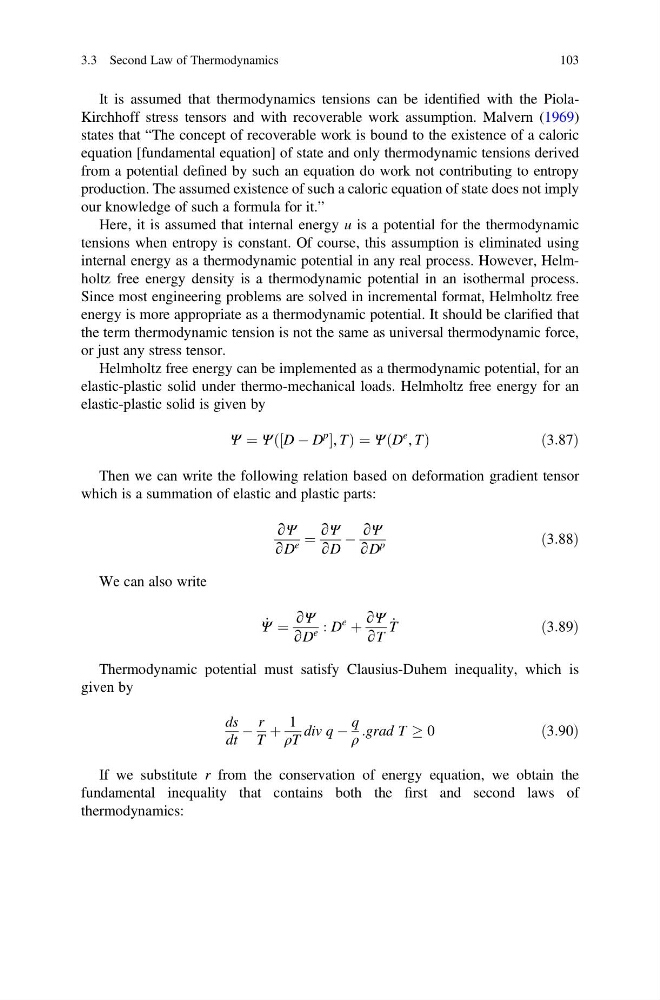
It is assumed that thermodynamics tensions can be identified with the PiolaKirchhoff stress tensors and with recoverable work assumption. Malvern (1969)
states that “The concept of recoverable work is bound to the existence of a caloric
equation [fundamental equation] of state and only thermodynamic tensions derived
from a potential defined by such an equation do work not contributing to entropy
production. The assumed existence of such a caloric equation of state does not imply
our knowledge of such a formula for it.”
Here, it is assumed that internal energy u is a potential for the thermodynamic
tensions when entropy is constant. Of course, this assumption is eliminated using
internal energy as a thermodynamic potential in any real process. However, Helmholtz free energy density is a thermodynamic potential in an isothermal process.
Since most engineering problems are solved in incremental format, Helmholtz free
energy is more appropriate as a thermodynamic potential. It should be clarified that
the term thermodynamic tension is not the same as universal thermodynamic force,
or just any stress tensor.
Helmholtz free energy can be implemented as a thermodynamic potential, for an
elastic-plastic solid under thermo-mechanical loads. Helmholtz free energy for an
elastic-plastic solid is given by
Ψ ¼ Ψ D À D
p
½
, T
ð
Þ¼Ψ D
e , T
ð
Þ
ð3:87Þ
Then we can write the following relation based on deformation gradient tensor
which is a summation of elastic and plastic parts:
∂Ψ
∂D
e ¼
∂Ψ
∂D
À
∂Ψ
∂D
p
ð3:88Þ
We can also write
_
Ψ ¼
∂Ψ
∂D
e : D
e
þ
∂Ψ
∂T
_
T
ð3:89Þ
Thermodynamic potential must satisfy Clausius-Duhem inequality, which is
given by
ds
dt
À
r
T
þ
1
ρT
div q À
q
ρ
:grad T ! 0
ð3:90Þ
If we substitute r from the conservation of energy equation, we obtain the
fundamental inequality that contains both the first and second laws of
thermodynamics:
3.3 Second Law of Thermodynamics
103
states that “The concept of recoverable work is bound to the existence of a caloric
equation [fundamental equation] of state and only thermodynamic tensions derived
from a potential defined by such an equation do work not contributing to entropy
production. The assumed existence of such a caloric equation of state does not imply
our knowledge of such a formula for it.”
Here, it is assumed that internal energy u is a potential for the thermodynamic
tensions when entropy is constant. Of course, this assumption is eliminated using
internal energy as a thermodynamic potential in any real process. However, Helmholtz free energy density is a thermodynamic potential in an isothermal process.
Since most engineering problems are solved in incremental format, Helmholtz free
energy is more appropriate as a thermodynamic potential. It should be clarified that
the term thermodynamic tension is not the same as universal thermodynamic force,
or just any stress tensor.
Helmholtz free energy can be implemented as a thermodynamic potential, for an
elastic-plastic solid under thermo-mechanical loads. Helmholtz free energy for an
elastic-plastic solid is given by
Ψ ¼ Ψ D À D
p
½
, T
ð
Þ¼Ψ D
e , T
ð
Þ
ð3:87Þ
Then we can write the following relation based on deformation gradient tensor
which is a summation of elastic and plastic parts:
∂Ψ
∂D
e ¼
∂Ψ
∂D
À
∂Ψ
∂D
p
ð3:88Þ
We can also write
_
Ψ ¼
∂Ψ
∂D
e : D
e
þ
∂Ψ
∂T
_
T
ð3:89Þ
Thermodynamic potential must satisfy Clausius-Duhem inequality, which is
given by
ds
dt
À
r
T
þ
1
ρT
div q À
q
ρ
:grad T ! 0
ð3:90Þ
If we substitute r from the conservation of energy equation, we obtain the
fundamental inequality that contains both the first and second laws of
thermodynamics:
3.3 Second Law of Thermodynamics
103