

Independent Internal Thermodynamic Variables
1. Entropy.
2. Internal energy (this is not limited to mechanical energy).
3. Density of dislocations.
4. Crystal structure (phase).
5. Etc.
Formulation of Thermodynamic Potential
Postulate There exists a thermodynamic potential function defined by thermodynamic variables. The thermodynamic state laws are derived from this potential.
Thermodynamic potential must be concave [f
00 (X) < 0] with respect to temperature
and convex [f
00 (X) > 0] with respect to other variables. These convex and concave
requirements ensure the thermodynamic stability requirement imposed by the
Clausius-Duhem inequality. Malvern (1969) proposes the following thermodynamic
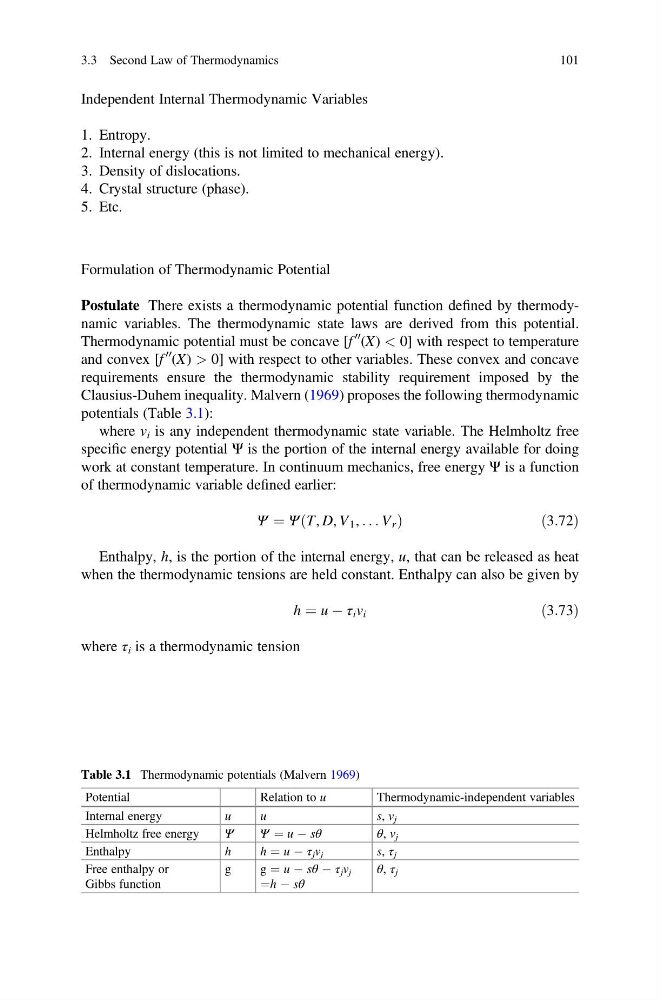
potentials (Table 3.1):
where v i is any independent thermodynamic state variable. The Helmholtz free
specific energy potential Ψ is the portion of the internal energy available for doing
work at constant temperature. In continuum mechanics, free energy Ψ is a function
of thermodynamic variable defined earlier:
Ψ ¼ Ψ T, D, V 1 , . . . V r
ð
Þ
ð 3:72Þ
Enthalpy, h, is the portion of the internal energy, u, that can be released as heat
when the thermodynamic tensions are held constant. Enthalpy can also be given by
h ¼ u À τ i v i
ð3:73Þ
where τ i is a thermodynamic tension
Table 3.1 Thermodynamic potentials (Malvern 1969)
Potential
Relation to u
Thermodynamic-independent variables
Internal energy
u
u
s, v j
Helmholtz free energy
Ψ
Ψ ¼ u À sθ
θ , v j
Enthalpy
h
h¼ u À τ j v j
s, τ j
Free enthalpy or
Gibbs function
g
g¼ u À sθ À τ j v j
¼h À sθ
θ, τ j
3.3 Second Law of Thermodynamics
101
1. Entropy.
2. Internal energy (this is not limited to mechanical energy).
3. Density of dislocations.
4. Crystal structure (phase).
5. Etc.
Formulation of Thermodynamic Potential
Postulate There exists a thermodynamic potential function defined by thermodynamic variables. The thermodynamic state laws are derived from this potential.
Thermodynamic potential must be concave [f
00 (X) < 0] with respect to temperature
and convex [f
00 (X) > 0] with respect to other variables. These convex and concave
requirements ensure the thermodynamic stability requirement imposed by the
Clausius-Duhem inequality. Malvern (1969) proposes the following thermodynamic
potentials (Table 3.1):
where v i is any independent thermodynamic state variable. The Helmholtz free
specific energy potential Ψ is the portion of the internal energy available for doing
work at constant temperature. In continuum mechanics, free energy Ψ is a function
of thermodynamic variable defined earlier:
Ψ ¼ Ψ T, D, V 1 , . . . V r
ð
Þ
ð 3:72Þ
Enthalpy, h, is the portion of the internal energy, u, that can be released as heat
when the thermodynamic tensions are held constant. Enthalpy can also be given by
h ¼ u À τ i v i
ð3:73Þ
where τ i is a thermodynamic tension
Table 3.1 Thermodynamic potentials (Malvern 1969)
Potential
Relation to u
Thermodynamic-independent variables
Internal energy
u
u
s, v j
Helmholtz free energy
Ψ
Ψ ¼ u À sθ
θ , v j
Enthalpy
h
h¼ u À τ j v j
s, τ j
Free enthalpy or
Gibbs function
g
g¼ u À sθ À τ j v j
¼h À sθ
θ, τ j
3.3 Second Law of Thermodynamics
101