

2. Immunize the mice three times with 30 μg EFn-3ÂM2e-HA2
plus 60 μg PA or inject subcutaneously once with 50 spores
from the Colorado serum Company.
3. Two weeks after the final immunizations, mice are subcutaneously challenged with 5 Â 10
4 –1.8 Â 10
5 spores. Monitor for
signs of illness and weigh for up to 14 days postinoculation [7].
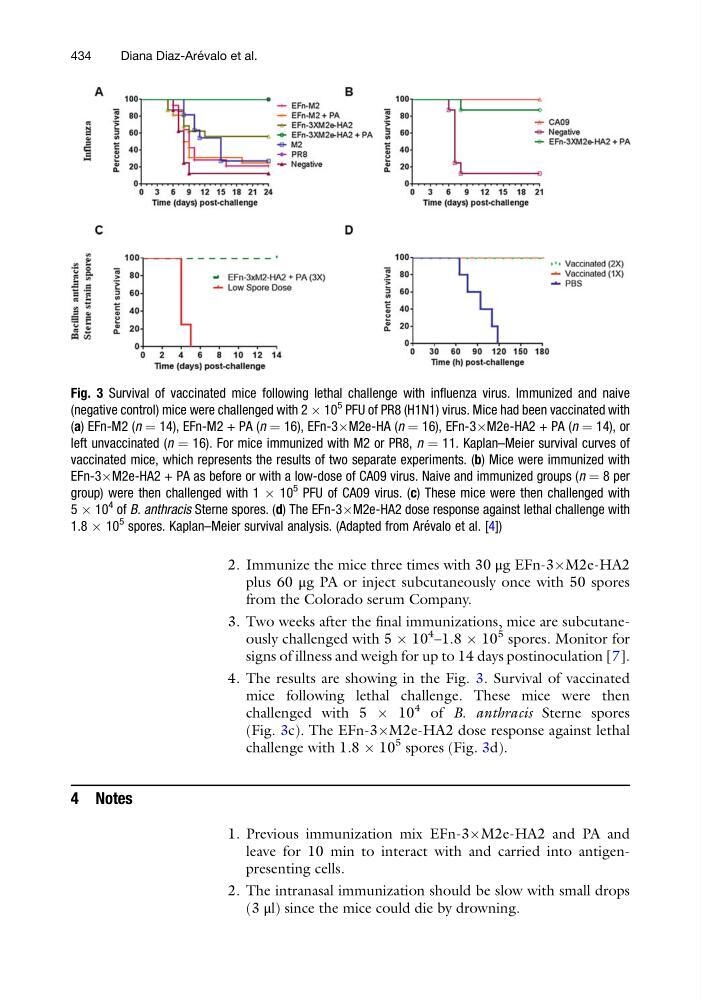
4. The results are showing in the Fig. 3. Survival of vaccinated
mice following lethal challenge. These mice were then
challenged with 5 Â 10
4 of B. anthracis Sterne spores
(Fig. 3c). The EFn-3ÂM2e-HA2 dose response against lethal
challenge with 1.8 Â 10
5 spores (Fig. 3d).
4 Notes
1. Previous immunization mix EFn-3ÂM2e-HA2 and PA and
leave for 10 min to interact with and carried into antigenpresenting cells.
2. The intranasal immunization should be slow with small drops
(3 μl) since the mice could die by drowning.
Fig. 3 Survival of vaccinated mice following lethal challenge with influenza virus. Immunized and naive
(negative control) mice were challenged with 2 Â 10
5 PFU of PR8 (H1N1) virus. Mice had been vaccinated with
(a) EFn-M2 (n ¼ 14), EFn-M2 + PA (n ¼ 16), EFn-3ÂM2e-HA (n ¼ 16), EFn-3ÂM2e-HA2 + PA (n ¼ 14), or
left unvaccinated (n ¼ 16). For mice immunized with M2 or PR8, n ¼ 11. Kaplan–Meier survival curves of
vaccinated mice, which represents the results of two separate experiments. (b) Mice were immunized with
EFn-3ÂM2e-HA2 + PA as before or with a low-dose of CA09 virus. Naive and immunized groups (n ¼ 8 per
group) were then challenged with 1 Â 10
5 PFU of CA09 virus. (c) These mice were then challenged with
5 Â 10
4 of B. anthracis Sterne spores. (d) The EFn-3ÂM2e-HA2 dose response against lethal challenge with
1.8 Â 10
5 spores. Kaplan–Meier survival analysis. (Adapted from Are ´ valo et al. [4])
434
Diana Diaz-Are ´ valo et al.
plus 60 μg PA or inject subcutaneously once with 50 spores
from the Colorado serum Company.
3. Two weeks after the final immunizations, mice are subcutaneously challenged with 5 Â 10
4 –1.8 Â 10
5 spores. Monitor for
signs of illness and weigh for up to 14 days postinoculation [7].
4. The results are showing in the Fig. 3. Survival of vaccinated
mice following lethal challenge. These mice were then
challenged with 5 Â 10
4 of B. anthracis Sterne spores
(Fig. 3c). The EFn-3ÂM2e-HA2 dose response against lethal
challenge with 1.8 Â 10
5 spores (Fig. 3d).
4 Notes
1. Previous immunization mix EFn-3ÂM2e-HA2 and PA and
leave for 10 min to interact with and carried into antigenpresenting cells.
2. The intranasal immunization should be slow with small drops
(3 μl) since the mice could die by drowning.
Fig. 3 Survival of vaccinated mice following lethal challenge with influenza virus. Immunized and naive
(negative control) mice were challenged with 2 Â 10
5 PFU of PR8 (H1N1) virus. Mice had been vaccinated with
(a) EFn-M2 (n ¼ 14), EFn-M2 + PA (n ¼ 16), EFn-3ÂM2e-HA (n ¼ 16), EFn-3ÂM2e-HA2 + PA (n ¼ 14), or
left unvaccinated (n ¼ 16). For mice immunized with M2 or PR8, n ¼ 11. Kaplan–Meier survival curves of
vaccinated mice, which represents the results of two separate experiments. (b) Mice were immunized with
EFn-3ÂM2e-HA2 + PA as before or with a low-dose of CA09 virus. Naive and immunized groups (n ¼ 8 per
group) were then challenged with 1 Â 10
5 PFU of CA09 virus. (c) These mice were then challenged with
5 Â 10
4 of B. anthracis Sterne spores. (d) The EFn-3ÂM2e-HA2 dose response against lethal challenge with
1.8 Â 10
5 spores. Kaplan–Meier survival analysis. (Adapted from Are ´ valo et al. [4])
434
Diana Diaz-Are ´ valo et al.