

2.1 Adenovirus
Purified adenovirus at 1 Â 10
10 infectious unit/ml (IU/ml) (see
Notes 1 and 2).
2.2 Polyethylene
Glycol
Heterobifunctional PEG (MAL-PEG-NHS) (Fig. 2) with a PEG
molecular weight of 5 kDa can be purchased from CreativePEGworks (Cat. PHB-952) (see Note 3).
2.3 Cell-Penetrating
Peptides
The cell-penetrating peptide, Pen (RQIKIWFQNRRMKWKKC)
has a cysteine residue added to the C-terminus end of the peptide.
2.4 Cells
1. NIH/3T3 cells.
2. The complete growth medium is Dulbecco’s Modified Eagle’s
Medium (DMEM) with bovine calf serum added to a final
concentration of 10%.
2.5 Buffers
1. 100 mM HEPES buffer: Dissolve 2.38 g of HEPES (free acid)
in 80 ml of deionized (DI) water. Bring the volume up to
100 ml with DI water. Filter through a 0.22 μm filter to
sterilize. Store at 4
C for up to 4 months.
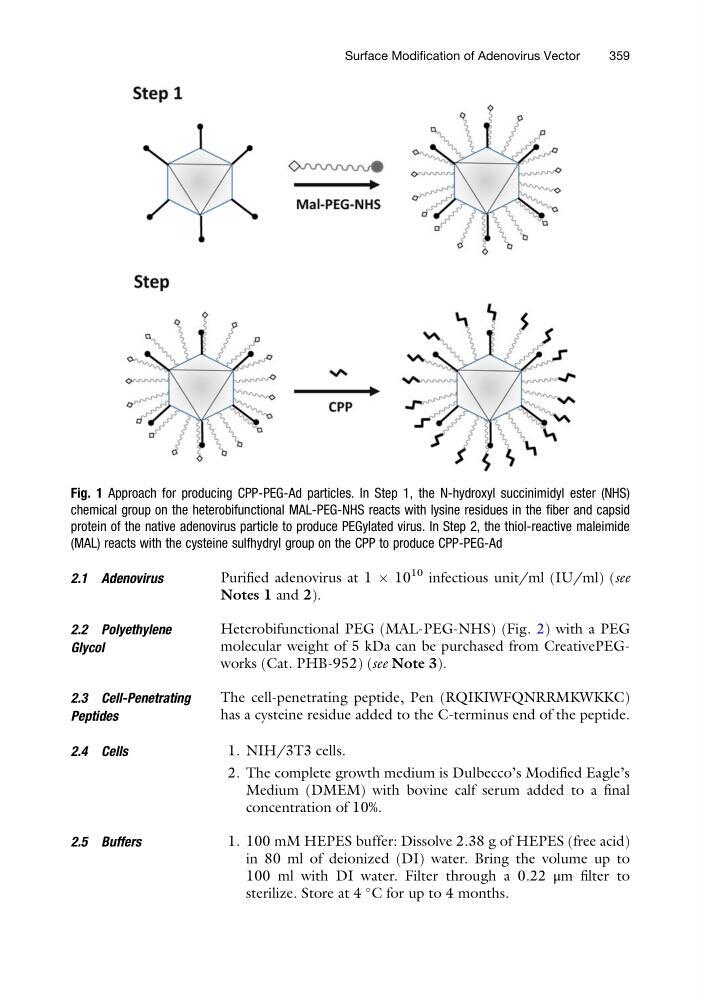
Fig. 1 Approach for producing CPP-PEG-Ad particles. In Step 1, the N-hydroxyl succinimidyl ester (NHS)
chemical group on the heterobifunctional MAL-PEG-NHS reacts with lysine residues in the fiber and capsid
protein of the native adenovirus particle to produce PEGylated virus. In Step 2, the thiol-reactive maleimide
(MAL) reacts with the cysteine sulfhydryl group on the CPP to produce CPP-PEG-Ad
Surface Modification of Adenovirus Vector
359
Purified adenovirus at 1 Â 10
10 infectious unit/ml (IU/ml) (see
Notes 1 and 2).
2.2 Polyethylene
Glycol
Heterobifunctional PEG (MAL-PEG-NHS) (Fig. 2) with a PEG
molecular weight of 5 kDa can be purchased from CreativePEGworks (Cat. PHB-952) (see Note 3).
2.3 Cell-Penetrating
Peptides
The cell-penetrating peptide, Pen (RQIKIWFQNRRMKWKKC)
has a cysteine residue added to the C-terminus end of the peptide.
2.4 Cells
1. NIH/3T3 cells.
2. The complete growth medium is Dulbecco’s Modified Eagle’s
Medium (DMEM) with bovine calf serum added to a final
concentration of 10%.
2.5 Buffers
1. 100 mM HEPES buffer: Dissolve 2.38 g of HEPES (free acid)
in 80 ml of deionized (DI) water. Bring the volume up to
100 ml with DI water. Filter through a 0.22 μm filter to
sterilize. Store at 4
C for up to 4 months.
Fig. 1 Approach for producing CPP-PEG-Ad particles. In Step 1, the N-hydroxyl succinimidyl ester (NHS)
chemical group on the heterobifunctional MAL-PEG-NHS reacts with lysine residues in the fiber and capsid
protein of the native adenovirus particle to produce PEGylated virus. In Step 2, the thiol-reactive maleimide
(MAL) reacts with the cysteine sulfhydryl group on the CPP to produce CPP-PEG-Ad
Surface Modification of Adenovirus Vector
359