

whole-cell killed oral cholera vaccine (OCV). Additionally, the
vaccine does not produce any adverse effects on the pregnancy
outcome as it cannot replicate in the gut and oral route intake. It
was also observed that no harmful effects on pregnancy were seen
during the mass vaccination in Tanzania. However, a clinical study
showed that OCV has no harmful effect on pregnant women thus
indicating that OCV is safe with no loss of fetal life in pregnant
women while they are suffering from cholera [110, 111]. Therefore,
it should be recommended that pregnant women take OCV when
they are at high risk of losing a fetus while suffering from cholera.
Malaria is also one of the common causes of morbidity and
mortality in tropical and subtropical regions. It can be controlled by
developing an efficient vaccine that should be cost-effective also
[112]. This infection is transmitted by the bite of female Anopheles
mosquito, which injects sporozoites in the skin. Researchers are
trying to develop a vaccine based on antigens of blood stage parasites [113]. Richards et al. reported that a whole killed blood lysate
vaccine could be significantly applied to protect against the liverstage as well as blood-stage malaria infections [114].
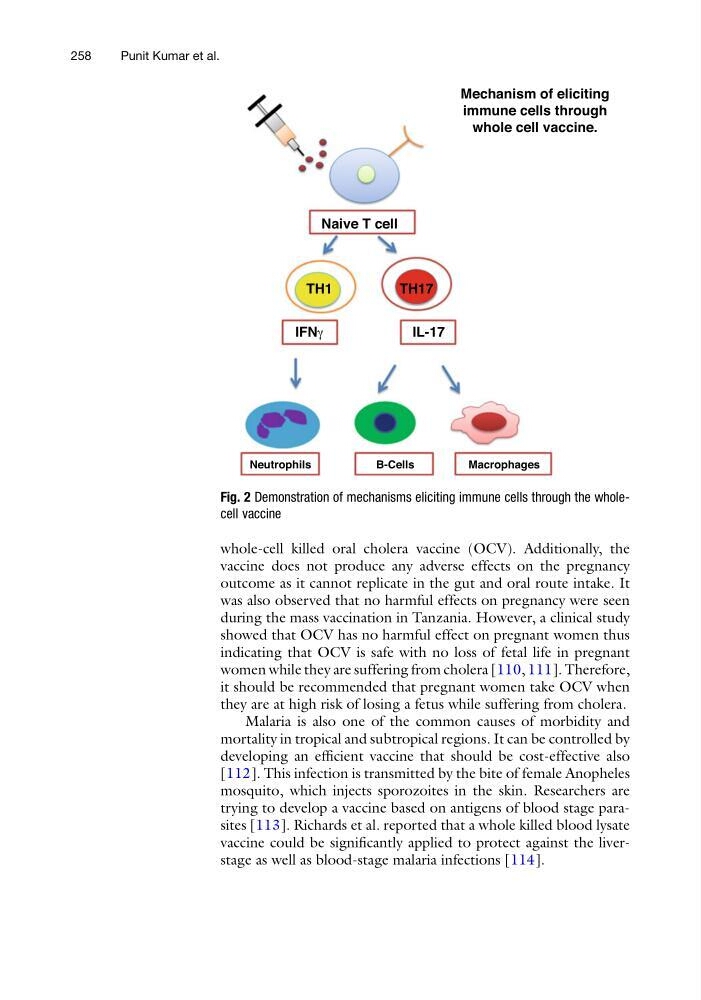
Mechanism of eliciting
immune cells through
whole cell vaccine.
Naive T cell
TH1
TH17
IL-17
Neutrophils
B-Cells
Macrophages
IFNγ
Fig. 2 Demonstration of mechanisms eliciting immune cells through the wholecell vaccine
258
Punit Kumar et al.
vaccine does not produce any adverse effects on the pregnancy
outcome as it cannot replicate in the gut and oral route intake. It
was also observed that no harmful effects on pregnancy were seen
during the mass vaccination in Tanzania. However, a clinical study
showed that OCV has no harmful effect on pregnant women thus
indicating that OCV is safe with no loss of fetal life in pregnant
women while they are suffering from cholera [110, 111]. Therefore,
it should be recommended that pregnant women take OCV when
they are at high risk of losing a fetus while suffering from cholera.
Malaria is also one of the common causes of morbidity and
mortality in tropical and subtropical regions. It can be controlled by
developing an efficient vaccine that should be cost-effective also
[112]. This infection is transmitted by the bite of female Anopheles
mosquito, which injects sporozoites in the skin. Researchers are
trying to develop a vaccine based on antigens of blood stage parasites [113]. Richards et al. reported that a whole killed blood lysate
vaccine could be significantly applied to protect against the liverstage as well as blood-stage malaria infections [114].
Mechanism of eliciting
immune cells through
whole cell vaccine.
Naive T cell
TH1
TH17
IL-17
Neutrophils
B-Cells
Macrophages
IFNγ
Fig. 2 Demonstration of mechanisms eliciting immune cells through the wholecell vaccine
258
Punit Kumar et al.