

and passive administration of antibodies towards particular antigen
to demonstrate that specific antigen must be present in vaccines
[36]. Different mechanisms of vaccine development have been
employed by researchers such as attenuation, cell culture, reassortment, inactivation, subunit vaccines, and genetic engineering [37–
41].
Attenuation is the very basic mechanism of vaccine development. Live attenuated vaccines are one of the most successful and
cost-effective vaccines. Such vaccines protect against acute diseases
caused by human and veterinary viral and bacterial infections, but
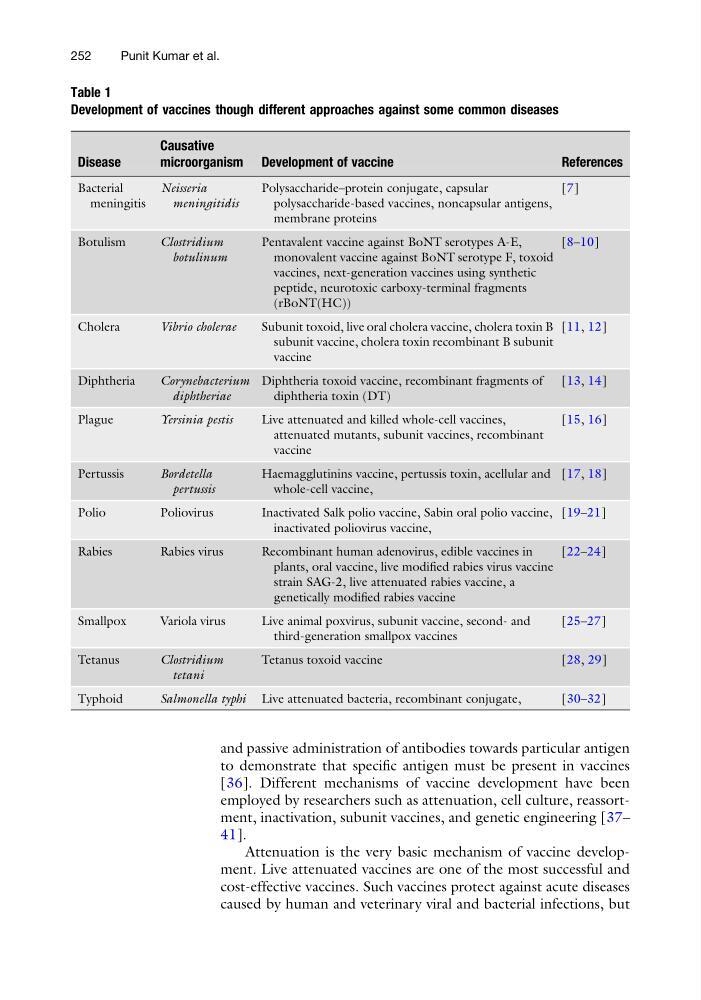
Table 1
Development of vaccines though different approaches against some common diseases
Disease
Causative
microorganism Development of vaccine
References
Bacterial
meningitis
Neisseria
meningitidis
Polysaccharide–protein conjugate, capsular
polysaccharide-based vaccines, noncapsular antigens,
membrane proteins
[7]
Botulism
Clostridium
botulinum
Pentavalent vaccine against BoNT serotypes A-E,
monovalent vaccine against BoNT serotype F, toxoid
vaccines, next-generation vaccines using synthetic
peptide, neurotoxic carboxy-terminal fragments
(rBoNT(HC))
[8–10]
Cholera
Vibrio cholerae
Subunit toxoid, live oral cholera vaccine, cholera toxin B
subunit vaccine, cholera toxin recombinant B subunit
vaccine
[11, 12]
Diphtheria
Corynebacterium
diphtheriae
Diphtheria toxoid vaccine, recombinant fragments of
diphtheria toxin (DT)
[13, 14]
Plague
Yersinia pestis
Live attenuated and killed whole-cell vaccines,
attenuated mutants, subunit vaccines, recombinant
vaccine
[15, 16]
Pertussis
Bordetella
pertussis
Haemagglutinins vaccine, pertussis toxin, acellular and
whole-cell vaccine,
[17, 18]
Polio
Poliovirus
Inactivated Salk polio vaccine, Sabin oral polio vaccine,
inactivated poliovirus vaccine,
[19–21]
Rabies
Rabies virus
Recombinant human adenovirus, edible vaccines in
plants, oral vaccine, live modified rabies virus vaccine
strain SAG-2, live attenuated rabies vaccine, a
genetically modified rabies vaccine
[22–24]
Smallpox
Variola virus
Live animal poxvirus, subunit vaccine, second- and
third-generation smallpox vaccines
[25–27]
Tetanus
Clostridium
tetani
Tetanus toxoid vaccine
[28, 29]
Typhoid
Salmonella typhi Live attenuated bacteria, recombinant conjugate,
[30–32]
252
Punit Kumar et al.
to demonstrate that specific antigen must be present in vaccines
[36]. Different mechanisms of vaccine development have been
employed by researchers such as attenuation, cell culture, reassortment, inactivation, subunit vaccines, and genetic engineering [37–
41].
Attenuation is the very basic mechanism of vaccine development. Live attenuated vaccines are one of the most successful and
cost-effective vaccines. Such vaccines protect against acute diseases
caused by human and veterinary viral and bacterial infections, but
Table 1
Development of vaccines though different approaches against some common diseases
Disease
Causative
microorganism Development of vaccine
References
Bacterial
meningitis
Neisseria
meningitidis
Polysaccharide–protein conjugate, capsular
polysaccharide-based vaccines, noncapsular antigens,
membrane proteins
[7]
Botulism
Clostridium
botulinum
Pentavalent vaccine against BoNT serotypes A-E,
monovalent vaccine against BoNT serotype F, toxoid
vaccines, next-generation vaccines using synthetic
peptide, neurotoxic carboxy-terminal fragments
(rBoNT(HC))
[8–10]
Cholera
Vibrio cholerae
Subunit toxoid, live oral cholera vaccine, cholera toxin B
subunit vaccine, cholera toxin recombinant B subunit
vaccine
[11, 12]
Diphtheria
Corynebacterium
diphtheriae
Diphtheria toxoid vaccine, recombinant fragments of
diphtheria toxin (DT)
[13, 14]
Plague
Yersinia pestis
Live attenuated and killed whole-cell vaccines,
attenuated mutants, subunit vaccines, recombinant
vaccine
[15, 16]
Pertussis
Bordetella
pertussis
Haemagglutinins vaccine, pertussis toxin, acellular and
whole-cell vaccine,
[17, 18]
Polio
Poliovirus
Inactivated Salk polio vaccine, Sabin oral polio vaccine,
inactivated poliovirus vaccine,
[19–21]
Rabies
Rabies virus
Recombinant human adenovirus, edible vaccines in
plants, oral vaccine, live modified rabies virus vaccine
strain SAG-2, live attenuated rabies vaccine, a
genetically modified rabies vaccine
[22–24]
Smallpox
Variola virus
Live animal poxvirus, subunit vaccine, second- and
third-generation smallpox vaccines
[25–27]
Tetanus
Clostridium
tetani
Tetanus toxoid vaccine
[28, 29]
Typhoid
Salmonella typhi Live attenuated bacteria, recombinant conjugate,
[30–32]
252
Punit Kumar et al.