

1.2.1 Evaluation
of the Purification Process
Performance
In order to ensure the required product quality, appropriate analytical methods have to be established. Depending on the target
nanoplex, the process-related contaminants and the intended application, there is a broad range of possible assays available. Parameters
to be evaluated include nanoplex concentration, morphological
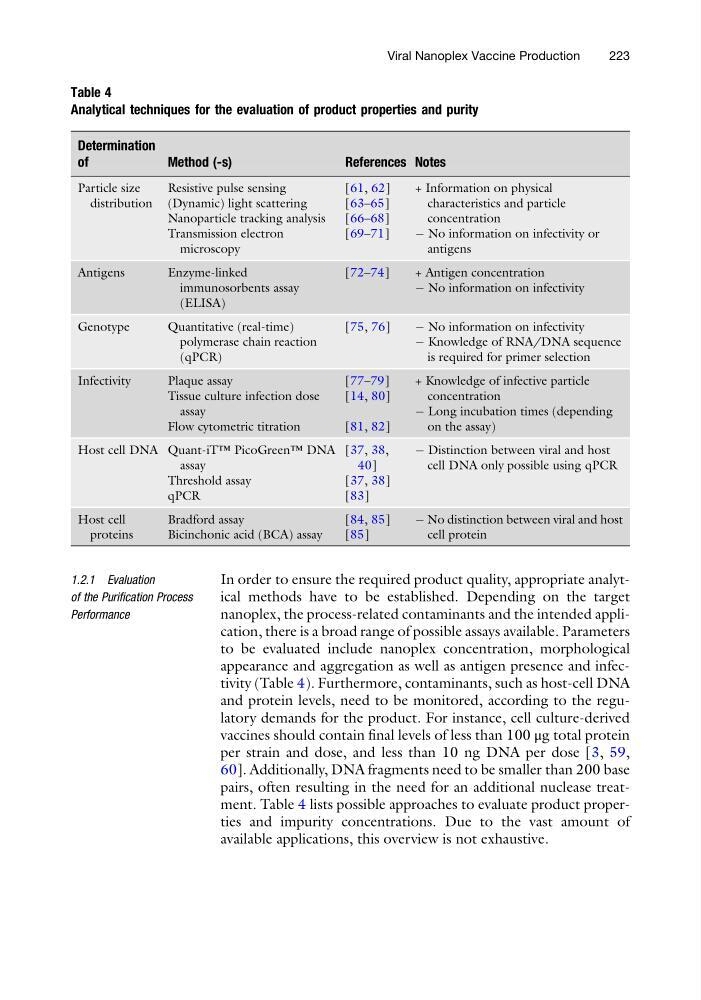
appearance and aggregation as well as antigen presence and infectivity (Table 4). Furthermore, contaminants, such as host-cell DNA
and protein levels, need to be monitored, according to the regulatory demands for the product. For instance, cell culture-derived
vaccines should contain final levels of less than 100 μg total protein
per strain and dose, and less than 10 ng DNA per dose [3, 59,
60]. Additionally, DNA fragments need to be smaller than 200 base
pairs, often resulting in the need for an additional nuclease treatment. Table 4 lists possible approaches to evaluate product properties and impurity concentrations. Due to the vast amount of
available applications, this overview is not exhaustive.
Table 4
Analytical techniques for the evaluation of product properties and purity
Determination
of
Method (-s)
References Notes
Particle size
distribution
Resistive pulse sensing
(Dynamic) light scattering
Nanoparticle tracking analysis
Transmission electron
microscopy
[61, 62]
[63–65]
[66–68]
[69–71]
+ Information on physical
characteristics and particle
concentration
À No information on infectivity or
antigens
Antigens
Enzyme-linked
immunosorbents assay
(ELISA)
[72–74]
+ Antigen concentration
À No information on infectivity
Genotype
Quantitative (real-time)
polymerase chain reaction
(qPCR)
[75, 76]
À No information on infectivity
À Knowledge of RNA/DNA sequence
is required for primer selection
Infectivity
Plaque assay
Tissue culture infection dose
assay
Flow cytometric titration
[77–79]
[14, 80]
[81, 82]
+ Knowledge of infective particle
concentration
À Long incubation times (depending
on the assay)
Host cell DNA Quant-iT™ PicoGreen™ DNA
assay
Threshold assay
qPCR
[37, 38,
40]
[37, 38]
[83]
À Distinction between viral and host
cell DNA only possible using qPCR
Host cell
proteins
Bradford assay
Bicinchonic acid (BCA) assay
[84, 85]
[85]
À No distinction between viral and host
cell protein
Viral Nanoplex Vaccine Production
223
of the Purification Process
Performance
In order to ensure the required product quality, appropriate analytical methods have to be established. Depending on the target
nanoplex, the process-related contaminants and the intended application, there is a broad range of possible assays available. Parameters
to be evaluated include nanoplex concentration, morphological
appearance and aggregation as well as antigen presence and infectivity (Table 4). Furthermore, contaminants, such as host-cell DNA
and protein levels, need to be monitored, according to the regulatory demands for the product. For instance, cell culture-derived
vaccines should contain final levels of less than 100 μg total protein
per strain and dose, and less than 10 ng DNA per dose [3, 59,
60]. Additionally, DNA fragments need to be smaller than 200 base
pairs, often resulting in the need for an additional nuclease treatment. Table 4 lists possible approaches to evaluate product properties and impurity concentrations. Due to the vast amount of
available applications, this overview is not exhaustive.
Table 4
Analytical techniques for the evaluation of product properties and purity
Determination
of
Method (-s)
References Notes
Particle size
distribution
Resistive pulse sensing
(Dynamic) light scattering
Nanoparticle tracking analysis
Transmission electron
microscopy
[61, 62]
[63–65]
[66–68]
[69–71]
+ Information on physical
characteristics and particle
concentration
À No information on infectivity or
antigens
Antigens
Enzyme-linked
immunosorbents assay
(ELISA)
[72–74]
+ Antigen concentration
À No information on infectivity
Genotype
Quantitative (real-time)
polymerase chain reaction
(qPCR)
[75, 76]
À No information on infectivity
À Knowledge of RNA/DNA sequence
is required for primer selection
Infectivity
Plaque assay
Tissue culture infection dose
assay
Flow cytometric titration
[77–79]
[14, 80]
[81, 82]
+ Knowledge of infective particle
concentration
À Long incubation times (depending
on the assay)
Host cell DNA Quant-iT™ PicoGreen™ DNA
assay
Threshold assay
qPCR
[37, 38,
40]
[37, 38]
[83]
À Distinction between viral and host
cell DNA only possible using qPCR
Host cell
proteins
Bradford assay
Bicinchonic acid (BCA) assay
[84, 85]
[85]
À No distinction between viral and host
cell protein
Viral Nanoplex Vaccine Production
223