

4. Freezing Buffer: 50 mM Tris–HCl pH 6.8, 150 mM NaCl,
10% glycerol, 2 mM EDTA.
5. 1 L Erlenmeyer flasks.
6. 1 mm electroporation cuvettes (CellProjects).
7. Fritted filtration columns (ISOLUTE).
8. Strep-tactin Superflow beads (IBA).
3 Methods
3.1 Production Strain
1. Glycosylation competent Escherichia coli: We use E. coli BL21Gold(DE3) for glycoconjugate VLP production. However, in
principle, any E. coli strain can be used. To modify target
proteins with the glucose oligosaccharide structure requires
coexpression of two enzymes (the NGT and α6GlcT) together
with the protein substrate. We find that expression of the NGT
behind a weak lacUV5 promoter [10] from a medium–low
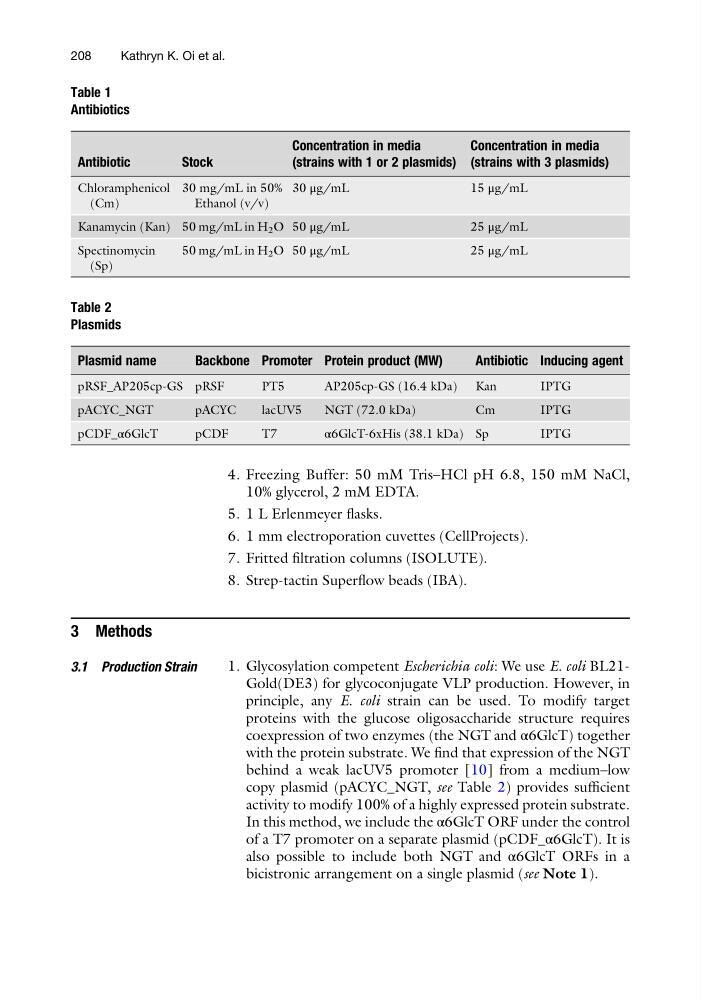
copy plasmid (pACYC_NGT, see Table 2) provides sufficient
activity to modify 100% of a highly expressed protein substrate.
In this method, we include the α6GlcT ORF under the control
of a T7 promoter on a separate plasmid (pCDF_α6GlcT). It is
also possible to include both NGT and α6GlcT ORFs in a
bicistronic arrangement on a single plasmid (see Note 1).
Table 1
Antibiotics
Antibiotic
Stock
Concentration in media
(strains with 1 or 2 plasmids)
Concentration in media
(strains with 3 plasmids)
Chloramphenicol
(Cm)
30 mg/mL in 50%
Ethanol (v/v)
30 μg/mL
15 μg/mL
Kanamycin (Kan) 50 mg/mL in H 2 O 50 μg/mL
25 μg/mL
Spectinomycin
(Sp)
50 mg/mL in H 2 O 50 μg/mL
25 μg/mL
Table 2
Plasmids
Plasmid name
Backbone Promoter Protein product (MW)
Antibiotic Inducing agent
pRSF_AP205cp-GS pRSF
PT5
AP205cp-GS (16.4 kDa) Kan
IPTG
pACYC_NGT
pACYC
lacUV5
NGT (72.0 kDa)
Cm
IPTG
pCDF_α6GlcT
pCDF
T7
α6GlcT-6xHis (38.1 kDa) Sp
IPTG
208
Kathryn K. Oi et al.
10% glycerol, 2 mM EDTA.
5. 1 L Erlenmeyer flasks.
6. 1 mm electroporation cuvettes (CellProjects).
7. Fritted filtration columns (ISOLUTE).
8. Strep-tactin Superflow beads (IBA).
3 Methods
3.1 Production Strain
1. Glycosylation competent Escherichia coli: We use E. coli BL21Gold(DE3) for glycoconjugate VLP production. However, in
principle, any E. coli strain can be used. To modify target
proteins with the glucose oligosaccharide structure requires
coexpression of two enzymes (the NGT and α6GlcT) together
with the protein substrate. We find that expression of the NGT
behind a weak lacUV5 promoter [10] from a medium–low
copy plasmid (pACYC_NGT, see Table 2) provides sufficient
activity to modify 100% of a highly expressed protein substrate.
In this method, we include the α6GlcT ORF under the control
of a T7 promoter on a separate plasmid (pCDF_α6GlcT). It is
also possible to include both NGT and α6GlcT ORFs in a
bicistronic arrangement on a single plasmid (see Note 1).
Table 1
Antibiotics
Antibiotic
Stock
Concentration in media
(strains with 1 or 2 plasmids)
Concentration in media
(strains with 3 plasmids)
Chloramphenicol
(Cm)
30 mg/mL in 50%
Ethanol (v/v)
30 μg/mL
15 μg/mL
Kanamycin (Kan) 50 mg/mL in H 2 O 50 μg/mL
25 μg/mL
Spectinomycin
(Sp)
50 mg/mL in H 2 O 50 μg/mL
25 μg/mL
Table 2
Plasmids
Plasmid name
Backbone Promoter Protein product (MW)
Antibiotic Inducing agent
pRSF_AP205cp-GS pRSF
PT5
AP205cp-GS (16.4 kDa) Kan
IPTG
pACYC_NGT
pACYC
lacUV5
NGT (72.0 kDa)
Cm
IPTG
pCDF_α6GlcT
pCDF
T7
α6GlcT-6xHis (38.1 kDa) Sp
IPTG
208
Kathryn K. Oi et al.