

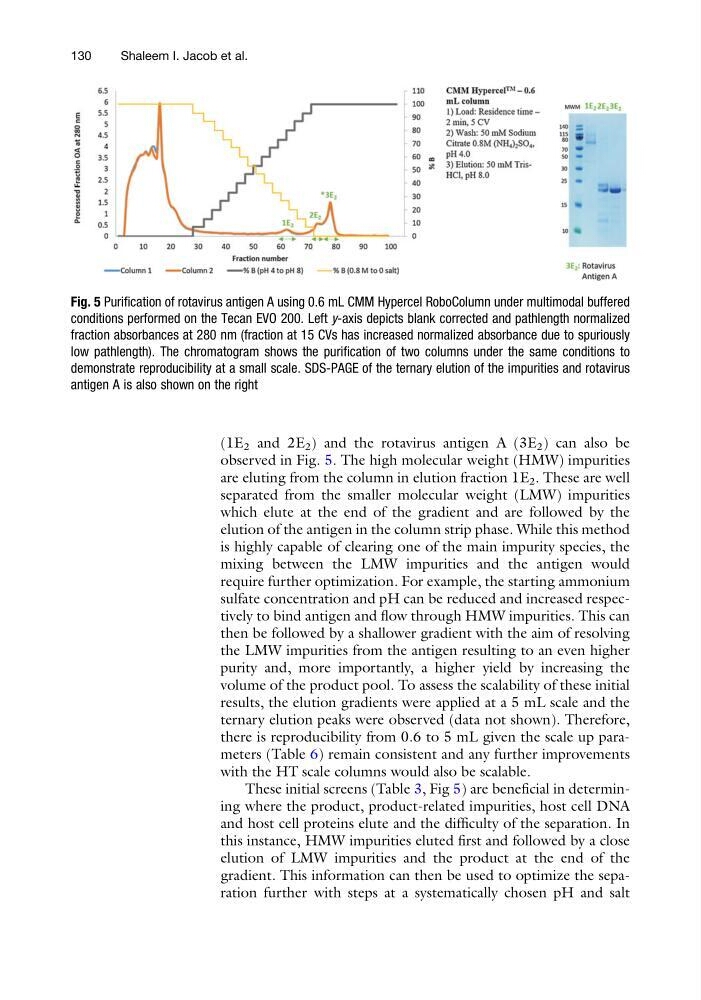
(1E 2 and 2E 2 ) and the rotavirus antigen A (3E 2 ) can also be
observed in Fig. 5. The high molecular weight (HMW) impurities
are eluting from the column in elution fraction 1E 2 . These are well
separated from the smaller molecular weight (LMW) impurities
which elute at the end of the gradient and are followed by the
elution of the antigen in the column strip phase. While this method
is highly capable of clearing one of the main impurity species, the
mixing between the LMW impurities and the antigen would
require further optimization. For example, the starting ammonium
sulfate concentration and pH can be reduced and increased respectively to bind antigen and flow through HMW impurities. This can
then be followed by a shallower gradient with the aim of resolving
the LMW impurities from the antigen resulting to an even higher
purity and, more importantly, a higher yield by increasing the
volume of the product pool. To assess the scalability of these initial
results, the elution gradients were applied at a 5 mL scale and the
ternary elution peaks were observed (data not shown). Therefore,
there is reproducibility from 0.6 to 5 mL given the scale up parameters (Table 6) remain consistent and any further improvements
with the HT scale columns would also be scalable.
These initial screens (Table 3, Fig 5) are beneficial in determining where the product, product-related impurities, host cell DNA
and host cell proteins elute and the difficulty of the separation. In
this instance, HMW impurities eluted first and followed by a close
elution of LMW impurities and the product at the end of the
gradient. This information can then be used to optimize the separation further with steps at a systematically chosen pH and salt
Fig. 5 Purification of rotavirus antigen A using 0.6 mL CMM Hypercel RoboColumn under multimodal buffered
conditions performed on the Tecan EVO 200. Left y-axis depicts blank corrected and pathlength normalized
fraction absorbances at 280 nm (fraction at 15 CVs has increased normalized absorbance due to spuriously
low pathlength). The chromatogram shows the purification of two columns under the same conditions to
demonstrate reproducibility at a small scale. SDS-PAGE of the ternary elution of the impurities and rotavirus
antigen A is also shown on the right
130
Shaleem I. Jacob et al.
observed in Fig. 5. The high molecular weight (HMW) impurities
are eluting from the column in elution fraction 1E 2 . These are well
separated from the smaller molecular weight (LMW) impurities
which elute at the end of the gradient and are followed by the
elution of the antigen in the column strip phase. While this method
is highly capable of clearing one of the main impurity species, the
mixing between the LMW impurities and the antigen would
require further optimization. For example, the starting ammonium
sulfate concentration and pH can be reduced and increased respectively to bind antigen and flow through HMW impurities. This can
then be followed by a shallower gradient with the aim of resolving
the LMW impurities from the antigen resulting to an even higher
purity and, more importantly, a higher yield by increasing the
volume of the product pool. To assess the scalability of these initial
results, the elution gradients were applied at a 5 mL scale and the
ternary elution peaks were observed (data not shown). Therefore,
there is reproducibility from 0.6 to 5 mL given the scale up parameters (Table 6) remain consistent and any further improvements
with the HT scale columns would also be scalable.
These initial screens (Table 3, Fig 5) are beneficial in determining where the product, product-related impurities, host cell DNA
and host cell proteins elute and the difficulty of the separation. In
this instance, HMW impurities eluted first and followed by a close
elution of LMW impurities and the product at the end of the
gradient. This information can then be used to optimize the separation further with steps at a systematically chosen pH and salt
Fig. 5 Purification of rotavirus antigen A using 0.6 mL CMM Hypercel RoboColumn under multimodal buffered
conditions performed on the Tecan EVO 200. Left y-axis depicts blank corrected and pathlength normalized
fraction absorbances at 280 nm (fraction at 15 CVs has increased normalized absorbance due to spuriously
low pathlength). The chromatogram shows the purification of two columns under the same conditions to
demonstrate reproducibility at a small scale. SDS-PAGE of the ternary elution of the impurities and rotavirus
antigen A is also shown on the right
130
Shaleem I. Jacob et al.