

3.4 Application of HT
Column
Chromatography
for Multimodal Resins
(MMC)
Each resin in Table 1 was tested for a different set of buffered
conditions and they included changes in pH, sodium chloride
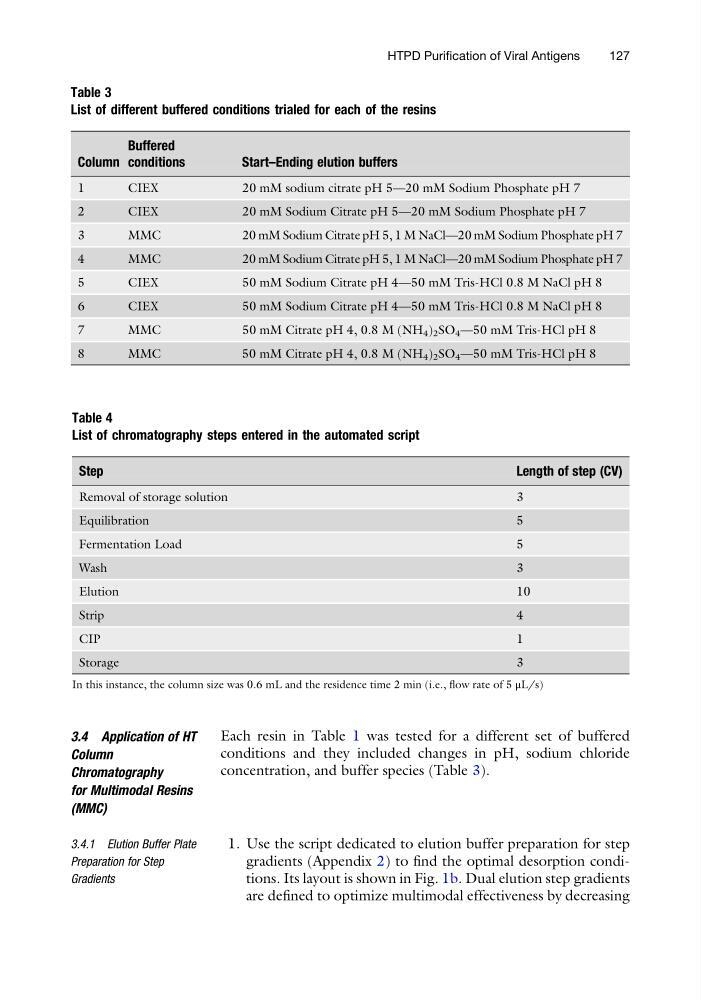
concentration, and buffer species (Table 3).
3.4.1 Elution Buffer Plate
Preparation for Step
Gradients
1. Use the script dedicated to elution buffer preparation for step
gradients (Appendix 2) to find the optimal desorption conditions. Its layout is shown in Fig. 1b. Dual elution step gradients
are defined to optimize multimodal effectiveness by decreasing
Table 3
List of different buffered conditions trialed for each of the resins
Column
Buffered
conditions
Start–Ending elution buffers
1
CIEX
20 mM sodium citrate pH 5—20 mM Sodium Phosphate pH 7
2
CIEX
20 mM Sodium Citrate pH 5—20 mM Sodium Phosphate pH 7
3
MMC
20 mM Sodium Citrate pH 5, 1 M NaCl—20 mM Sodium Phosphate pH 7
4
MMC
20 mM Sodium Citrate pH 5, 1 M NaCl—20 mM Sodium Phosphate pH 7
5
CIEX
50 mM Sodium Citrate pH 4—50 mM Tris-HCl 0.8 M NaCl pH 8
6
CIEX
50 mM Sodium Citrate pH 4—50 mM Tris-HCl 0.8 M NaCl pH 8
7
MMC
50 mM Citrate pH 4, 0.8 M (NH 4 ) 2 SO 4 —50 mM Tris-HCl pH 8
8
MMC
50 mM Citrate pH 4, 0.8 M (NH 4 ) 2 SO 4 —50 mM Tris-HCl pH 8
Table 4
List of chromatography steps entered in the automated script
Step
Length of step (CV)
Removal of storage solution
3
Equilibration
5
Fermentation Load
5
Wash
3
Elution
10
Strip
4
CIP
1
Storage
3
In this instance, the column size was 0.6 mL and the residence time 2 min (i.e., flow rate of 5 μL/s)
HTPD Purification of Viral Antigens
127
Column
Chromatography
for Multimodal Resins
(MMC)
Each resin in Table 1 was tested for a different set of buffered
conditions and they included changes in pH, sodium chloride
concentration, and buffer species (Table 3).
3.4.1 Elution Buffer Plate
Preparation for Step
Gradients
1. Use the script dedicated to elution buffer preparation for step
gradients (Appendix 2) to find the optimal desorption conditions. Its layout is shown in Fig. 1b. Dual elution step gradients
are defined to optimize multimodal effectiveness by decreasing
Table 3
List of different buffered conditions trialed for each of the resins
Column
Buffered
conditions
Start–Ending elution buffers
1
CIEX
20 mM sodium citrate pH 5—20 mM Sodium Phosphate pH 7
2
CIEX
20 mM Sodium Citrate pH 5—20 mM Sodium Phosphate pH 7
3
MMC
20 mM Sodium Citrate pH 5, 1 M NaCl—20 mM Sodium Phosphate pH 7
4
MMC
20 mM Sodium Citrate pH 5, 1 M NaCl—20 mM Sodium Phosphate pH 7
5
CIEX
50 mM Sodium Citrate pH 4—50 mM Tris-HCl 0.8 M NaCl pH 8
6
CIEX
50 mM Sodium Citrate pH 4—50 mM Tris-HCl 0.8 M NaCl pH 8
7
MMC
50 mM Citrate pH 4, 0.8 M (NH 4 ) 2 SO 4 —50 mM Tris-HCl pH 8
8
MMC
50 mM Citrate pH 4, 0.8 M (NH 4 ) 2 SO 4 —50 mM Tris-HCl pH 8
Table 4
List of chromatography steps entered in the automated script
Step
Length of step (CV)
Removal of storage solution
3
Equilibration
5
Fermentation Load
5
Wash
3
Elution
10
Strip
4
CIP
1
Storage
3
In this instance, the column size was 0.6 mL and the residence time 2 min (i.e., flow rate of 5 μL/s)
HTPD Purification of Viral Antigens
127