

2.3 Optical Fiber Configurations and Modes
51
2.3.2 Concepts of Rays and Modes
The electromagnetic light field that is guided along an optical fiber can be represented
by a superposition of bound or trapped modes. Each of these guided modes consists
of a set of simple electromagnetic field configurations. For monochromatic light
fields of radian frequency ω, a mode traveling in the positive z direction (i.e., along
the fiber axis) has a time and z dependence given by
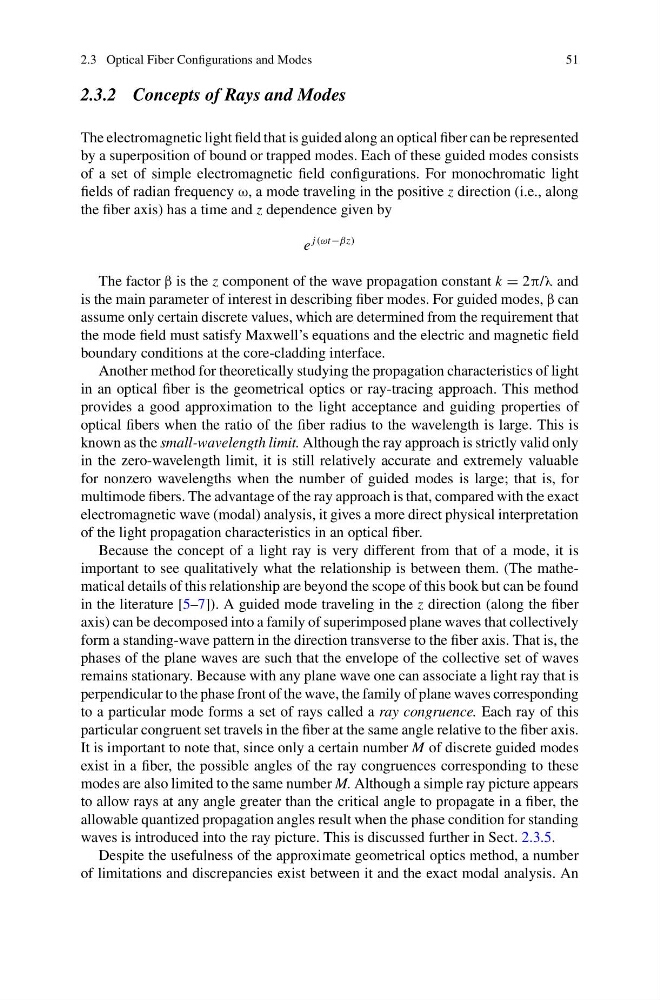
e
j (ωt−βz)
The factor β is the z component of the wave propagation constant k = 2π/λ and
is the main parameter of interest in describing fiber modes. For guided modes, β can
assume only certain discrete values, which are determined from the requirement that
the mode field must satisfy Maxwell’s equations and the electric and magnetic field
boundary conditions at the core-cladding interface.
Another method for theoretically studying the propagation characteristics of light
in an optical fiber is the geometrical optics or ray-tracing approach. This method
provides a good approximation to the light acceptance and guiding properties of
optical fibers when the ratio of the fiber radius to the wavelength is large. This is
known as the small-wavelength limit. Although the ray approach is strictly valid only
in the zero-wavelength limit, it is still relatively accurate and extremely valuable
for nonzero wavelengths when the number of guided modes is large; that is, for
multimode fibers. The advantage of the ray approach is that, compared with the exact
electromagnetic wave (modal) analysis, it gives a more direct physical interpretation
of the light propagation characteristics in an optical fiber.
Because the concept of a light ray is very different from that of a mode, it is
important to see qualitatively what the relationship is between them. (The mathematical details of this relationship are beyond the scope of this book but can be found
in the literature [5–7]). A guided mode traveling in the z direction (along the fiber
axis) can be decomposed into a family of superimposed plane waves that collectively
form a standing-wave pattern in the direction transverse to the fiber axis. That is, the
phases of the plane waves are such that the envelope of the collective set of waves
remains stationary. Because with any plane wave one can associate a light ray that is
perpendicular to the phase front of the wave, the family of plane waves corresponding
to a particular mode forms a set of rays called a ray congruence. Each ray of this
particular congruent set travels in the fiber at the same angle relative to the fiber axis.
It is important to note that, since only a certain number M of discrete guided modes
exist in a fiber, the possible angles of the ray congruences corresponding to these
modes are also limited to the same number M. Although a simple ray picture appears
to allow rays at any angle greater than the critical angle to propagate in a fiber, the
allowable quantized propagation angles result when the phase condition for standing
waves is introduced into the ray picture. This is discussed further in Sect. 2.3.5.
Despite the usefulness of the approximate geometrical optics method, a number
of limitations and discrepancies exist between it and the exact modal analysis. An
51
2.3.2 Concepts of Rays and Modes
The electromagnetic light field that is guided along an optical fiber can be represented
by a superposition of bound or trapped modes. Each of these guided modes consists
of a set of simple electromagnetic field configurations. For monochromatic light
fields of radian frequency ω, a mode traveling in the positive z direction (i.e., along
the fiber axis) has a time and z dependence given by
e
j (ωt−βz)
The factor β is the z component of the wave propagation constant k = 2π/λ and
is the main parameter of interest in describing fiber modes. For guided modes, β can
assume only certain discrete values, which are determined from the requirement that
the mode field must satisfy Maxwell’s equations and the electric and magnetic field
boundary conditions at the core-cladding interface.
Another method for theoretically studying the propagation characteristics of light
in an optical fiber is the geometrical optics or ray-tracing approach. This method
provides a good approximation to the light acceptance and guiding properties of
optical fibers when the ratio of the fiber radius to the wavelength is large. This is
known as the small-wavelength limit. Although the ray approach is strictly valid only
in the zero-wavelength limit, it is still relatively accurate and extremely valuable
for nonzero wavelengths when the number of guided modes is large; that is, for
multimode fibers. The advantage of the ray approach is that, compared with the exact
electromagnetic wave (modal) analysis, it gives a more direct physical interpretation
of the light propagation characteristics in an optical fiber.
Because the concept of a light ray is very different from that of a mode, it is
important to see qualitatively what the relationship is between them. (The mathematical details of this relationship are beyond the scope of this book but can be found
in the literature [5–7]). A guided mode traveling in the z direction (along the fiber
axis) can be decomposed into a family of superimposed plane waves that collectively
form a standing-wave pattern in the direction transverse to the fiber axis. That is, the
phases of the plane waves are such that the envelope of the collective set of waves
remains stationary. Because with any plane wave one can associate a light ray that is
perpendicular to the phase front of the wave, the family of plane waves corresponding
to a particular mode forms a set of rays called a ray congruence. Each ray of this
particular congruent set travels in the fiber at the same angle relative to the fiber axis.
It is important to note that, since only a certain number M of discrete guided modes
exist in a fiber, the possible angles of the ray congruences corresponding to these
modes are also limited to the same number M. Although a simple ray picture appears
to allow rays at any angle greater than the critical angle to propagate in a fiber, the
allowable quantized propagation angles result when the phase condition for standing
waves is introduced into the ray picture. This is discussed further in Sect. 2.3.5.
Despite the usefulness of the approximate geometrical optics method, a number
of limitations and discrepancies exist between it and the exact modal analysis. An