

50
2 Optical Fiber Structures and Light Guiding Principles
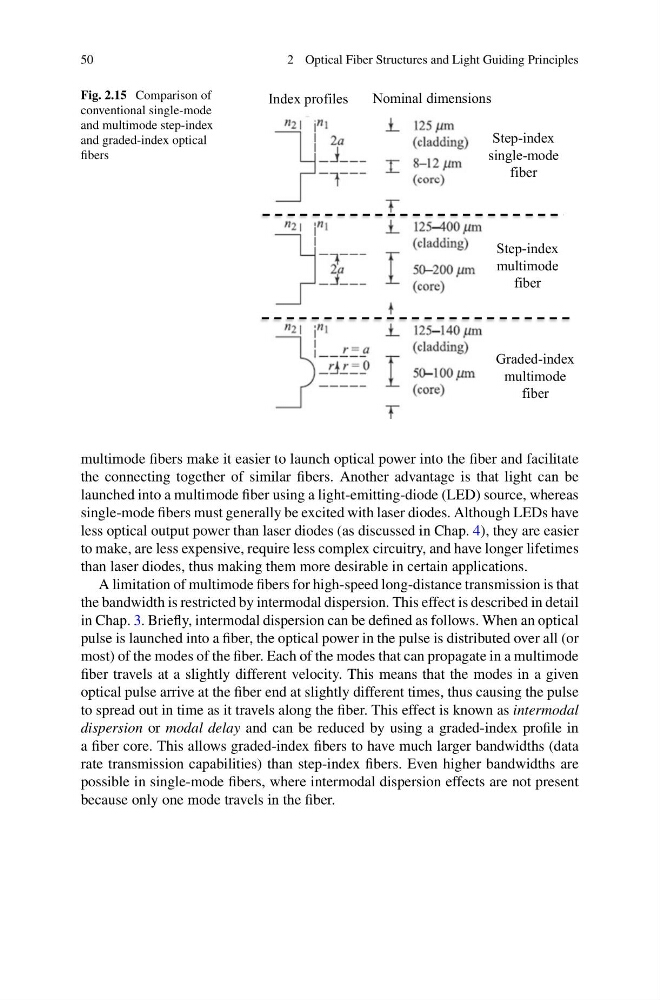
Fig. 2.15 Comparison of
conventional single-mode
and multimode step-index
and graded-index optical
fibers
Index profiles
Nominal dimensions
Step-index
single-mode
fiber
Step-index
multimode
fiber
Graded-index
multimode
fiber
multimode fibers make it easier to launch optical power into the fiber and facilitate
the connecting together of similar fibers. Another advantage is that light can be
launched into a multimode fiber using a light-emitting-diode (LED) source, whereas
single-mode fibers must generally be excited with laser diodes. Although LEDs have
less optical output power than laser diodes (as discussed in Chap. 4), they are easier
to make, are less expensive, require less complex circuitry, and have longer lifetimes
than laser diodes, thus making them more desirable in certain applications.
A limitation of multimode fibers for high-speed long-distance transmission is that
the bandwidth is restricted by intermodal dispersion. This effect is described in detail
in Chap. 3. Briefly, intermodal dispersion can be defined as follows. When an optical
pulse is launched into a fiber, the optical power in the pulse is distributed over all (or
most) of the modes of the fiber. Each of the modes that can propagate in a multimode
fiber travels at a slightly different velocity. This means that the modes in a given
optical pulse arrive at the fiber end at slightly different times, thus causing the pulse
to spread out in time as it travels along the fiber. This effect is known as intermodal
dispersion or modal delay and can be reduced by using a graded-index profile in
a fiber core. This allows graded-index fibers to have much larger bandwidths (data
rate transmission capabilities) than step-index fibers. Even higher bandwidths are
possible in single-mode fibers, where intermodal dispersion effects are not present
because only one mode travels in the fiber.
2 Optical Fiber Structures and Light Guiding Principles
Fig. 2.15 Comparison of
conventional single-mode
and multimode step-index
and graded-index optical
fibers
Index profiles
Nominal dimensions
Step-index
single-mode
fiber
Step-index
multimode
fiber
Graded-index
multimode
fiber
multimode fibers make it easier to launch optical power into the fiber and facilitate
the connecting together of similar fibers. Another advantage is that light can be
launched into a multimode fiber using a light-emitting-diode (LED) source, whereas
single-mode fibers must generally be excited with laser diodes. Although LEDs have
less optical output power than laser diodes (as discussed in Chap. 4), they are easier
to make, are less expensive, require less complex circuitry, and have longer lifetimes
than laser diodes, thus making them more desirable in certain applications.
A limitation of multimode fibers for high-speed long-distance transmission is that
the bandwidth is restricted by intermodal dispersion. This effect is described in detail
in Chap. 3. Briefly, intermodal dispersion can be defined as follows. When an optical
pulse is launched into a fiber, the optical power in the pulse is distributed over all (or
most) of the modes of the fiber. Each of the modes that can propagate in a multimode
fiber travels at a slightly different velocity. This means that the modes in a given
optical pulse arrive at the fiber end at slightly different times, thus causing the pulse
to spread out in time as it travels along the fiber. This effect is known as intermodal
dispersion or modal delay and can be reduced by using a graded-index profile in
a fiber core. This allows graded-index fibers to have much larger bandwidths (data
rate transmission capabilities) than step-index fibers. Even higher bandwidths are
possible in single-mode fibers, where intermodal dispersion effects are not present
because only one mode travels in the fiber.