

14.9 Summary
621
S =
π (NA)
2
4π n 2 =
1
4
NA
n
2
where NA is the fiber numerical aperture, n is the core refractive index, and
NA/n represents the half-angle of the cone of captured rays. If NA = 0.20
and n = 1.50, show that fraction of the scattered light that is recaptured by
the fiber in the reverse direction is S = 0.004.
14.7 Suppose a single-mode OTDR has a usable dynamic range of 30 dB.
Assuming typical fiber attenuation of 0.20 dB/km at 1550 nm and splices
every 2 km (loss of 0.1 dB per splice), show that such a unit will be able to
accurately certify distances of up to 120 km.
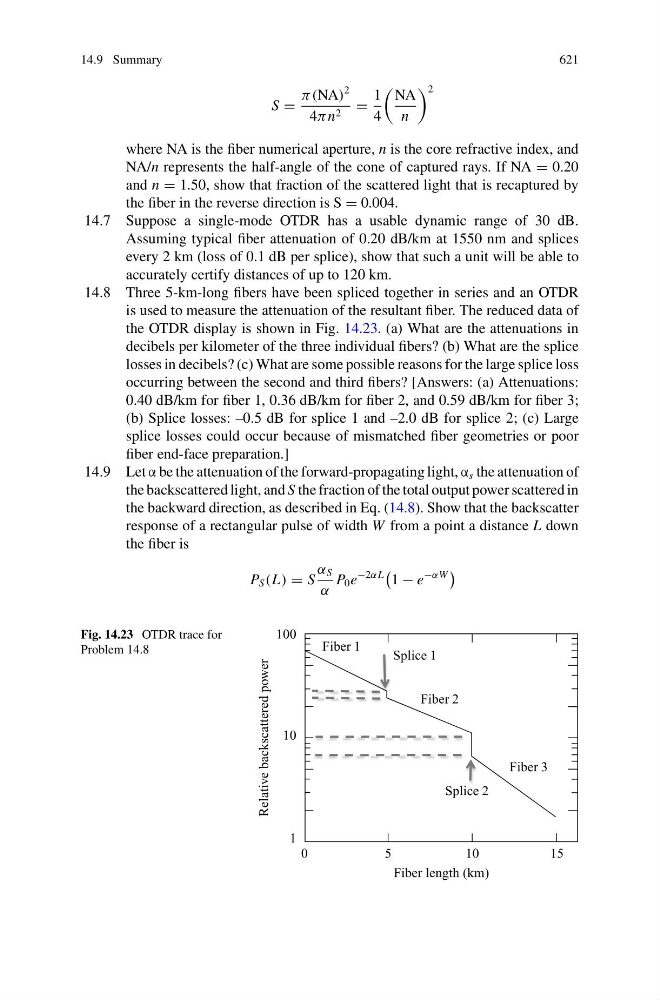
14.8 Three 5-km-long fibers have been spliced together in series and an OTDR
is used to measure the attenuation of the resultant fiber. The reduced data of
the OTDR display is shown in Fig. 14.23. (a) What are the attenuations in
decibels per kilometer of the three individual fibers? (b) What are the splice
losses in decibels? (c) What are some possible reasons for the large splice loss
occurring between the second and third fibers? [Answers: (a) Attenuations:
0.40 dB/km for fiber 1, 0.36 dB/km for fiber 2, and 0.59 dB/km for fiber 3;
(b) Splice losses: –0.5 dB for splice 1 and –2.0 dB for splice 2; (c) Large
splice losses could occur because of mismatched fiber geometries or poor
fiber end-face preparation.]
14.9 Let α be the attenuation of the forward-propagating light, α s the attenuation of
the backscattered light, and S the fraction of the total output power scattered in
the backward direction, as described in Eq. (14.8). Show that the backscatter
response of a rectangular pulse of width W from a point a distance L down
the fiber is
P S (L) = S
α S
α
P 0 e
−2αL
1 − e
−αW
Fig. 14.23 OTDR trace for
Problem 14.8