

614
14 Basic Measurement and Monitoring Techniques
the optical spectrum is an average-power, low-speed measurement, so it does not
give information about the effects of temporal impairments on channel performance.
However, because it can be correlated to the BER, the OSNR provides indirect BER
information for preliminary performance diagnosis of a multichannel system or for
giving advance warning of a possible BER degradation on a given DWDM channel.
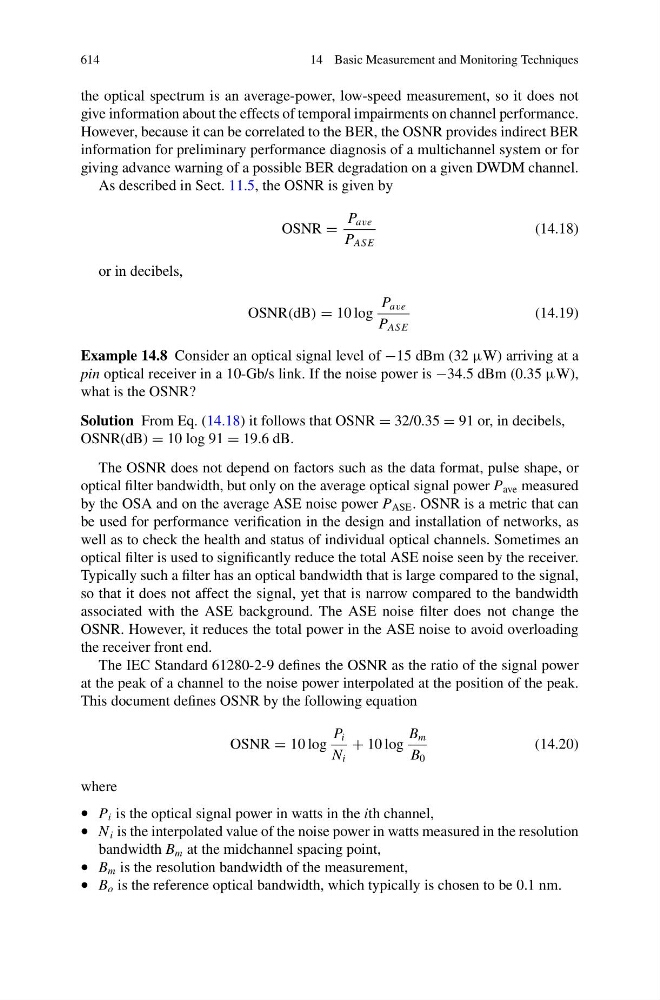
As described in Sect. 11.5, the OSNR is given by
OSNR =
P ave
P AS E
(14.18)
or in decibels,
OSNR(dB) = 10 log
P ave
P AS E
(14.19)
Example 14.8 Consider an optical signal level of −15 dBm (32 μW) arriving at a
pin optical receiver in a 10-Gb/s link. If the noise power is −34.5 dBm (0.35 μW),
what is the OSNR?
Solution From Eq. (14.18) it follows that OSNR = 32/0.35 = 91 or, in decibels,
OSNR(dB) = 10 log 91 = 19.6 dB.
The OSNR does not depend on factors such as the data format, pulse shape, or
optical filter bandwidth, but only on the average optical signal power P ave measured
by the OSA and on the average ASE noise power P ASE . OSNR is a metric that can
be used for performance verification in the design and installation of networks, as
well as to check the health and status of individual optical channels. Sometimes an
optical filter is used to significantly reduce the total ASE noise seen by the receiver.
Typically such a filter has an optical bandwidth that is large compared to the signal,
so that it does not affect the signal, yet that is narrow compared to the bandwidth
associated with the ASE background. The ASE noise filter does not change the
OSNR. However, it reduces the total power in the ASE noise to avoid overloading
the receiver front end.
The IEC Standard 61280-2-9 defines the OSNR as the ratio of the signal power
at the peak of a channel to the noise power interpolated at the position of the peak.
This document defines OSNR by the following equation
OSNR = 10 log
P i
N i
+ 10 log
B m
B 0
(14.20)
where
• P i is the optical signal power in watts in the ith channel,
• N i is the interpolated value of the noise power in watts measured in the resolution
bandwidth B m at the midchannel spacing point,
• B m is the resolution bandwidth of the measurement,
• B o is the reference optical bandwidth, which typically is chosen to be 0.1 nm.