

14.6 Optical Time-Domain Reflectometer
599
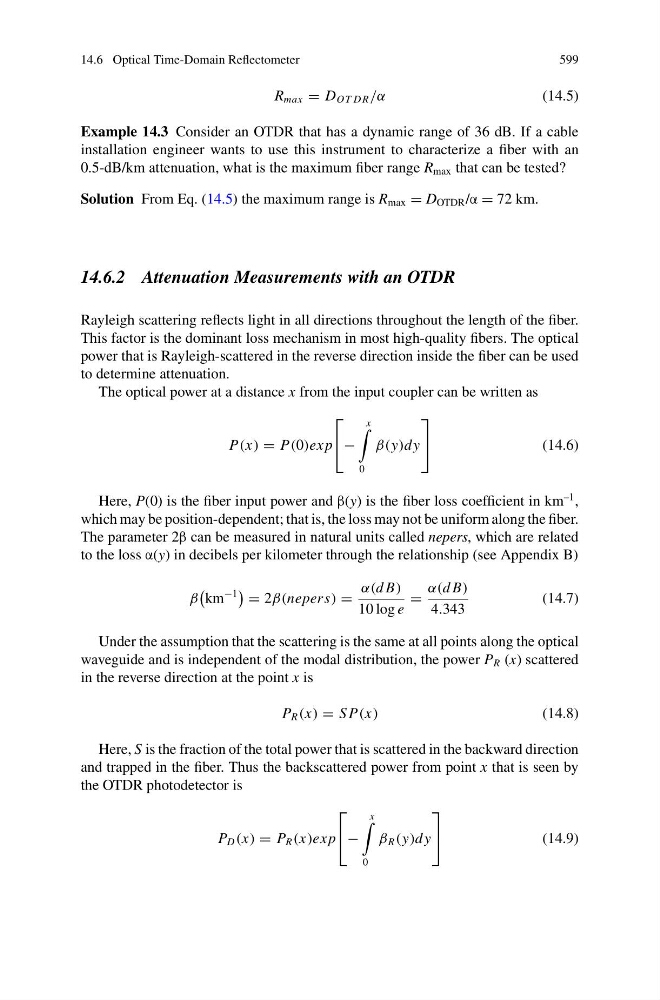
R max = D OT D R /α
(14.5)
Example 14.3 Consider an OTDR that has a dynamic range of 36 dB. If a cable
installation engineer wants to use this instrument to characterize a fiber with an
0.5-dB/km attenuation, what is the maximum fiber range R max that can be tested?
Solution From Eq. (14.5) the maximum range is R max = D OTDR /α = 72 km.
14.6.2 Attenuation Measurements with an OTDR
Rayleigh scattering reflects light in all directions throughout the length of the fiber.
This factor is the dominant loss mechanism in most high-quality fibers. The optical
power that is Rayleigh-scattered in the reverse direction inside the fiber can be used
to determine attenuation.
The optical power at a distance x from the input coupler can be written as
P(x) = P(0)ex p
⎡
⎣ −
x
0
β(y)dy
⎤
⎦
(14.6)
Here, P(0) is the fiber input power and β(y) is the fiber loss coefficient in km
–1 ,
which may be position-dependent; that is, the loss may not be uniform along the fiber.
The parameter 2β can be measured in natural units called nepers, which are related
to the loss α(y) in decibels per kilometer through the relationship (see Appendix B)
β
km
−1
= 2β(nepers) =
α(d B)
10 log e
=
α(d B)
4.343
(14.7)
Under the assumption that the scattering is the same at all points along the optical
waveguide and is independent of the modal distribution, the power P R (x) scattered
in the reverse direction at the point x is
P R (x) = S P(x)
(14.8)
Here, S is the fraction of the total power that is scattered in the backward direction
and trapped in the fiber. Thus the backscattered power from point x that is seen by
the OTDR photodetector is
P D (x) = P R (x)ex p
⎡
⎣ −
x
0
β R (y)dy
⎤
⎦
(14.9)