

546
13 Fiber Optic Communication Networks
is defined as a temporary point-to-point optical connection. Although this model
tends to overestimate the probability that a wavelength is blocked along a path, it
provides insight into the network performance improvement when using wavelength
conversion.
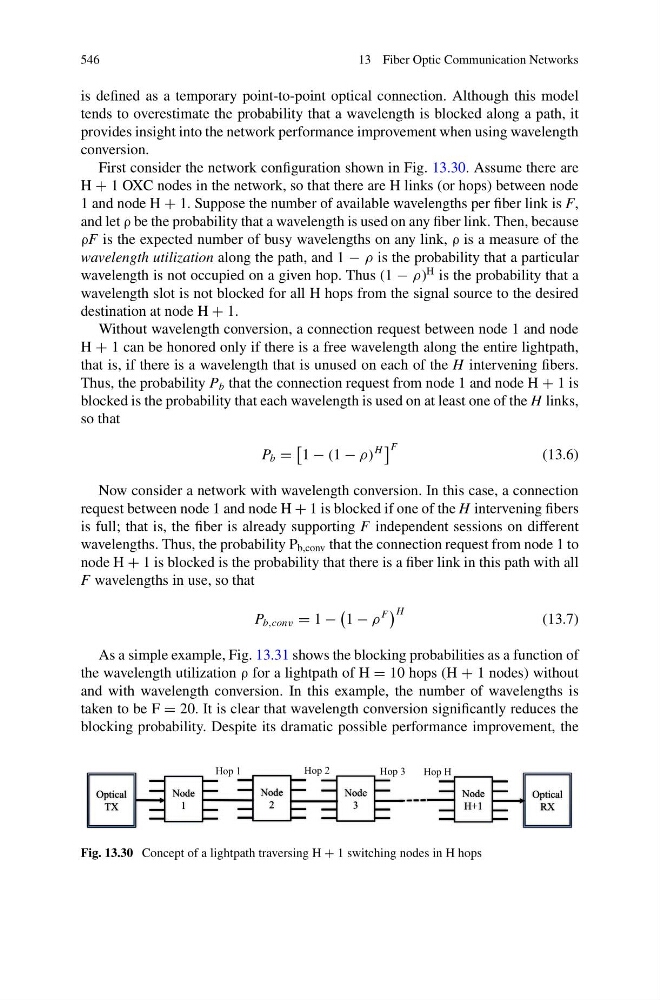
First consider the network configuration shown in Fig. 13.30. Assume there are
H + 1 OXC nodes in the network, so that there are H links (or hops) between node
1 and node H + 1. Suppose the number of available wavelengths per fiber link is F,
and let ρ be the probability that a wavelength is used on any fiber link. Then, because
ρF is the expected number of busy wavelengths on any link, ρ is a measure of the
wavelength utilization along the path, and 1 − ρ is the probability that a particular
wavelength is not occupied on a given hop. Thus (1 − ρ)
H is the probability that a
wavelength slot is not blocked for all H hops from the signal source to the desired
destination at node H + 1.
Without wavelength conversion, a connection request between node 1 and node
H + 1 can be honored only if there is a free wavelength along the entire lightpath,
that is, if there is a wavelength that is unused on each of the H intervening fibers.
Thus, the probability P b that the connection request from node 1 and node H + 1 is
blocked is the probability that each wavelength is used on at least one of the H links,
so that
P b =
1 − (1 − ρ)
H
F
(13.6)
Now consider a network with wavelength conversion. In this case, a connection
request between node 1 and node H + 1 is blocked if one of the H intervening fibers
is full; that is, the fiber is already supporting F independent sessions on different
wavelengths. Thus, the probability P b,conv that the connection request from node 1 to
node H + 1 is blocked is the probability that there is a fiber link in this path with all
F wavelengths in use, so that
P b,conv = 1 −
1 − ρ
F
H
(13.7)
As a simple example, Fig. 13.31 shows the blocking probabilities as a function of
the wavelength utilization ρ for a lightpath of H = 10 hops (H + 1 nodes) without
and with wavelength conversion. In this example, the number of wavelengths is
taken to be F = 20. It is clear that wavelength conversion significantly reduces the
blocking probability. Despite its dramatic possible performance improvement, the
Optical
TX
Optical
TX
Node
1
Node
1
Node
2
Node
2
Node
3
Node
3
Node
H+1
Node
H+1
Optical
RX
Optical
RX
Hop 1
Hop H
Hop 2
Hop 3
Fig. 13.30 Concept of a lightpath traversing H + 1 switching nodes in H hops