

13.6 Optical Switching Architectures
545
13.6.2 Considerations for Wavelength Conversion
Contentions for lightpath use could arise in the architecture shown in Fig. 13.28
when channels having the same wavelength but traveling on different input fibers
enter the OXC and need to be switched simultaneously to the same output fiber. This
could be resolved by assigning a fixed wavelength to each optical path throughout the
network, or by dropping one of the incoming channels at the node and retransmitting
it at another wavelength. However, in the first case, wavelength reuse and network
scalability (expandability) are reduced, and in the second case the add/drop flexibility
of the OXC is lost. Example 13.3 illustrates how wavelength conversion at any output
of the OXC can eliminate these blocking characteristics [30–32].
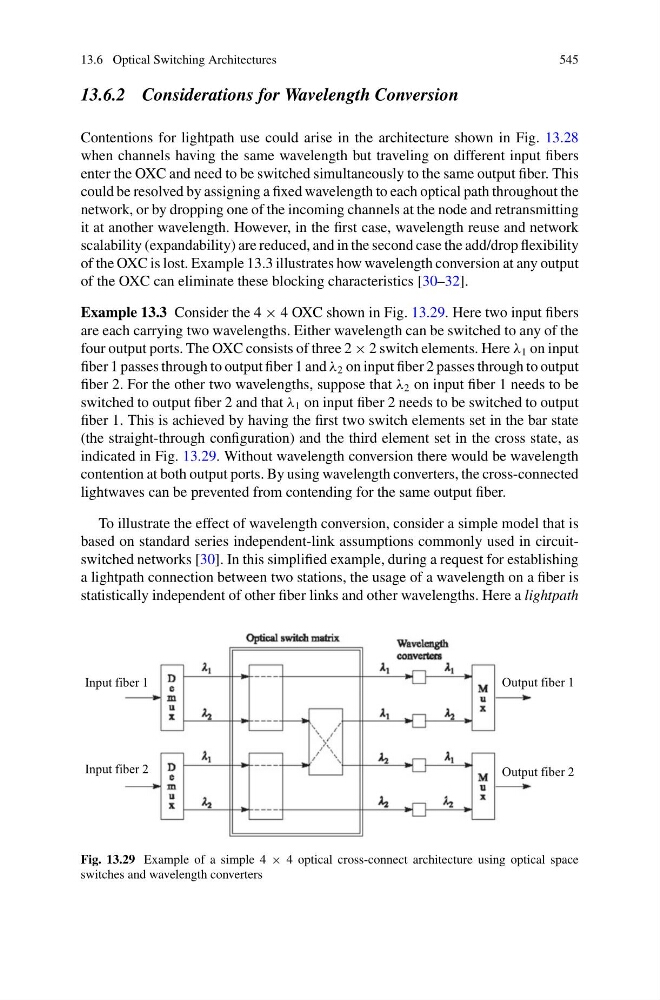
Example 13.3 Consider the 4 × 4 OXC shown in Fig. 13.29. Here two input fibers
are each carrying two wavelengths. Either wavelength can be switched to any of the
four output ports. The OXC consists of three 2 × 2 switch elements. Here λ 1 on input
fiber 1 passes through to output fiber 1 and λ 2 on input fiber 2 passes through to output
fiber 2. For the other two wavelengths, suppose that λ 2 on input fiber 1 needs to be
switched to output fiber 2 and that λ 1 on input fiber 2 needs to be switched to output
fiber 1. This is achieved by having the first two switch elements set in the bar state
(the straight-through configuration) and the third element set in the cross state, as
indicated in Fig. 13.29. Without wavelength conversion there would be wavelength
contention at both output ports. By using wavelength converters, the cross-connected
lightwaves can be prevented from contending for the same output fiber.
To illustrate the effect of wavelength conversion, consider a simple model that is
based on standard series independent-link assumptions commonly used in circuitswitched networks [30]. In this simplified example, during a request for establishing
a lightpath connection between two stations, the usage of a wavelength on a fiber is
statistically independent of other fiber links and other wavelengths. Here a lightpath
Input fiber 1
Input fiber 2
Output fiber 1
Output fiber 2
Fig. 13.29 Example of a simple 4 × 4 optical cross-connect architecture using optical space
switches and wavelength converters