

13.6 Optical Switching Architectures
543
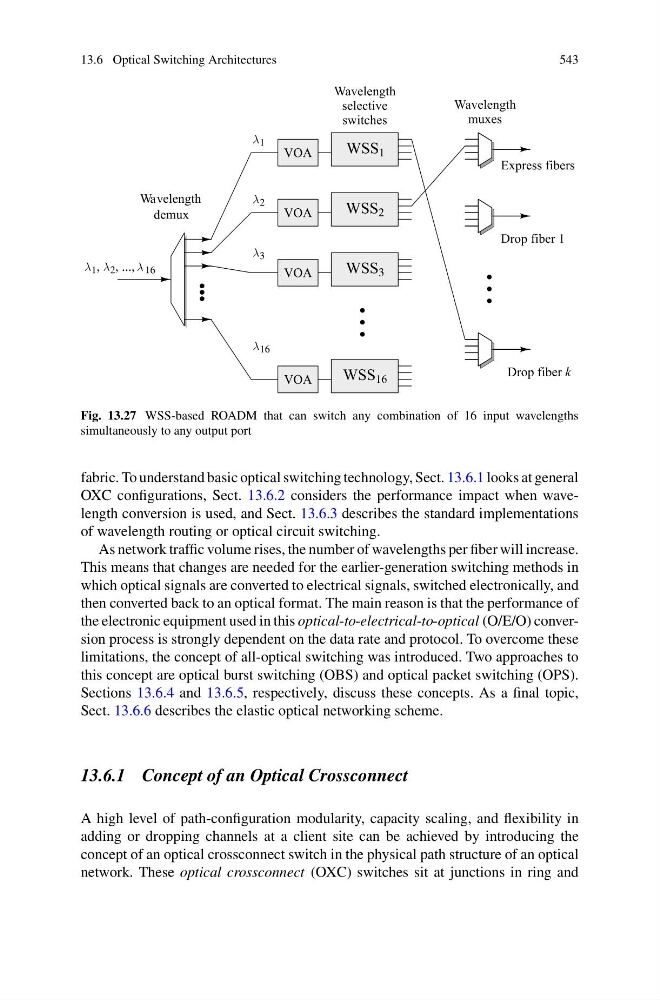
Fig. 13.27 WSS-based ROADM that can switch any combination of 16 input wavelengths
simultaneously to any output port
fabric. To understand basic optical switching technology, Sect. 13.6.1 looks at general
OXC configurations, Sect. 13.6.2 considers the performance impact when wavelength conversion is used, and Sect. 13.6.3 describes the standard implementations
of wavelength routing or optical circuit switching.
As network traffic volume rises, the number of wavelengths per fiber will increase.
This means that changes are needed for the earlier-generation switching methods in
which optical signals are converted to electrical signals, switched electronically, and
then converted back to an optical format. The main reason is that the performance of
the electronic equipment used in this optical-to-electrical-to-optical (O/E/O) conversion process is strongly dependent on the data rate and protocol. To overcome these
limitations, the concept of all-optical switching was introduced. Two approaches to
this concept are optical burst switching (OBS) and optical packet switching (OPS).
Sections 13.6.4 and 13.6.5, respectively, discuss these concepts. As a final topic,
Sect. 13.6.6 describes the elastic optical networking scheme.
13.6.1 Concept of an Optical Crossconnect
A high level of path-configuration modularity, capacity scaling, and flexibility in
adding or dropping channels at a client site can be achieved by introducing the
concept of an optical crossconnect switch in the physical path structure of an optical
network. These optical crossconnect (OXC) switches sit at junctions in ring and