

542
13 Fiber Optic Communication Networks
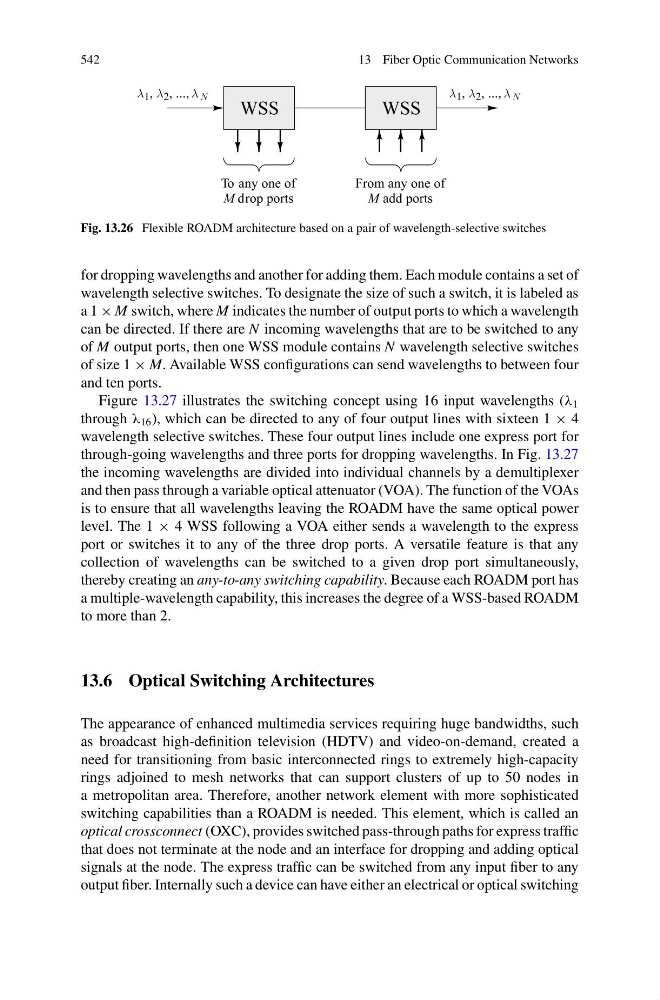
Fig. 13.26 Flexible ROADM architecture based on a pair of wavelength-selective switches
for dropping wavelengths and another for adding them. Each module contains a set of
wavelength selective switches. To designate the size of such a switch, it is labeled as
a 1 × M switch, where M indicates the number of output ports to which a wavelength
can be directed. If there are N incoming wavelengths that are to be switched to any
of M output ports, then one WSS module contains N wavelength selective switches
of size 1 × M. Available WSS configurations can send wavelengths to between four
and ten ports.
Figure 13.27 illustrates the switching concept using 16 input wavelengths (λ 1
through λ 16 ), which can be directed to any of four output lines with sixteen 1 × 4
wavelength selective switches. These four output lines include one express port for
through-going wavelengths and three ports for dropping wavelengths. In Fig. 13.27
the incoming wavelengths are divided into individual channels by a demultiplexer
and then pass through a variable optical attenuator (VOA). The function of the VOAs
is to ensure that all wavelengths leaving the ROADM have the same optical power
level. The 1 × 4 WSS following a VOA either sends a wavelength to the express
port or switches it to any of the three drop ports. A versatile feature is that any
collection of wavelengths can be switched to a given drop port simultaneously,
thereby creating an any-to-any switching capability. Because each ROADM port has
a multiple-wavelength capability, this increases the degree of a WSS-based ROADM
to more than 2.
13.6 Optical Switching Architectures
The appearance of enhanced multimedia services requiring huge bandwidths, such
as broadcast high-definition television (HDTV) and video-on-demand, created a
need for transitioning from basic interconnected rings to extremely high-capacity
rings adjoined to mesh networks that can support clusters of up to 50 nodes in
a metropolitan area. Therefore, another network element with more sophisticated
switching capabilities than a ROADM is needed. This element, which is called an
optical crossconnect (OXC), provides switched pass-through paths for express traffic
that does not terminate at the node and an interface for dropping and adding optical
signals at the node. The express traffic can be switched from any input fiber to any
output fiber. Internally such a device can have either an electrical or optical switching