

524
13 Fiber Optic Communication Networks
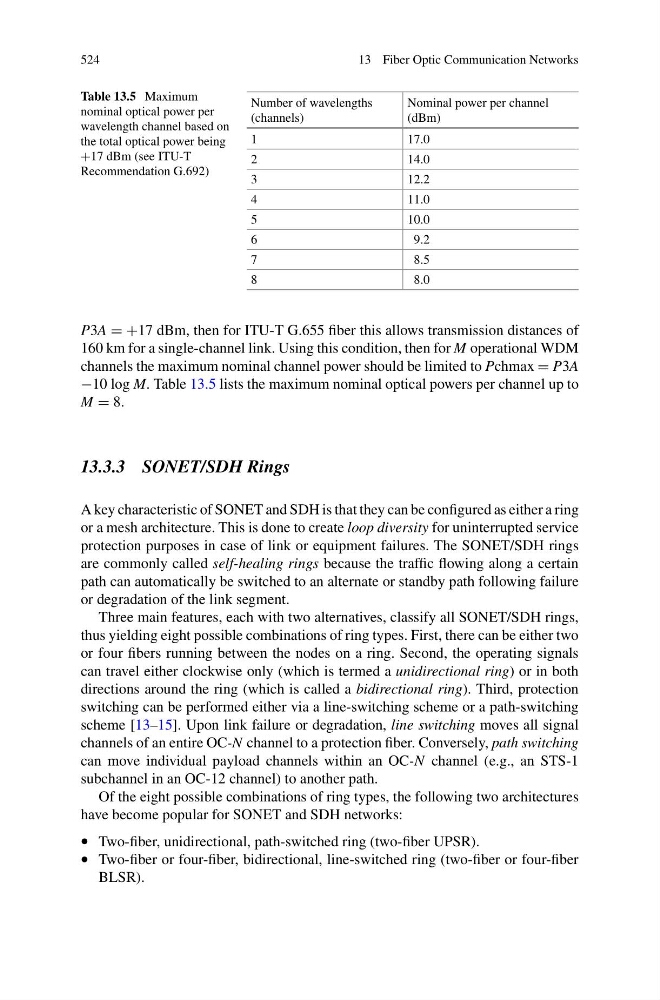
Table 13.5 Maximum
nominal optical power per
wavelength channel based on
the total optical power being
+17 dBm (see ITU-T
Recommendation G.692)
Number of wavelengths
(channels)
Nominal power per channel
(dBm)
1
17.0
2
14.0
3
12.2
4
11.0
5
10.0
6
9.2
7
8.5
8
8.0
P3A = +17 dBm, then for ITU-T G.655 fiber this allows transmission distances of
160 km for a single-channel link. Using this condition, then for M operational WDM
channels the maximum nominal channel power should be limited to Pchmax = P3A
−10 log M. Table 13.5 lists the maximum nominal optical powers per channel up to
M = 8.
13.3.3 SONET/SDH Rings
A key characteristic of SONET and SDH is that they can be configured as either a ring
or a mesh architecture. This is done to create loop diversity for uninterrupted service
protection purposes in case of link or equipment failures. The SONET/SDH rings
are commonly called self-healing rings because the traffic flowing along a certain
path can automatically be switched to an alternate or standby path following failure
or degradation of the link segment.
Three main features, each with two alternatives, classify all SONET/SDH rings,
thus yielding eight possible combinations of ring types. First, there can be either two
or four fibers running between the nodes on a ring. Second, the operating signals
can travel either clockwise only (which is termed a unidirectional ring) or in both
directions around the ring (which is called a bidirectional ring). Third, protection
switching can be performed either via a line-switching scheme or a path-switching
scheme [13–15]. Upon link failure or degradation, line switching moves all signal
channels of an entire OC-N channel to a protection fiber. Conversely, path switching
can move individual payload channels within an OC-N channel (e.g., an STS-1
subchannel in an OC-12 channel) to another path.
Of the eight possible combinations of ring types, the following two architectures
have become popular for SONET and SDH networks:
• Two-fiber, unidirectional, path-switched ring (two-fiber UPSR).
• Two-fiber or four-fiber, bidirectional, line-switched ring (two-fiber or four-fiber
BLSR).
13 Fiber Optic Communication Networks
Table 13.5 Maximum
nominal optical power per
wavelength channel based on
the total optical power being
+17 dBm (see ITU-T
Recommendation G.692)
Number of wavelengths
(channels)
Nominal power per channel
(dBm)
1
17.0
2
14.0
3
12.2
4
11.0
5
10.0
6
9.2
7
8.5
8
8.0
P3A = +17 dBm, then for ITU-T G.655 fiber this allows transmission distances of
160 km for a single-channel link. Using this condition, then for M operational WDM
channels the maximum nominal channel power should be limited to Pchmax = P3A
−10 log M. Table 13.5 lists the maximum nominal optical powers per channel up to
M = 8.
13.3.3 SONET/SDH Rings
A key characteristic of SONET and SDH is that they can be configured as either a ring
or a mesh architecture. This is done to create loop diversity for uninterrupted service
protection purposes in case of link or equipment failures. The SONET/SDH rings
are commonly called self-healing rings because the traffic flowing along a certain
path can automatically be switched to an alternate or standby path following failure
or degradation of the link segment.
Three main features, each with two alternatives, classify all SONET/SDH rings,
thus yielding eight possible combinations of ring types. First, there can be either two
or four fibers running between the nodes on a ring. Second, the operating signals
can travel either clockwise only (which is termed a unidirectional ring) or in both
directions around the ring (which is called a bidirectional ring). Third, protection
switching can be performed either via a line-switching scheme or a path-switching
scheme [13–15]. Upon link failure or degradation, line switching moves all signal
channels of an entire OC-N channel to a protection fiber. Conversely, path switching
can move individual payload channels within an OC-N channel (e.g., an STS-1
subchannel in an OC-12 channel) to another path.
Of the eight possible combinations of ring types, the following two architectures
have become popular for SONET and SDH networks:
• Two-fiber, unidirectional, path-switched ring (two-fiber UPSR).
• Two-fiber or four-fiber, bidirectional, line-switched ring (two-fiber or four-fiber
BLSR).