

13.3 Basic SONET/SDH Concepts
521
called the synchronous payload envelope (SPE) and carries user data plus nine bytes
of path overhead (POH). The POH supports performance monitoring by the end
equipment, status, signal labeling, a tracing function, and a user channel. The nine
path-overhead bytes are always in a column and can be located anywhere in the SPE.
An important point to note is that the synchronous byte-interleaved multiplexing in
SONET/SDH (unlike the asynchronous bit interleaving used in earlier TDM standards) facilitates add/drop multiplexing of individual information channels in optical
networks.
For values of N greater than 1, the columns of the frame become N times wider,
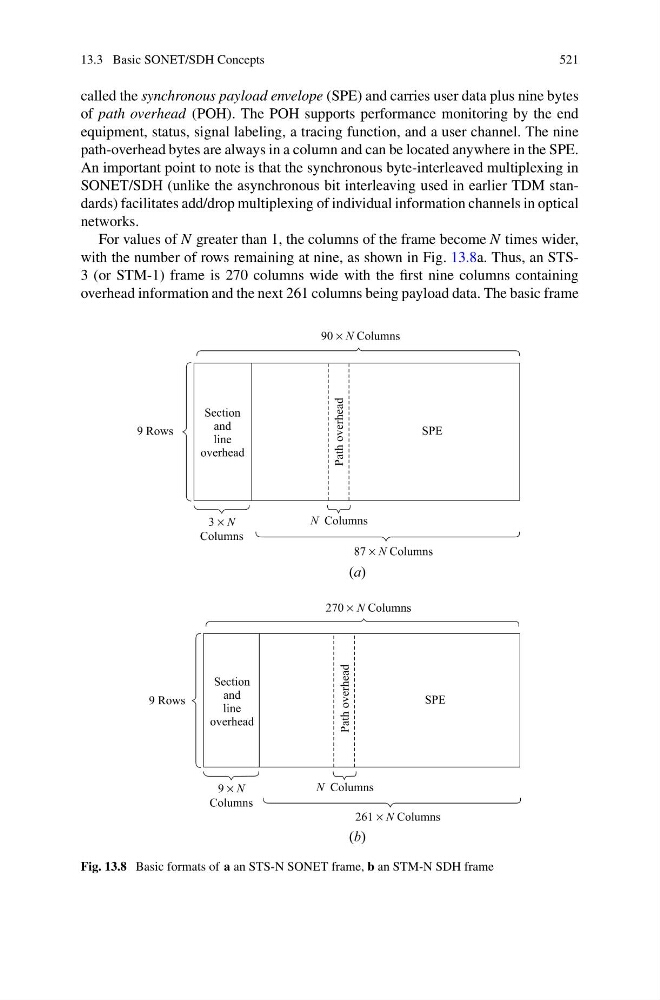
with the number of rows remaining at nine, as shown in Fig. 13.8a. Thus, an STS3 (or STM-1) frame is 270 columns wide with the first nine columns containing
overhead information and the next 261 columns being payload data. The basic frame
Fig. 13.8 Basic formats of a an STS-N SONET frame, b an STM-N SDH frame
521
called the synchronous payload envelope (SPE) and carries user data plus nine bytes
of path overhead (POH). The POH supports performance monitoring by the end
equipment, status, signal labeling, a tracing function, and a user channel. The nine
path-overhead bytes are always in a column and can be located anywhere in the SPE.
An important point to note is that the synchronous byte-interleaved multiplexing in
SONET/SDH (unlike the asynchronous bit interleaving used in earlier TDM standards) facilitates add/drop multiplexing of individual information channels in optical
networks.
For values of N greater than 1, the columns of the frame become N times wider,
with the number of rows remaining at nine, as shown in Fig. 13.8a. Thus, an STS3 (or STM-1) frame is 270 columns wide with the first nine columns containing
overhead information and the next 261 columns being payload data. The basic frame
Fig. 13.8 Basic formats of a an STS-N SONET frame, b an STM-N SDH frame