

520
13 Fiber Optic Communication Networks
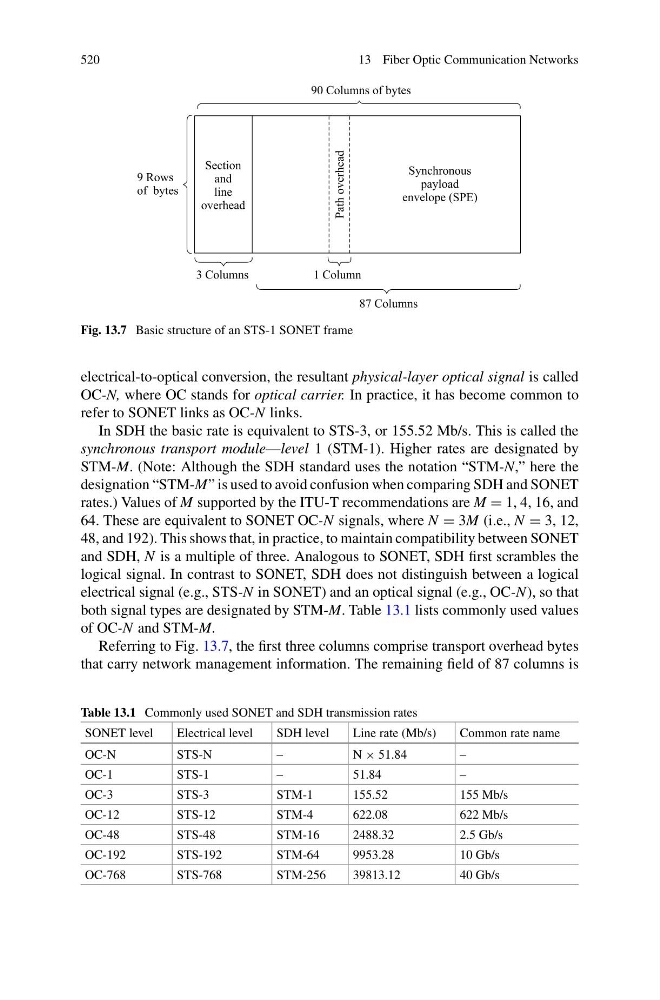
Fig. 13.7 Basic structure of an STS-1 SONET frame
electrical-to-optical conversion, the resultant physical-layer optical signal is called
OC-N, where OC stands for optical carrier. In practice, it has become common to
refer to SONET links as OC-N links.
In SDH the basic rate is equivalent to STS-3, or 155.52 Mb/s. This is called the
synchronous transport module—level 1 (STM-1). Higher rates are designated by
STM-M. (Note: Although the SDH standard uses the notation “STM-N,” here the
designation “STM-M” is used to avoid confusion when comparing SDH and SONET
rates.) Values of M supported by the ITU-T recommendations are M = 1, 4, 16, and
64. These are equivalent to SONET OC-N signals, where N = 3M (i.e., N = 3, 12,
48, and 192). This shows that, in practice, to maintain compatibility between SONET
and SDH, N is a multiple of three. Analogous to SONET, SDH first scrambles the
logical signal. In contrast to SONET, SDH does not distinguish between a logical
electrical signal (e.g., STS-N in SONET) and an optical signal (e.g., OC-N), so that
both signal types are designated by STM-M. Table 13.1 lists commonly used values
of OC-N and STM-M.
Referring to Fig. 13.7, the first three columns comprise transport overhead bytes
that carry network management information. The remaining field of 87 columns is
Table 13.1 Commonly used SONET and SDH transmission rates
SONET level
Electrical level
SDH level
Line rate (Mb/s)
Common rate name
OC-N
STS-N
–
N × 51.84
–
OC-1
STS-1
–
51.84
–
OC-3
STS-3
STM-1
155.52
155 Mb/s
OC-12
STS-12
STM-4
622.08
622 Mb/s
OC-48
STS-48
STM-16
2488.32
2.5 Gb/s
OC-192
STS-192
STM-64
9953.28
10 Gb/s
OC-768
STS-768
STM-256
39813.12
40 Gb/s
13 Fiber Optic Communication Networks
Fig. 13.7 Basic structure of an STS-1 SONET frame
electrical-to-optical conversion, the resultant physical-layer optical signal is called
OC-N, where OC stands for optical carrier. In practice, it has become common to
refer to SONET links as OC-N links.
In SDH the basic rate is equivalent to STS-3, or 155.52 Mb/s. This is called the
synchronous transport module—level 1 (STM-1). Higher rates are designated by
STM-M. (Note: Although the SDH standard uses the notation “STM-N,” here the
designation “STM-M” is used to avoid confusion when comparing SDH and SONET
rates.) Values of M supported by the ITU-T recommendations are M = 1, 4, 16, and
64. These are equivalent to SONET OC-N signals, where N = 3M (i.e., N = 3, 12,
48, and 192). This shows that, in practice, to maintain compatibility between SONET
and SDH, N is a multiple of three. Analogous to SONET, SDH first scrambles the
logical signal. In contrast to SONET, SDH does not distinguish between a logical
electrical signal (e.g., STS-N in SONET) and an optical signal (e.g., OC-N), so that
both signal types are designated by STM-M. Table 13.1 lists commonly used values
of OC-N and STM-M.
Referring to Fig. 13.7, the first three columns comprise transport overhead bytes
that carry network management information. The remaining field of 87 columns is
Table 13.1 Commonly used SONET and SDH transmission rates
SONET level
Electrical level
SDH level
Line rate (Mb/s)
Common rate name
OC-N
STS-N
–
N × 51.84
–
OC-1
STS-1
–
51.84
–
OC-3
STS-3
STM-1
155.52
155 Mb/s
OC-12
STS-12
STM-4
622.08
622 Mb/s
OC-48
STS-48
STM-16
2488.32
2.5 Gb/s
OC-192
STS-192
STM-64
9953.28
10 Gb/s
OC-768
STS-768
STM-256
39813.12
40 Gb/s