

12.5 Self-Phase Modulation
487
wavelength. For example, γ = 1.3 W
−1 km
−1 at 1550 nm for a G.652 single-mode
fiber that has an effective area equal to 72 μm
2 . The frequency shift arising from
SPM is given by
=
dϕ
dt
= γ L e f f
d P
dt
(12.8)
Here L eff is the effective length given by Eq. (12.1) and dP/dt is the derivative of the
optical pulse power; that is, it shows that the frequency shift occurs when the optical
pulse power is changing in time.
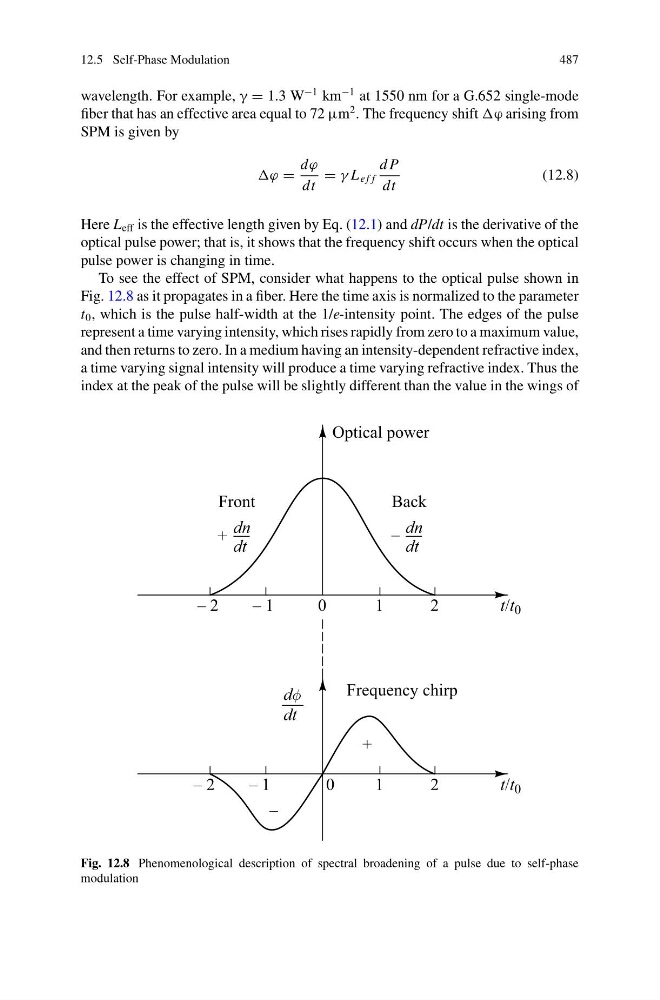
To see the effect of SPM, consider what happens to the optical pulse shown in
Fig. 12.8 as it propagates in a fiber. Here the time axis is normalized to the parameter
t 0 , which is the pulse half-width at the 1/e-intensity point. The edges of the pulse
represent a time varying intensity, which rises rapidly from zero to a maximum value,
and then returns to zero. In a medium having an intensity-dependent refractive index,
a time varying signal intensity will produce a time varying refractive index. Thus the
index at the peak of the pulse will be slightly different than the value in the wings of
Fig. 12.8 Phenomenological description of spectral broadening of a pulse due to self-phase
modulation
487
wavelength. For example, γ = 1.3 W
−1 km
−1 at 1550 nm for a G.652 single-mode
fiber that has an effective area equal to 72 μm
2 . The frequency shift arising from
SPM is given by
=
dϕ
dt
= γ L e f f
d P
dt
(12.8)
Here L eff is the effective length given by Eq. (12.1) and dP/dt is the derivative of the
optical pulse power; that is, it shows that the frequency shift occurs when the optical
pulse power is changing in time.
To see the effect of SPM, consider what happens to the optical pulse shown in
Fig. 12.8 as it propagates in a fiber. Here the time axis is normalized to the parameter
t 0 , which is the pulse half-width at the 1/e-intensity point. The edges of the pulse
represent a time varying intensity, which rises rapidly from zero to a maximum value,
and then returns to zero. In a medium having an intensity-dependent refractive index,
a time varying signal intensity will produce a time varying refractive index. Thus the
index at the peak of the pulse will be slightly different than the value in the wings of
Fig. 12.8 Phenomenological description of spectral broadening of a pulse due to self-phase
modulation