

486
12 Nonlinear Processes in Optical Fibers
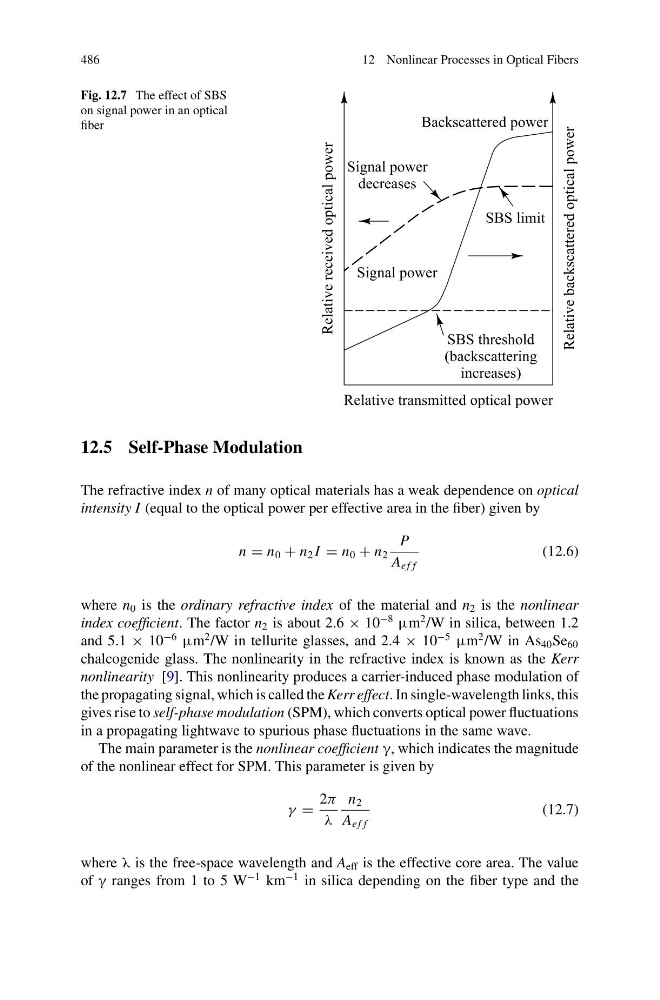
Fig. 12.7 The effect of SBS
on signal power in an optical
fiber
12.5 Self-Phase Modulation
The refractive index n of many optical materials has a weak dependence on optical
intensity I (equal to the optical power per effective area in the fiber) given by
n = n 0 + n 2 I = n 0 + n 2
P
A e f f
(12.6)
where n 0 is the ordinary refractive index of the material and n 2 is the nonlinear
index coefficient. The factor n 2 is about 2.6 × 10
−8
μm
2 /W in silica, between 1.2
and 5.1 × 10
−6
μm
2 /W in tellurite glasses, and 2.4 × 10
−5
μm
2 /W in As 40 Se 60
chalcogenide glass. The nonlinearity in the refractive index is known as the Kerr
nonlinearity [9]. This nonlinearity produces a carrier-induced phase modulation of
the propagating signal, which is called the Kerr effect. In single-wavelength links, this
gives rise to self-phase modulation (SPM), which converts optical power fluctuations
in a propagating lightwave to spurious phase fluctuations in the same wave.
The main parameter is the nonlinear coefficient γ, which indicates the magnitude
of the nonlinear effect for SPM. This parameter is given by
γ =
2π
λ
n 2
A e f f
(12.7)
where λ is the free-space wavelength and A eff is the effective core area. The value
of γ ranges from 1 to 5 W
−1 km
−1 in silica depending on the fiber type and the
12 Nonlinear Processes in Optical Fibers
Fig. 12.7 The effect of SBS
on signal power in an optical
fiber
12.5 Self-Phase Modulation
The refractive index n of many optical materials has a weak dependence on optical
intensity I (equal to the optical power per effective area in the fiber) given by
n = n 0 + n 2 I = n 0 + n 2
P
A e f f
(12.6)
where n 0 is the ordinary refractive index of the material and n 2 is the nonlinear
index coefficient. The factor n 2 is about 2.6 × 10
−8
μm
2 /W in silica, between 1.2
and 5.1 × 10
−6
μm
2 /W in tellurite glasses, and 2.4 × 10
−5
μm
2 /W in As 40 Se 60
chalcogenide glass. The nonlinearity in the refractive index is known as the Kerr
nonlinearity [9]. This nonlinearity produces a carrier-induced phase modulation of
the propagating signal, which is called the Kerr effect. In single-wavelength links, this
gives rise to self-phase modulation (SPM), which converts optical power fluctuations
in a propagating lightwave to spurious phase fluctuations in the same wave.
The main parameter is the nonlinear coefficient γ, which indicates the magnitude
of the nonlinear effect for SPM. This parameter is given by
γ =
2π
λ
n 2
A e f f
(12.7)
where λ is the free-space wavelength and A eff is the effective core area. The value
of γ ranges from 1 to 5 W
−1 km
−1 in silica depending on the fiber type and the