

12.3 Stimulated Raman Scattering
481
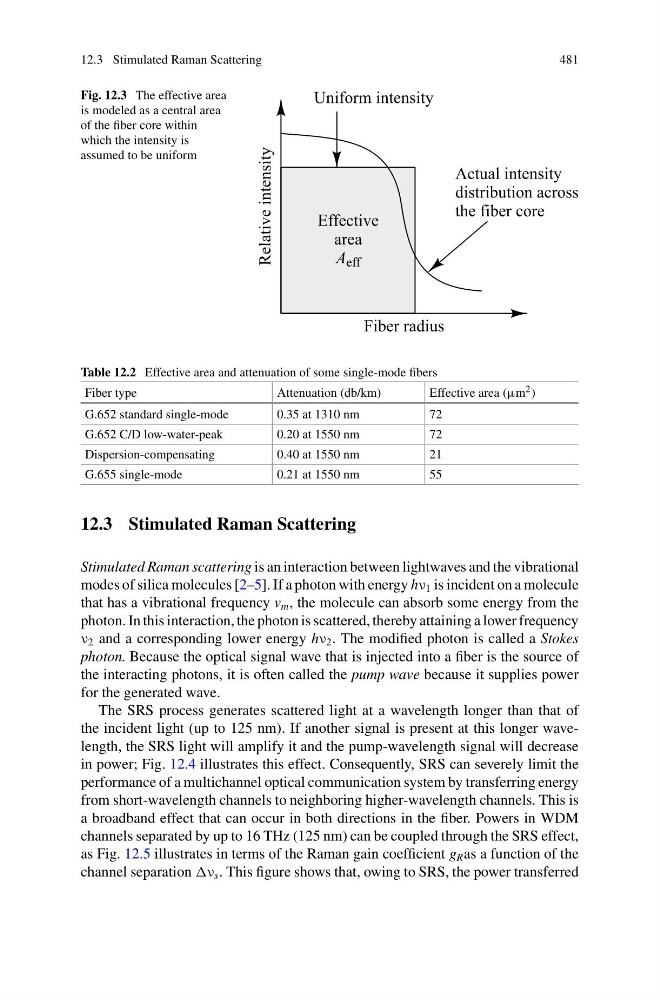
Fig. 12.3 The effective area
is modeled as a central area
of the fiber core within
which the intensity is
assumed to be uniform
Table 12.2 Effective area and attenuation of some single-mode fibers
Fiber type
Attenuation (db/km)
Effective area (μm 2 )
G.652 standard single-mode
0.35 at 1310 nm
72
G.652 C/D low-water-peak
0.20 at 1550 nm
72
Dispersion-compensating
0.40 at 1550 nm
21
G.655 single-mode
0.21 at 1550 nm
55
12.3 Stimulated Raman Scattering
Stimulated Raman scattering is an interaction between lightwaves and the vibrational
modes of silica molecules [2–5]. If a photon with energy hν 1 is incident on a molecule
that has a vibrational frequency v m , the molecule can absorb some energy from the
photon. In this interaction, the photon is scattered, thereby attaining a lower frequency
ν 2 and a corresponding lower energy hν 2 . The modified photon is called a Stokes
photon. Because the optical signal wave that is injected into a fiber is the source of
the interacting photons, it is often called the pump wave because it supplies power
for the generated wave.
The SRS process generates scattered light at a wavelength longer than that of
the incident light (up to 125 nm). If another signal is present at this longer wavelength, the SRS light will amplify it and the pump-wavelength signal will decrease
in power; Fig. 12.4 illustrates this effect. Consequently, SRS can severely limit the
performance of a multichannel optical communication system by transferring energy
from short-wavelength channels to neighboring higher-wavelength channels. This is
a broadband effect that can occur in both directions in the fiber. Powers in WDM
channels separated by up to 16 THz (125 nm) can be coupled through the SRS effect,
as Fig. 12.5 illustrates in terms of the Raman gain coefficient g R as a function of the
channel separation s . This figure shows that, owing to SRS, the power transferred
481
Fig. 12.3 The effective area
is modeled as a central area
of the fiber core within
which the intensity is
assumed to be uniform
Table 12.2 Effective area and attenuation of some single-mode fibers
Fiber type
Attenuation (db/km)
Effective area (μm 2 )
G.652 standard single-mode
0.35 at 1310 nm
72
G.652 C/D low-water-peak
0.20 at 1550 nm
72
Dispersion-compensating
0.40 at 1550 nm
21
G.655 single-mode
0.21 at 1550 nm
55
12.3 Stimulated Raman Scattering
Stimulated Raman scattering is an interaction between lightwaves and the vibrational
modes of silica molecules [2–5]. If a photon with energy hν 1 is incident on a molecule
that has a vibrational frequency v m , the molecule can absorb some energy from the
photon. In this interaction, the photon is scattered, thereby attaining a lower frequency
ν 2 and a corresponding lower energy hν 2 . The modified photon is called a Stokes
photon. Because the optical signal wave that is injected into a fiber is the source of
the interacting photons, it is often called the pump wave because it supplies power
for the generated wave.
The SRS process generates scattered light at a wavelength longer than that of
the incident light (up to 125 nm). If another signal is present at this longer wavelength, the SRS light will amplify it and the pump-wavelength signal will decrease
in power; Fig. 12.4 illustrates this effect. Consequently, SRS can severely limit the
performance of a multichannel optical communication system by transferring energy
from short-wavelength channels to neighboring higher-wavelength channels. This is
a broadband effect that can occur in both directions in the fiber. Powers in WDM
channels separated by up to 16 THz (125 nm) can be coupled through the SRS effect,
as Fig. 12.5 illustrates in terms of the Raman gain coefficient g R as a function of the
channel separation s . This figure shows that, owing to SRS, the power transferred