

472
11 Basics of Optical Amplifiers
(a) Find the amplifier gain.
(b) What is the minimum pump power that is required?
11.7 .
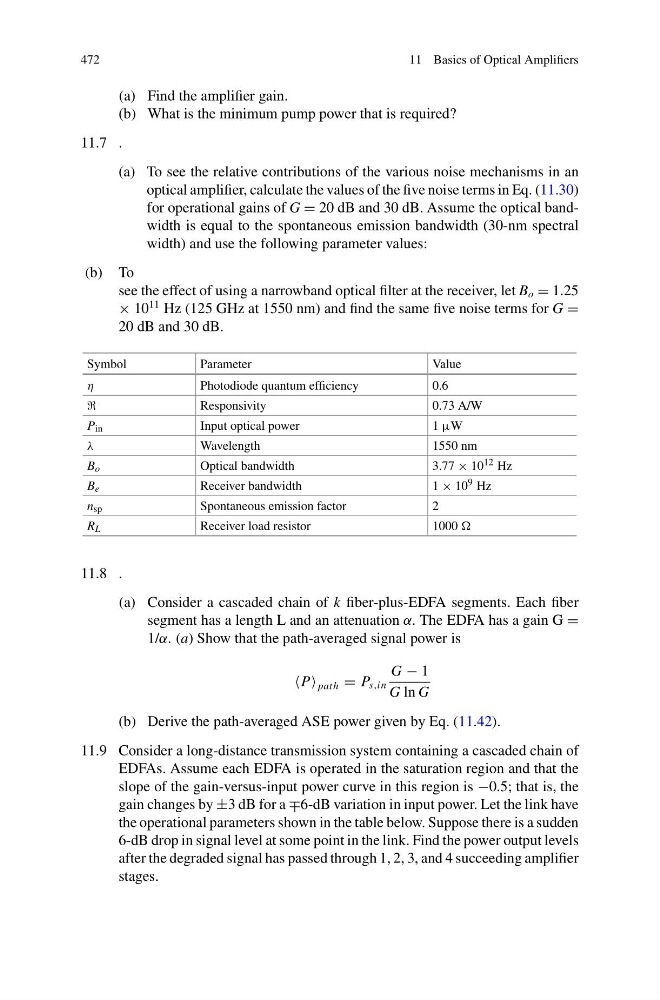
(a) To see the relative contributions of the various noise mechanisms in an
optical amplifier, calculate the values of the five noise terms in Eq. (11.30)
for operational gains of G = 20 dB and 30 dB. Assume the optical bandwidth is equal to the spontaneous emission bandwidth (30-nm spectral
width) and use the following parameter values:
(b) To
see the effect of using a narrowband optical filter at the receiver, let B o = 1.25
× 10
11 Hz (125 GHz at 1550 nm) and find the same five noise terms for G =
20 dB and 30 dB.
Symbol
Parameter
Value
η
Photodiode quantum efficiency
0.6
Responsivity
0.73 A/W
P in
Input optical power
1 μW
λ
Wavelength
1550 nm
B o
Optical bandwidth
3.77 × 10 12 Hz
B e
Receiver bandwidth
1 × 10 9 Hz
n sp
Spontaneous emission factor
2
R L
Receiver load resistor
1000
11.8 .
(a) Consider a cascaded chain of k fiber-plus-EDFA segments. Each fiber
segment has a length L and an attenuation α. The EDFA has a gain G =
1/α. (a) Show that the path-averaged signal power is
P path = P s,in
G − 1
G ln G
(b) Derive the path-averaged ASE power given by Eq. (11.42).
11.9 Consider a long-distance transmission system containing a cascaded chain of
EDFAs. Assume each EDFA is operated in the saturation region and that the
slope of the gain-versus-input power curve in this region is −0.5; that is, the
gain changes by ±3 dB for a ∓6-dB variation in input power. Let the link have
the operational parameters shown in the table below. Suppose there is a sudden
6-dB drop in signal level at some point in the link. Find the power output levels
after the degraded signal has passed through 1, 2, 3, and 4 succeeding amplifier
stages.
11 Basics of Optical Amplifiers
(a) Find the amplifier gain.
(b) What is the minimum pump power that is required?
11.7 .
(a) To see the relative contributions of the various noise mechanisms in an
optical amplifier, calculate the values of the five noise terms in Eq. (11.30)
for operational gains of G = 20 dB and 30 dB. Assume the optical bandwidth is equal to the spontaneous emission bandwidth (30-nm spectral
width) and use the following parameter values:
(b) To
see the effect of using a narrowband optical filter at the receiver, let B o = 1.25
× 10
11 Hz (125 GHz at 1550 nm) and find the same five noise terms for G =
20 dB and 30 dB.
Symbol
Parameter
Value
η
Photodiode quantum efficiency
0.6
Responsivity
0.73 A/W
P in
Input optical power
1 μW
λ
Wavelength
1550 nm
B o
Optical bandwidth
3.77 × 10 12 Hz
B e
Receiver bandwidth
1 × 10 9 Hz
n sp
Spontaneous emission factor
2
R L
Receiver load resistor
1000
11.8 .
(a) Consider a cascaded chain of k fiber-plus-EDFA segments. Each fiber
segment has a length L and an attenuation α. The EDFA has a gain G =
1/α. (a) Show that the path-averaged signal power is
P path = P s,in
G − 1
G ln G
(b) Derive the path-averaged ASE power given by Eq. (11.42).
11.9 Consider a long-distance transmission system containing a cascaded chain of
EDFAs. Assume each EDFA is operated in the saturation region and that the
slope of the gain-versus-input power curve in this region is −0.5; that is, the
gain changes by ±3 dB for a ∓6-dB variation in input power. Let the link have
the operational parameters shown in the table below. Suppose there is a sudden
6-dB drop in signal level at some point in the link. Find the power output levels
after the degraded signal has passed through 1, 2, 3, and 4 succeeding amplifier
stages.