

11.10 Summary
471
Raman amplifier application, optical power from one or more Raman pump lasers
is inserted into the end of the transmission fiber toward the transmitting end. This
process converts the final 20–40 km of the transmission fiber into a preamplifier.
Problems
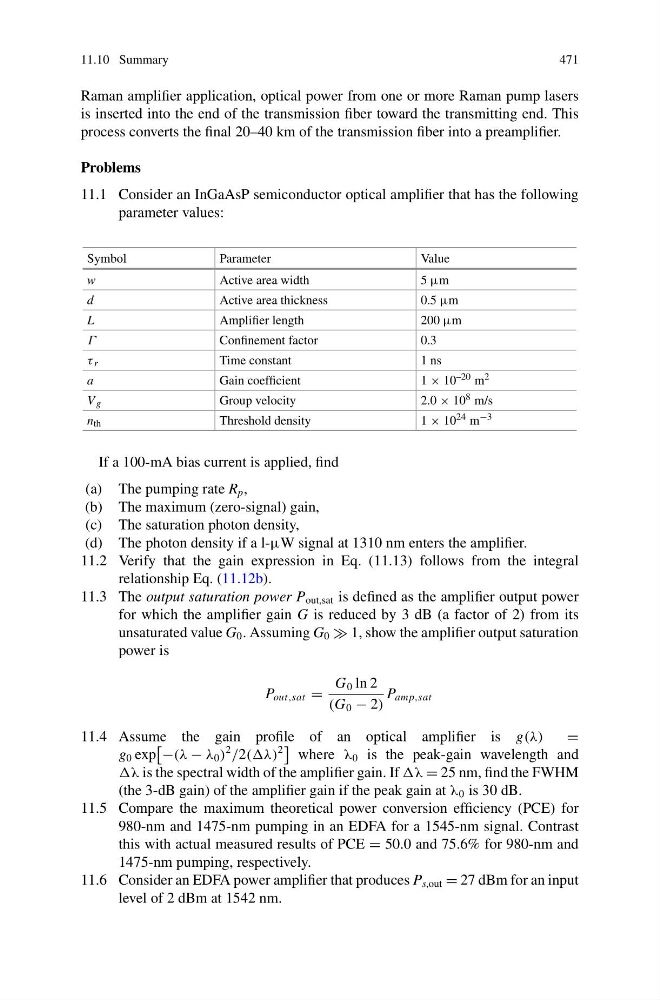
11.1 Consider an InGaAsP semiconductor optical amplifier that has the following
parameter values:
Symbol
Parameter
Value
w
Active area width
5 μm
d
Active area thickness
0.5 μm
L
Amplifier length
200 μm
Γ
Confinement factor
0.3
τ r
Time constant
1 ns
a
Gain coefficient
1 × 10 –20 m 2
V g
Group velocity
2.0 × 10 8 m/s
n th
Threshold density
1 × 10 24 m −3
If a 100-mA bias current is applied, find
(a) The pumping rate R p ,
(b) The maximum (zero-signal) gain,
(c) The saturation photon density,
(d) The photon density if a l-μW signal at 1310 nm enters the amplifier.
11.2 Verify that the gain expression in Eq. (11.13) follows from the integral
relationship Eq. (11.12b).
11.3 The output saturation power P out,sat is defined as the amplifier output power
for which the amplifier gain G is reduced by 3 dB (a factor of 2) from its
unsaturated value G 0 . Assuming G 0 1, show the amplifier output saturation
power is
P out,sat =
G 0 ln 2
(G 0 − 2)
P amp,sat
11.4 Assume the gain profile of an optical amplifier is g(λ)
=
g 0 exp
−(λ − λ 0 )
2
/2(λ)
2
where λ 0 is the peak-gain wavelength and
λ is the spectral width of the amplifier gain. If λ = 25 nm, find the FWHM
(the 3-dB gain) of the amplifier gain if the peak gain at λ 0 is 30 dB.
11.5 Compare the maximum theoretical power conversion efficiency (PCE) for
980-nm and 1475-nm pumping in an EDFA for a 1545-nm signal. Contrast
this with actual measured results of PCE = 50.0 and 75.6% for 980-nm and
1475-nm pumping, respectively.
11.6 Consider an EDFA power amplifier that produces P s,out = 27 dBm for an input
level of 2 dBm at 1542 nm.
471
Raman amplifier application, optical power from one or more Raman pump lasers
is inserted into the end of the transmission fiber toward the transmitting end. This
process converts the final 20–40 km of the transmission fiber into a preamplifier.
Problems
11.1 Consider an InGaAsP semiconductor optical amplifier that has the following
parameter values:
Symbol
Parameter
Value
w
Active area width
5 μm
d
Active area thickness
0.5 μm
L
Amplifier length
200 μm
Γ
Confinement factor
0.3
τ r
Time constant
1 ns
a
Gain coefficient
1 × 10 –20 m 2
V g
Group velocity
2.0 × 10 8 m/s
n th
Threshold density
1 × 10 24 m −3
If a 100-mA bias current is applied, find
(a) The pumping rate R p ,
(b) The maximum (zero-signal) gain,
(c) The saturation photon density,
(d) The photon density if a l-μW signal at 1310 nm enters the amplifier.
11.2 Verify that the gain expression in Eq. (11.13) follows from the integral
relationship Eq. (11.12b).
11.3 The output saturation power P out,sat is defined as the amplifier output power
for which the amplifier gain G is reduced by 3 dB (a factor of 2) from its
unsaturated value G 0 . Assuming G 0 1, show the amplifier output saturation
power is
P out,sat =
G 0 ln 2
(G 0 − 2)
P amp,sat
11.4 Assume the gain profile of an optical amplifier is g(λ)
=
g 0 exp
−(λ − λ 0 )
2
/2(λ)
2
where λ 0 is the peak-gain wavelength and
λ is the spectral width of the amplifier gain. If λ = 25 nm, find the FWHM
(the 3-dB gain) of the amplifier gain if the peak gain at λ 0 is 30 dB.
11.5 Compare the maximum theoretical power conversion efficiency (PCE) for
980-nm and 1475-nm pumping in an EDFA for a 1545-nm signal. Contrast
this with actual measured results of PCE = 50.0 and 75.6% for 980-nm and
1475-nm pumping, respectively.
11.6 Consider an EDFA power amplifier that produces P s,out = 27 dBm for an input
level of 2 dBm at 1542 nm.