

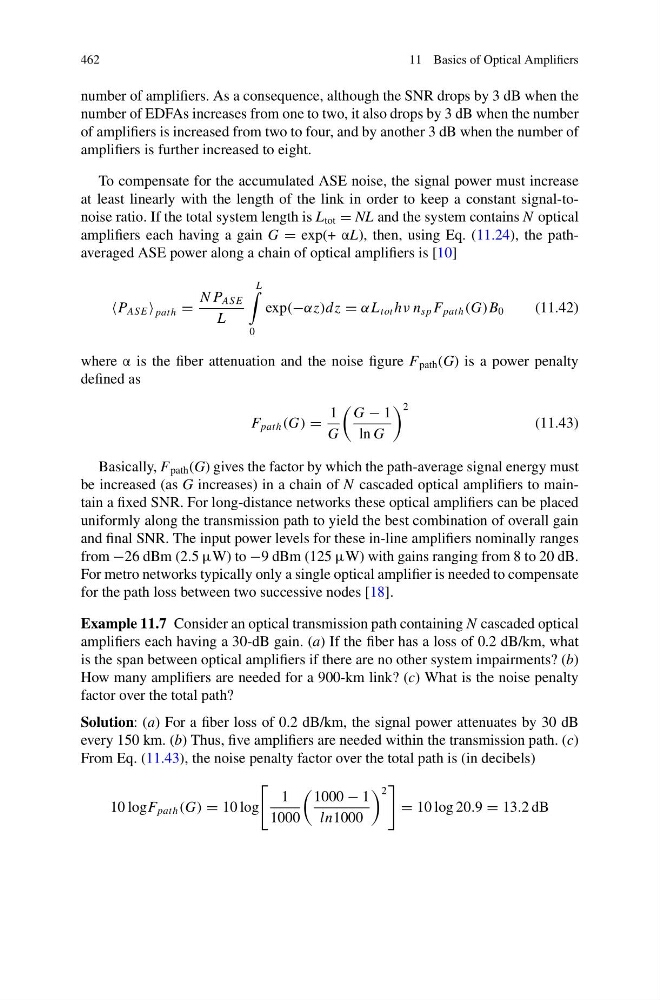
462
11 Basics of Optical Amplifiers
number of amplifiers. As a consequence, although the SNR drops by 3 dB when the
number of EDFAs increases from one to two, it also drops by 3 dB when the number
of amplifiers is increased from two to four, and by another 3 dB when the number of
amplifiers is further increased to eight.
To compensate for the accumulated ASE noise, the signal power must increase
at least linearly with the length of the link in order to keep a constant signal-tonoise ratio. If the total system length is L tot = NL and the system contains N optical
amplifiers each having a gain G = exp(+ αL), then, using Eq. (11.24), the pathaveraged ASE power along a chain of optical amplifiers is [10]
P AS E path =
N P AS E
L
L
0
exp(−αz)dz = αL tot hν n sp F path (G)B 0
(11.42)
where α is the fiber attenuation and the noise figure F path (G) is a power penalty
defined as
F path (G) =
1
G
G − 1
ln G
2
(11.43)
Basically, F path (G) gives the factor by which the path-average signal energy must
be increased (as G increases) in a chain of N cascaded optical amplifiers to maintain a fixed SNR. For long-distance networks these optical amplifiers can be placed
uniformly along the transmission path to yield the best combination of overall gain
and final SNR. The input power levels for these in-line amplifiers nominally ranges
from −26 dBm (2.5 μW) to −9 dBm (125 μW) with gains ranging from 8 to 20 dB.
For metro networks typically only a single optical amplifier is needed to compensate
for the path loss between two successive nodes [18].
Example 11.7 Consider an optical transmission path containing N cascaded optical
amplifiers each having a 30-dB gain. (a) If the fiber has a loss of 0.2 dB/km, what
is the span between optical amplifiers if there are no other system impairments? (b)
How many amplifiers are needed for a 900-km link? (c) What is the noise penalty
factor over the total path?
Solution: (a) For a fiber loss of 0.2 dB/km, the signal power attenuates by 30 dB
every 150 km. (b) Thus, five amplifiers are needed within the transmission path. (c)
From Eq. (11.43), the noise penalty factor over the total path is (in decibels)
10 logF path (G) = 10 log
1
1000
1000 − 1
ln1000
2
= 10 log 20.9 = 13.2 dB
11 Basics of Optical Amplifiers
number of amplifiers. As a consequence, although the SNR drops by 3 dB when the
number of EDFAs increases from one to two, it also drops by 3 dB when the number
of amplifiers is increased from two to four, and by another 3 dB when the number of
amplifiers is further increased to eight.
To compensate for the accumulated ASE noise, the signal power must increase
at least linearly with the length of the link in order to keep a constant signal-tonoise ratio. If the total system length is L tot = NL and the system contains N optical
amplifiers each having a gain G = exp(+ αL), then, using Eq. (11.24), the pathaveraged ASE power along a chain of optical amplifiers is [10]
P AS E path =
N P AS E
L
L
0
exp(−αz)dz = αL tot hν n sp F path (G)B 0
(11.42)
where α is the fiber attenuation and the noise figure F path (G) is a power penalty
defined as
F path (G) =
1
G
G − 1
ln G
2
(11.43)
Basically, F path (G) gives the factor by which the path-average signal energy must
be increased (as G increases) in a chain of N cascaded optical amplifiers to maintain a fixed SNR. For long-distance networks these optical amplifiers can be placed
uniformly along the transmission path to yield the best combination of overall gain
and final SNR. The input power levels for these in-line amplifiers nominally ranges
from −26 dBm (2.5 μW) to −9 dBm (125 μW) with gains ranging from 8 to 20 dB.
For metro networks typically only a single optical amplifier is needed to compensate
for the path loss between two successive nodes [18].
Example 11.7 Consider an optical transmission path containing N cascaded optical
amplifiers each having a 30-dB gain. (a) If the fiber has a loss of 0.2 dB/km, what
is the span between optical amplifiers if there are no other system impairments? (b)
How many amplifiers are needed for a 900-km link? (c) What is the noise penalty
factor over the total path?
Solution: (a) For a fiber loss of 0.2 dB/km, the signal power attenuates by 30 dB
every 150 km. (b) Thus, five amplifiers are needed within the transmission path. (c)
From Eq. (11.43), the noise penalty factor over the total path is (in decibels)
10 logF path (G) = 10 log
1
1000
1000 − 1
ln1000
2
= 10 log 20.9 = 13.2 dB