

452
11 Basics of Optical Amplifiers
opposite direction to the signal flow, which is known as counterdirectional pumping.
As shown in Fig. 11.6, one can employ either a single pump source or use dual-pump
schemes, with the resultant gains typically being +17 dB and +35 dB, respectively.
Counter-directional pumping allows higher gains, but codirectional pumping gives
better noise performance. In addition, pumping at 980 nm is preferred, because
it produces less noise and achieves larger population inversions than pumping at
1480 nm.
11.3.3 EDFA Power-Conversion Efficiency and Gain
As is the case with any amplifier, as the magnitude of the output signal from an EDFA
increases, the amplifier gain eventually starts to saturate. The reduction of gain in
an EDFA occurs when the population inversion is reduced significantly by a large
signal, thereby yielding the typical gain-versus-power performance curve shown in
Fig. 11.3.
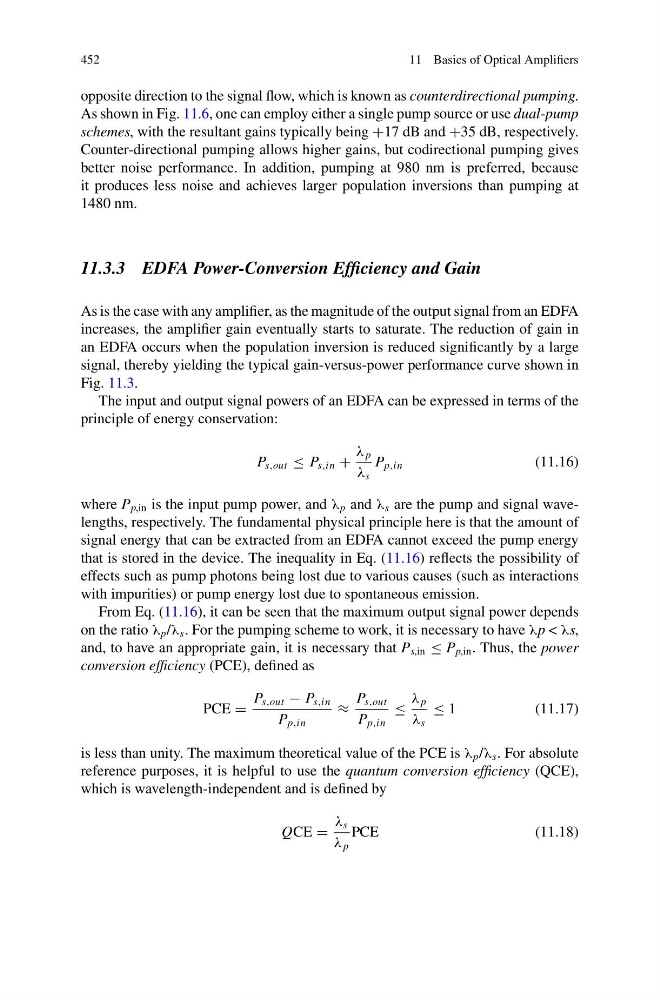
The input and output signal powers of an EDFA can be expressed in terms of the
principle of energy conservation:
P s,out ≤ P s,in +
λ p
λ s
P p,in
(11.16)
where P p,in is the input pump power, and λ p and λ s are the pump and signal wavelengths, respectively. The fundamental physical principle here is that the amount of
signal energy that can be extracted from an EDFA cannot exceed the pump energy
that is stored in the device. The inequality in Eq. (11.16) reflects the possibility of
effects such as pump photons being lost due to various causes (such as interactions
with impurities) or pump energy lost due to spontaneous emission.
From Eq. (11.16), it can be seen that the maximum output signal power depends
on the ratio λ p /λ s . For the pumping scheme to work, it is necessary to have λp < λs,
and, to have an appropriate gain, it is necessary that P s,in ≤ P p,in . Thus, the power
conversion efficiency (PCE), defined as
PCE =
P s,out − P s,in
P p,in
≈
P s,out
P p,in
≤
λ p
λ s
≤ 1
(11.17)
is less than unity. The maximum theoretical value of the PCE is λ p /λ s . For absolute
reference purposes, it is helpful to use the quantum conversion efficiency (QCE),
which is wavelength-independent and is defined by
QCE =
λ s
λ p
PCE
(11.18)
11 Basics of Optical Amplifiers
opposite direction to the signal flow, which is known as counterdirectional pumping.
As shown in Fig. 11.6, one can employ either a single pump source or use dual-pump
schemes, with the resultant gains typically being +17 dB and +35 dB, respectively.
Counter-directional pumping allows higher gains, but codirectional pumping gives
better noise performance. In addition, pumping at 980 nm is preferred, because
it produces less noise and achieves larger population inversions than pumping at
1480 nm.
11.3.3 EDFA Power-Conversion Efficiency and Gain
As is the case with any amplifier, as the magnitude of the output signal from an EDFA
increases, the amplifier gain eventually starts to saturate. The reduction of gain in
an EDFA occurs when the population inversion is reduced significantly by a large
signal, thereby yielding the typical gain-versus-power performance curve shown in
Fig. 11.3.
The input and output signal powers of an EDFA can be expressed in terms of the
principle of energy conservation:
P s,out ≤ P s,in +
λ p
λ s
P p,in
(11.16)
where P p,in is the input pump power, and λ p and λ s are the pump and signal wavelengths, respectively. The fundamental physical principle here is that the amount of
signal energy that can be extracted from an EDFA cannot exceed the pump energy
that is stored in the device. The inequality in Eq. (11.16) reflects the possibility of
effects such as pump photons being lost due to various causes (such as interactions
with impurities) or pump energy lost due to spontaneous emission.
From Eq. (11.16), it can be seen that the maximum output signal power depends
on the ratio λ p /λ s . For the pumping scheme to work, it is necessary to have λp < λs,
and, to have an appropriate gain, it is necessary that P s,in ≤ P p,in . Thus, the power
conversion efficiency (PCE), defined as
PCE =
P s,out − P s,in
P p,in
≈
P s,out
P p,in
≤
λ p
λ s
≤ 1
(11.17)
is less than unity. The maximum theoretical value of the PCE is λ p /λ s . For absolute
reference purposes, it is helpful to use the quantum conversion efficiency (QCE),
which is wavelength-independent and is defined by
QCE =
λ s
λ p
PCE
(11.18)