

11.2 Semiconductor Optical Amplifiers
443
is the external pumping rate from the injection current density J(t) into an active layer
of thickness d, τ r is the combined time constant coming from spontaneous emission
and carrier-recombination mechanisms, and
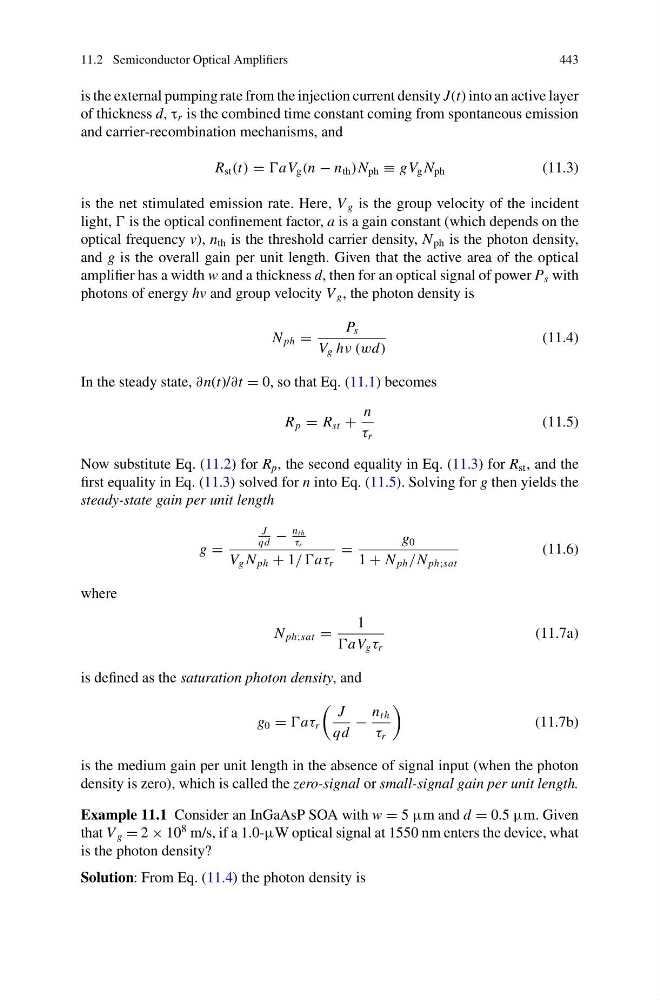
R st (t) = aV g (n − n th )N ph ≡ gV g N ph
(11.3)
is the net stimulated emission rate. Here, V g is the group velocity of the incident
light, is the optical confinement factor, a is a gain constant (which depends on the
optical frequency v), n th is the threshold carrier density, N ph is the photon density,
and g is the overall gain per unit length. Given that the active area of the optical
amplifier has a width w and a thickness d, then for an optical signal of power P s with
photons of energy hv and group velocity V g , the photon density is
N ph =
P s
V g hν (wd)
(11.4)
In the steady state, ∂n(t)/∂t = 0, so that Eq. (11.1) becomes
R p = R st +
n
τ r
(11.5)
Now substitute Eq. (11.2) for R p , the second equality in Eq. (11.3) for R st , and the
first equality in Eq. (11.3) solved for n into Eq. (11.5). Solving for g then yields the
steady-state gain per unit length
g =
J
qd
−
n th
τ r
V g N ph + 1/ /aτ r
=
g 0
1 + N ph /N ph;sat
(11.6)
where
N ph;sat =
1
aV g τ r
(11.7a)
is defined as the saturation photon density, and
g 0 = aτ r
J
qd
−
n th
τ r
(11.7b)
is the medium gain per unit length in the absence of signal input (when the photon
density is zero), which is called the zero-signal or small-signal gain per unit length.
Example 11.1 Consider an InGaAsP SOA with w = 5 μm and d = 0.5 μm. Given
that V g = 2 × 10
8 m/s, if a 1.0-μW optical signal at 1550 nm enters the device, what
is the photon density?
Solution: From Eq. (11.4) the photon density is
443
is the external pumping rate from the injection current density J(t) into an active layer
of thickness d, τ r is the combined time constant coming from spontaneous emission
and carrier-recombination mechanisms, and
R st (t) = aV g (n − n th )N ph ≡ gV g N ph
(11.3)
is the net stimulated emission rate. Here, V g is the group velocity of the incident
light, is the optical confinement factor, a is a gain constant (which depends on the
optical frequency v), n th is the threshold carrier density, N ph is the photon density,
and g is the overall gain per unit length. Given that the active area of the optical
amplifier has a width w and a thickness d, then for an optical signal of power P s with
photons of energy hv and group velocity V g , the photon density is
N ph =
P s
V g hν (wd)
(11.4)
In the steady state, ∂n(t)/∂t = 0, so that Eq. (11.1) becomes
R p = R st +
n
τ r
(11.5)
Now substitute Eq. (11.2) for R p , the second equality in Eq. (11.3) for R st , and the
first equality in Eq. (11.3) solved for n into Eq. (11.5). Solving for g then yields the
steady-state gain per unit length
g =
J
qd
−
n th
τ r
V g N ph + 1/ /aτ r
=
g 0
1 + N ph /N ph;sat
(11.6)
where
N ph;sat =
1
aV g τ r
(11.7a)
is defined as the saturation photon density, and
g 0 = aτ r
J
qd
−
n th
τ r
(11.7b)
is the medium gain per unit length in the absence of signal input (when the photon
density is zero), which is called the zero-signal or small-signal gain per unit length.
Example 11.1 Consider an InGaAsP SOA with w = 5 μm and d = 0.5 μm. Given
that V g = 2 × 10
8 m/s, if a 1.0-μW optical signal at 1550 nm enters the device, what
is the photon density?
Solution: From Eq. (11.4) the photon density is