

432
10 Wavelength Division Multiplexing (WDM)
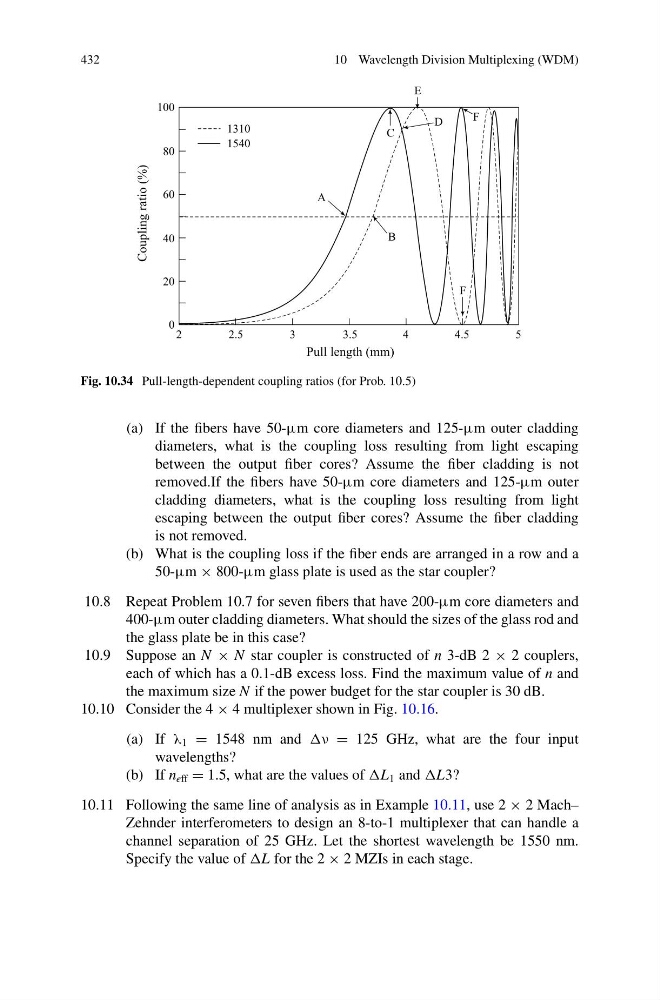
Fig. 10.34 Pull-length-dependent coupling ratios (for Prob. 10.5)
(a) If the fibers have 50-μm core diameters and 125-μm outer cladding
diameters, what is the coupling loss resulting from light escaping
between the output fiber cores? Assume the fiber cladding is not
removed.If the fibers have 50-μm core diameters and 125-μm outer
cladding diameters, what is the coupling loss resulting from light
escaping between the output fiber cores? Assume the fiber cladding
is not removed.
(b) What is the coupling loss if the fiber ends are arranged in a row and a
50-μm × 800-μm glass plate is used as the star coupler?
10.8 Repeat Problem 10.7 for seven fibers that have 200-μm core diameters and
400-μm outer cladding diameters. What should the sizes of the glass rod and
the glass plate be in this case?
10.9 Suppose an N × N star coupler is constructed of n 3-dB 2 × 2 couplers,
each of which has a 0.1-dB excess loss. Find the maximum value of n and
the maximum size N if the power budget for the star coupler is 30 dB.
10.10 Consider the 4 × 4 multiplexer shown in Fig. 10.16.
(a) If λ 1 = 1548 nm and = 125 GHz, what are the four input
wavelengths?
(b) If n eff = 1.5, what are the values of 1 and
10.11 Following the same line of analysis as in Example 10.11, use 2 × 2 Mach–
Zehnder interferometers to design an 8-to-1 multiplexer that can handle a
channel separation of 25 GHz. Let the shortest wavelength be 1550 nm.
Specify the value of for the 2 × 2 MZIs in each stage.
10 Wavelength Division Multiplexing (WDM)
Fig. 10.34 Pull-length-dependent coupling ratios (for Prob. 10.5)
(a) If the fibers have 50-μm core diameters and 125-μm outer cladding
diameters, what is the coupling loss resulting from light escaping
between the output fiber cores? Assume the fiber cladding is not
removed.If the fibers have 50-μm core diameters and 125-μm outer
cladding diameters, what is the coupling loss resulting from light
escaping between the output fiber cores? Assume the fiber cladding
is not removed.
(b) What is the coupling loss if the fiber ends are arranged in a row and a
50-μm × 800-μm glass plate is used as the star coupler?
10.8 Repeat Problem 10.7 for seven fibers that have 200-μm core diameters and
400-μm outer cladding diameters. What should the sizes of the glass rod and
the glass plate be in this case?
10.9 Suppose an N × N star coupler is constructed of n 3-dB 2 × 2 couplers,
each of which has a 0.1-dB excess loss. Find the maximum value of n and
the maximum size N if the power budget for the star coupler is 30 dB.
10.10 Consider the 4 × 4 multiplexer shown in Fig. 10.16.
(a) If λ 1 = 1548 nm and = 125 GHz, what are the four input
wavelengths?
(b) If n eff = 1.5, what are the values of 1 and
10.11 Following the same line of analysis as in Example 10.11, use 2 × 2 Mach–
Zehnder interferometers to design an 8-to-1 multiplexer that can handle a
channel separation of 25 GHz. Let the shortest wavelength be 1550 nm.
Specify the value of for the 2 × 2 MZIs in each stage.