

414
10 Wavelength Division Multiplexing (WDM)
light. This means that one can induce a change in the refractive index of the core by
exposing it to ultraviolet radiation such as 244 nm.
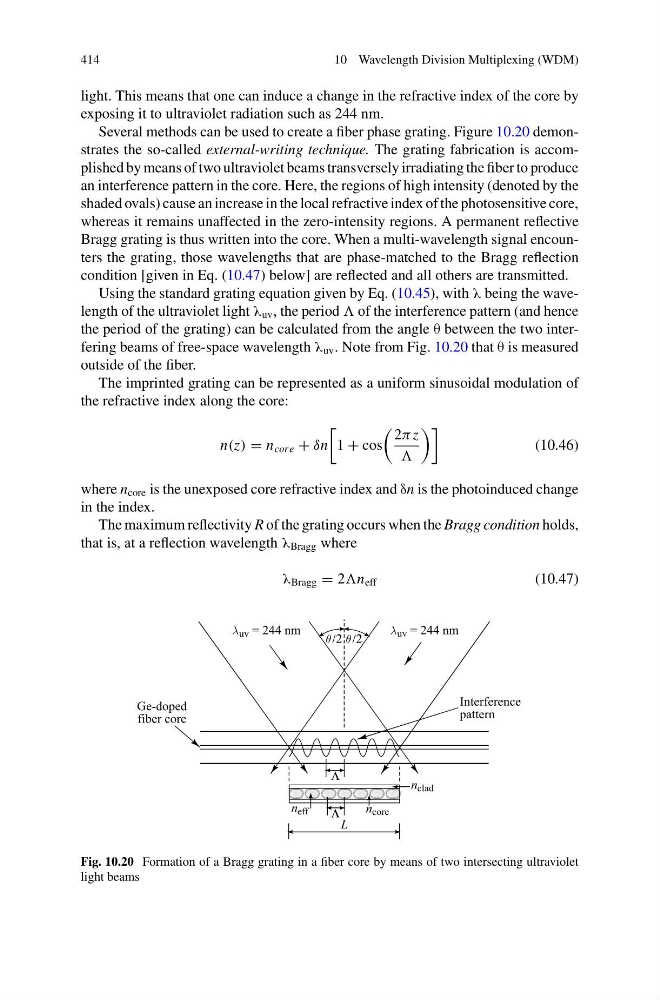
Several methods can be used to create a fiber phase grating. Figure 10.20 demonstrates the so-called external-writing technique. The grating fabrication is accomplished by means of two ultraviolet beams transversely irradiating the fiber to produce
an interference pattern in the core. Here, the regions of high intensity (denoted by the
shaded ovals) cause an increase in the local refractive index of the photosensitive core,
whereas it remains unaffected in the zero-intensity regions. A permanent reflective
Bragg grating is thus written into the core. When a multi-wavelength signal encounters the grating, those wavelengths that are phase-matched to the Bragg reflection
condition [given in Eq. (10.47) below] are reflected and all others are transmitted.
Using the standard grating equation given by Eq. (10.45), with λ being the wavelength of the ultraviolet light λ uv , the period of the interference pattern (and hence
the period of the grating) can be calculated from the angle θ between the two interfering beams of free-space wavelength λ uv . Note from Fig. 10.20 that θ is measured
outside of the fiber.
The imprinted grating can be represented as a uniform sinusoidal modulation of
the refractive index along the core:
n(z) = n core + δn
1 + cos
2π z
(10.46)
where n core is the unexposed core refractive index and δn is the photoinduced change
in the index.
The maximum reflectivity R of the grating occurs when the Bragg condition holds,
that is, at a reflection wavelength λ Bragg where
λ Bragg = 2 eff
(10.47)
Fig. 10.20 Formation of a Bragg grating in a fiber core by means of two intersecting ultraviolet
light beams
10 Wavelength Division Multiplexing (WDM)
light. This means that one can induce a change in the refractive index of the core by
exposing it to ultraviolet radiation such as 244 nm.
Several methods can be used to create a fiber phase grating. Figure 10.20 demonstrates the so-called external-writing technique. The grating fabrication is accomplished by means of two ultraviolet beams transversely irradiating the fiber to produce
an interference pattern in the core. Here, the regions of high intensity (denoted by the
shaded ovals) cause an increase in the local refractive index of the photosensitive core,
whereas it remains unaffected in the zero-intensity regions. A permanent reflective
Bragg grating is thus written into the core. When a multi-wavelength signal encounters the grating, those wavelengths that are phase-matched to the Bragg reflection
condition [given in Eq. (10.47) below] are reflected and all others are transmitted.
Using the standard grating equation given by Eq. (10.45), with λ being the wavelength of the ultraviolet light λ uv , the period of the interference pattern (and hence
the period of the grating) can be calculated from the angle θ between the two interfering beams of free-space wavelength λ uv . Note from Fig. 10.20 that θ is measured
outside of the fiber.
The imprinted grating can be represented as a uniform sinusoidal modulation of
the refractive index along the core:
n(z) = n core + δn
1 + cos
2π z
(10.46)
where n core is the unexposed core refractive index and δn is the photoinduced change
in the index.
The maximum reflectivity R of the grating occurs when the Bragg condition holds,
that is, at a reflection wavelength λ Bragg where
λ Bragg = 2 eff
(10.47)
Fig. 10.20 Formation of a Bragg grating in a fiber core by means of two intersecting ultraviolet
light beams