

10.4 WDM Devices Based on Grating Principles
413
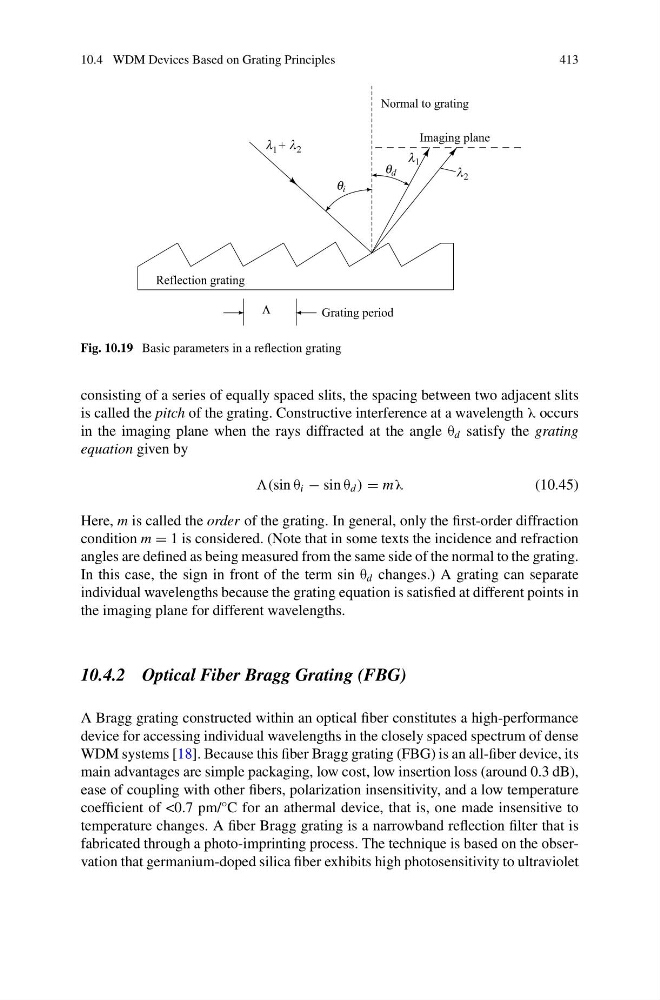
Fig. 10.19 Basic parameters in a reflection grating
consisting of a series of equally spaced slits, the spacing between two adjacent slits
is called the pitch of the grating. Constructive interference at a wavelength λ occurs
in the imaging plane when the rays diffracted at the angle θ d satisfy the grating
equation given by
(sin θ i − sin θ d ) = mλ
(10.45)
Here, m is called the order of the grating. In general, only the first-order diffraction
condition m = 1 is considered. (Note that in some texts the incidence and refraction
angles are defined as being measured from the same side of the normal to the grating.
In this case, the sign in front of the term sin θ d changes.) A grating can separate
individual wavelengths because the grating equation is satisfied at different points in
the imaging plane for different wavelengths.
10.4.2 Optical Fiber Bragg Grating (FBG)
A Bragg grating constructed within an optical fiber constitutes a high-performance
device for accessing individual wavelengths in the closely spaced spectrum of dense
WDM systems [18]. Because this fiber Bragg grating (FBG) is an all-fiber device, its
main advantages are simple packaging, low cost, low insertion loss (around 0.3 dB),
ease of coupling with other fibers, polarization insensitivity, and a low temperature
coefficient of <0.7 pm/°C for an athermal device, that is, one made insensitive to
temperature changes. A fiber Bragg grating is a narrowband reflection filter that is
fabricated through a photo-imprinting process. The technique is based on the observation that germanium-doped silica fiber exhibits high photosensitivity to ultraviolet
413
Fig. 10.19 Basic parameters in a reflection grating
consisting of a series of equally spaced slits, the spacing between two adjacent slits
is called the pitch of the grating. Constructive interference at a wavelength λ occurs
in the imaging plane when the rays diffracted at the angle θ d satisfy the grating
equation given by
(sin θ i − sin θ d ) = mλ
(10.45)
Here, m is called the order of the grating. In general, only the first-order diffraction
condition m = 1 is considered. (Note that in some texts the incidence and refraction
angles are defined as being measured from the same side of the normal to the grating.
In this case, the sign in front of the term sin θ d changes.) A grating can separate
individual wavelengths because the grating equation is satisfied at different points in
the imaging plane for different wavelengths.
10.4.2 Optical Fiber Bragg Grating (FBG)
A Bragg grating constructed within an optical fiber constitutes a high-performance
device for accessing individual wavelengths in the closely spaced spectrum of dense
WDM systems [18]. Because this fiber Bragg grating (FBG) is an all-fiber device, its
main advantages are simple packaging, low cost, low insertion loss (around 0.3 dB),
ease of coupling with other fibers, polarization insensitivity, and a low temperature
coefficient of <0.7 pm/°C for an athermal device, that is, one made insensitive to
temperature changes. A fiber Bragg grating is a narrowband reflection filter that is
fabricated through a photo-imprinting process. The technique is based on the observation that germanium-doped silica fiber exhibits high photosensitivity to ultraviolet