

386
10 Wavelength Division Multiplexing (WDM)
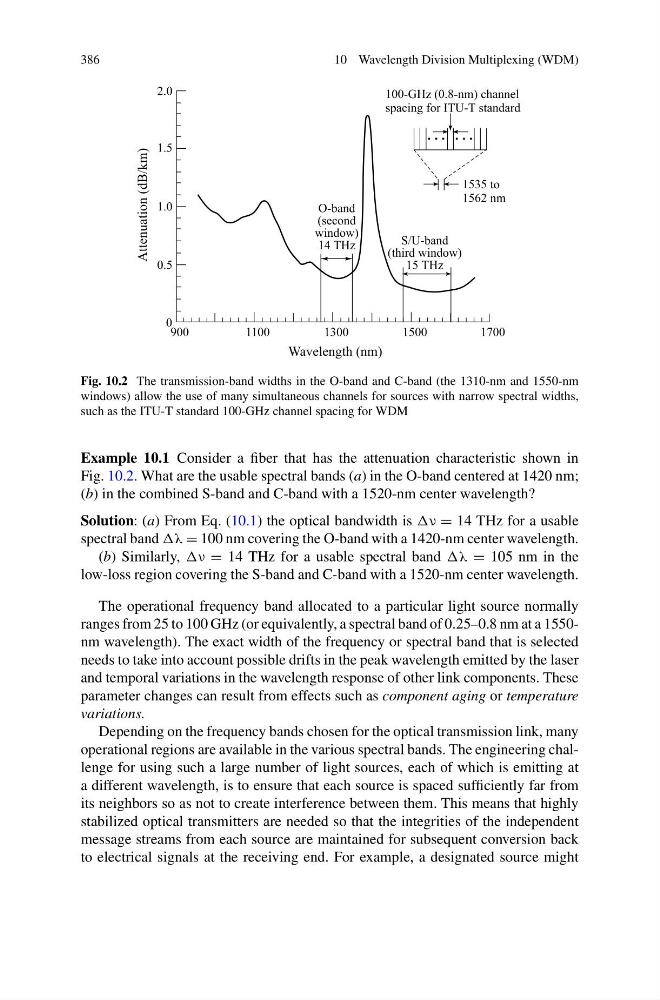
Fig. 10.2 The transmission-band widths in the O-band and C-band (the 1310-nm and 1550-nm
windows) allow the use of many simultaneous channels for sources with narrow spectral widths,
such as the ITU-T standard 100-GHz channel spacing for WDM
Example 10.1 Consider a fiber that has the attenuation characteristic shown in
Fig. 10.2. What are the usable spectral bands (a) in the O-band centered at 1420 nm;
(b) in the combined S-band and C-band with a 1520-nm center wavelength?
Solution: (a) From Eq. (10.1) the optical bandwidth is = 14 THz for a usable
spectral band = 100 nm covering the O-band with a 1420-nm center wavelength.
(b) Similarly, = 14 THz for a usable spectral band = 105 nm in the
low-loss region covering the S-band and C-band with a 1520-nm center wavelength.
The operational frequency band allocated to a particular light source normally
ranges from 25 to 100 GHz (or equivalently, a spectral band of 0.25–0.8 nm at a 1550nm wavelength). The exact width of the frequency or spectral band that is selected
needs to take into account possible drifts in the peak wavelength emitted by the laser
and temporal variations in the wavelength response of other link components. These
parameter changes can result from effects such as component aging or temperature
variations.
Depending on the frequency bands chosen for the optical transmission link, many
operational regions are available in the various spectral bands. The engineering challenge for using such a large number of light sources, each of which is emitting at
a different wavelength, is to ensure that each source is spaced sufficiently far from
its neighbors so as not to create interference between them. This means that highly
stabilized optical transmitters are needed so that the integrities of the independent
message streams from each source are maintained for subsequent conversion back
to electrical signals at the receiving end. For example, a designated source might
10 Wavelength Division Multiplexing (WDM)
Fig. 10.2 The transmission-band widths in the O-band and C-band (the 1310-nm and 1550-nm
windows) allow the use of many simultaneous channels for sources with narrow spectral widths,
such as the ITU-T standard 100-GHz channel spacing for WDM
Example 10.1 Consider a fiber that has the attenuation characteristic shown in
Fig. 10.2. What are the usable spectral bands (a) in the O-band centered at 1420 nm;
(b) in the combined S-band and C-band with a 1520-nm center wavelength?
Solution: (a) From Eq. (10.1) the optical bandwidth is = 14 THz for a usable
spectral band = 100 nm covering the O-band with a 1420-nm center wavelength.
(b) Similarly, = 14 THz for a usable spectral band = 105 nm in the
low-loss region covering the S-band and C-band with a 1520-nm center wavelength.
The operational frequency band allocated to a particular light source normally
ranges from 25 to 100 GHz (or equivalently, a spectral band of 0.25–0.8 nm at a 1550nm wavelength). The exact width of the frequency or spectral band that is selected
needs to take into account possible drifts in the peak wavelength emitted by the laser
and temporal variations in the wavelength response of other link components. These
parameter changes can result from effects such as component aging or temperature
variations.
Depending on the frequency bands chosen for the optical transmission link, many
operational regions are available in the various spectral bands. The engineering challenge for using such a large number of light sources, each of which is emitting at
a different wavelength, is to ensure that each source is spaced sufficiently far from
its neighbors so as not to create interference between them. This means that highly
stabilized optical transmitters are needed so that the integrities of the independent
message streams from each source are maintained for subsequent conversion back
to electrical signals at the receiving end. For example, a designated source might