

9.4 Spurious-Free Dynamic Range
375
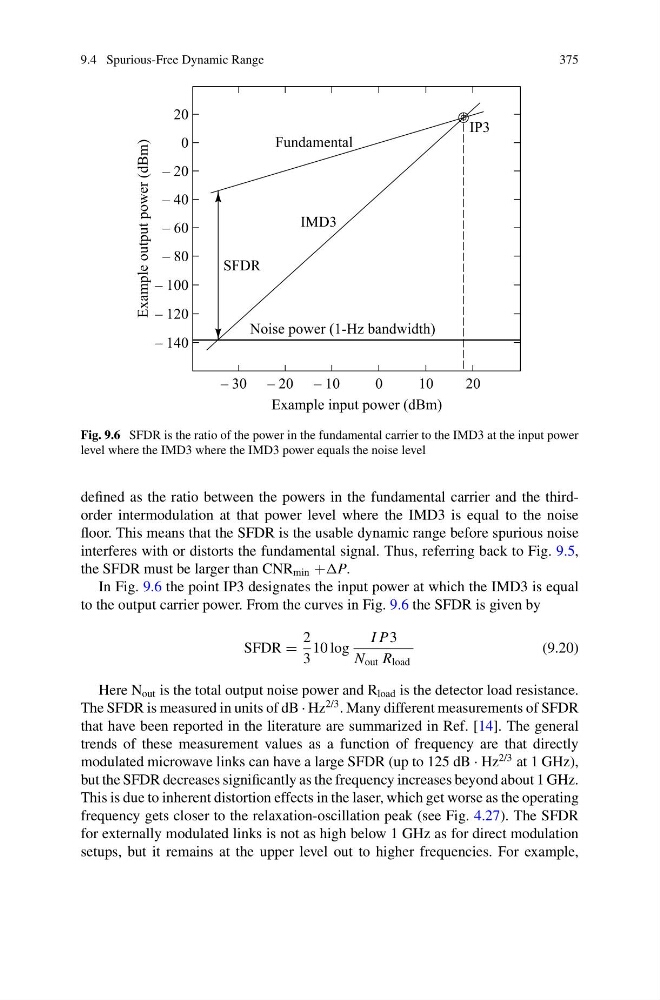
Fig. 9.6 SFDR is the ratio of the power in the fundamental carrier to the IMD3 at the input power
level where the IMD3 where the IMD3 power equals the noise level
defined as the ratio between the powers in the fundamental carrier and the thirdorder intermodulation at that power level where the IMD3 is equal to the noise
floor. This means that the SFDR is the usable dynamic range before spurious noise
interferes with or distorts the fundamental signal. Thus, referring back to Fig. 9.5,
the SFDR must be larger than CNR min +
In Fig. 9.6 the point IP3 designates the input power at which the IMD3 is equal
to the output carrier power. From the curves in Fig. 9.6 the SFDR is given by
SFDR =
2
3
10 log
I P3
N out R load
(9.20)
Here N out is the total output noise power and R load is the detector load resistance.
The SFDR is measured in units of dB · Hz
2/3 . Many different measurements of SFDR
that have been reported in the literature are summarized in Ref. [14]. The general
trends of these measurement values as a function of frequency are that directly
modulated microwave links can have a large SFDR (up to 125 dB · Hz
2/3 at 1 GHz),
but the SFDR decreases significantly as the frequency increases beyond about 1 GHz.
This is due to inherent distortion effects in the laser, which get worse as the operating
frequency gets closer to the relaxation-oscillation peak (see Fig. 4.27). The SFDR
for externally modulated links is not as high below 1 GHz as for direct modulation
setups, but it remains at the upper level out to higher frequencies. For example,
375
Fig. 9.6 SFDR is the ratio of the power in the fundamental carrier to the IMD3 at the input power
level where the IMD3 where the IMD3 power equals the noise level
defined as the ratio between the powers in the fundamental carrier and the thirdorder intermodulation at that power level where the IMD3 is equal to the noise
floor. This means that the SFDR is the usable dynamic range before spurious noise
interferes with or distorts the fundamental signal. Thus, referring back to Fig. 9.5,
the SFDR must be larger than CNR min +
In Fig. 9.6 the point IP3 designates the input power at which the IMD3 is equal
to the output carrier power. From the curves in Fig. 9.6 the SFDR is given by
SFDR =
2
3
10 log
I P3
N out R load
(9.20)
Here N out is the total output noise power and R load is the detector load resistance.
The SFDR is measured in units of dB · Hz
2/3 . Many different measurements of SFDR
that have been reported in the literature are summarized in Ref. [14]. The general
trends of these measurement values as a function of frequency are that directly
modulated microwave links can have a large SFDR (up to 125 dB · Hz
2/3 at 1 GHz),
but the SFDR decreases significantly as the frequency increases beyond about 1 GHz.
This is due to inherent distortion effects in the laser, which get worse as the operating
frequency gets closer to the relaxation-oscillation peak (see Fig. 4.27). The SFDR
for externally modulated links is not as high below 1 GHz as for direct modulation
setups, but it remains at the upper level out to higher frequencies. For example,