

374
9 Analog Optical Fiber Channels
9.4 Spurious-Free Dynamic Range
The dynamic range of an analog link is defined in relation to two-tone third-order
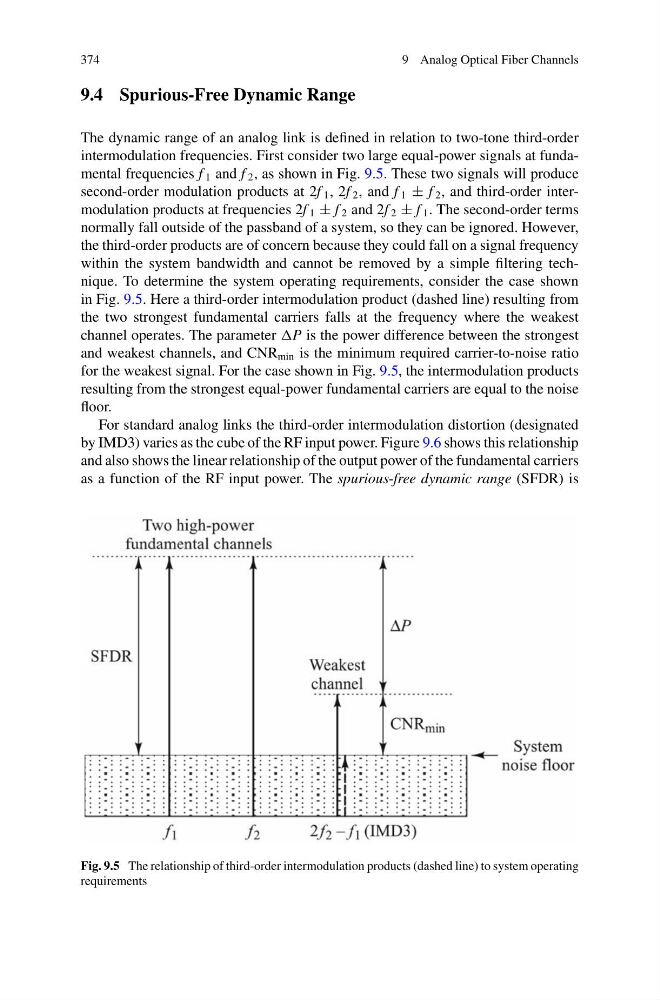
intermodulation frequencies. First consider two large equal-power signals at fundamental frequencies f 1 and f 2 , as shown in Fig. 9.5. These two signals will produce
second-order modulation products at 2f 1 , 2f 2 , and f 1 ± f 2 , and third-order intermodulation products at frequencies 2f 1 ± f 2 and 2f 2 ± f 1 . The second-order terms
normally fall outside of the passband of a system, so they can be ignored. However,
the third-order products are of concern because they could fall on a signal frequency
within the system bandwidth and cannot be removed by a simple filtering technique. To determine the system operating requirements, consider the case shown
in Fig. 9.5. Here a third-order intermodulation product (dashed line) resulting from
the two strongest fundamental carriers falls at the frequency where the weakest
channel operates. The parameter P is the power difference between the strongest
and weakest channels, and CNR min is the minimum required carrier-to-noise ratio
for the weakest signal. For the case shown in Fig. 9.5, the intermodulation products
resulting from the strongest equal-power fundamental carriers are equal to the noise
floor.
For standard analog links the third-order intermodulation distortion (designated
by IMD3) varies as the cube of the RF input power. Figure 9.6 shows this relationship
and also shows the linear relationship of the output power of the fundamental carriers
as a function of the RF input power. The spurious-free dynamic range (SFDR) is
Fig. 9.5 The relationship of third-order intermodulation products (dashed line) to system operating
requirements
9 Analog Optical Fiber Channels
9.4 Spurious-Free Dynamic Range
The dynamic range of an analog link is defined in relation to two-tone third-order
intermodulation frequencies. First consider two large equal-power signals at fundamental frequencies f 1 and f 2 , as shown in Fig. 9.5. These two signals will produce
second-order modulation products at 2f 1 , 2f 2 , and f 1 ± f 2 , and third-order intermodulation products at frequencies 2f 1 ± f 2 and 2f 2 ± f 1 . The second-order terms
normally fall outside of the passband of a system, so they can be ignored. However,
the third-order products are of concern because they could fall on a signal frequency
within the system bandwidth and cannot be removed by a simple filtering technique. To determine the system operating requirements, consider the case shown
in Fig. 9.5. Here a third-order intermodulation product (dashed line) resulting from
the two strongest fundamental carriers falls at the frequency where the weakest
channel operates. The parameter P is the power difference between the strongest
and weakest channels, and CNR min is the minimum required carrier-to-noise ratio
for the weakest signal. For the case shown in Fig. 9.5, the intermodulation products
resulting from the strongest equal-power fundamental carriers are equal to the noise
floor.
For standard analog links the third-order intermodulation distortion (designated
by IMD3) varies as the cube of the RF input power. Figure 9.6 shows this relationship
and also shows the linear relationship of the output power of the fundamental carriers
as a function of the RF input power. The spurious-free dynamic range (SFDR) is
Fig. 9.5 The relationship of third-order intermodulation products (dashed line) to system operating
requirements