

9.2 Concept of Carrier-to-Noise Ratio
369
Drill Problem 9.2 Consider a single-mode InGaAsP laser that has RIN = −
155 dB/Hz = 3.16 × 10
−16 Hz
−1 . Suppose the laser has an average optical
output power of 2 mW. If the laser output is incident directly on a pin photodetector receiver that has a responsivity of 0.6 A/W and a 100-MHz bandwidth,
(a) show that the rms value of the power fluctuation in a 100-MHz bandwidth
is 3.16 × 10
−7 W and (b) that the rms noise current due to the laser RIN is
2.13 × 10
−7 A.
9.2.4 Limiting C/N Conditions
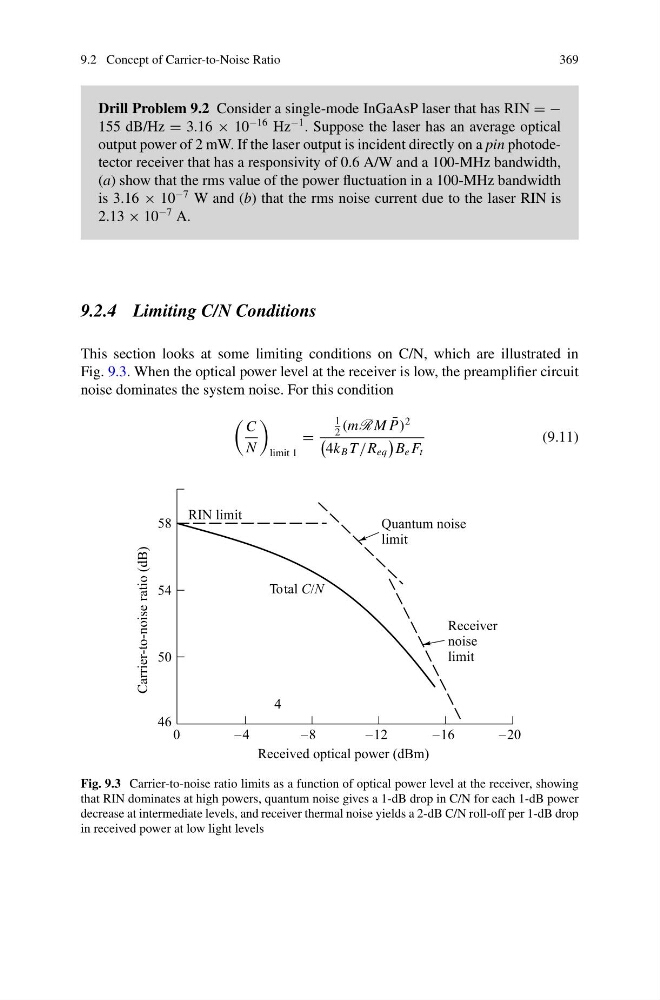
This section looks at some limiting conditions on C/N, which are illustrated in
Fig. 9.3. When the optical power level at the receiver is low, the preamplifier circuit
noise dominates the system noise. For this condition
C
N
limit 1
=
1
2
(mR M ¯
P)
2
4k B T /R eq
B e F t
(9.11)
Fig. 9.3 Carrier-to-noise ratio limits as a function of optical power level at the receiver, showing
that RIN dominates at high powers, quantum noise gives a 1-dB drop in C/N for each 1-dB power
decrease at intermediate levels, and receiver thermal noise yields a 2-dB C/N roll-off per 1-dB drop
in received power at low light levels
369
Drill Problem 9.2 Consider a single-mode InGaAsP laser that has RIN = −
155 dB/Hz = 3.16 × 10
−16 Hz
−1 . Suppose the laser has an average optical
output power of 2 mW. If the laser output is incident directly on a pin photodetector receiver that has a responsivity of 0.6 A/W and a 100-MHz bandwidth,
(a) show that the rms value of the power fluctuation in a 100-MHz bandwidth
is 3.16 × 10
−7 W and (b) that the rms noise current due to the laser RIN is
2.13 × 10
−7 A.
9.2.4 Limiting C/N Conditions
This section looks at some limiting conditions on C/N, which are illustrated in
Fig. 9.3. When the optical power level at the receiver is low, the preamplifier circuit
noise dominates the system noise. For this condition
C
N
limit 1
=
1
2
(mR M ¯
P)
2
4k B T /R eq
B e F t
(9.11)
Fig. 9.3 Carrier-to-noise ratio limits as a function of optical power level at the receiver, showing
that RIN dominates at high powers, quantum noise gives a 1-dB drop in C/N for each 1-dB power
decrease at intermediate levels, and receiver thermal noise yields a 2-dB C/N roll-off per 1-dB drop
in received power at low light levels