

368
9 Analog Optical Fiber Channels
0.1 mW into the fiber and the receiving pin photodiode receiver has a 0.6-A/W
responsivity. (a) Show that for a modulation index m = 0.5, the carrier power
at the receiver output is 1.12 × 10
−10 A
2 . (b) If the receiver is thermal noise
limited, show that the CNR value is 2.40 × 10
3 if the amplifier equivalent load
resistance is 50 with a 1.5-dB noise figure at T = 300°K and the signal is
measured in a 100 MHz bandwidth.
9.2.3 Effects of Relative Intensity Noise (RIN)
Within a semiconductor laser, fluctuations in the amplitude or intensity of the output
produce optical intensity noise. These fluctuations could arise from temperature
variations or from spontaneous emission contained in the laser output. The noise
resulting from the random intensity fluctuations is called relative intensity noise
(RIN), which may be defined in terms of the mean-square intensity variations. The
resultant mean-square noise current is given by
i
2
R I N
= σ
2
R I N = RIN(R M ¯
P)
2 B e
(9.7)
Then, the CNR due to laser amplitude fluctuations only is CNR RIN = C/σ
2
R I N .
Here, the RIN, which is measured in dB/Hz, is defined by the noise-to-signal power
ratio
RIN =
(P L )
2
¯
P
2
L
(9.8)
where
(P L )
2
is the mean-square intensity fluctuation of the laser output and ¯
P L
is the average laser light output power. This noise decreases as the injection current
level increases according to the relationship
RIN ∝
I B
I th
− 1
−3
(9.9)
where I B is the bias current and I th is the threshold current as shown in Fig. 9.2.
Vendor data sheets for 1550-nm DFB lasers typically quote RIN values of −152 to
−158 dB/Hz. Substituting the CNRs resulting from Eq. (9.4) through Eq. (9.7) into
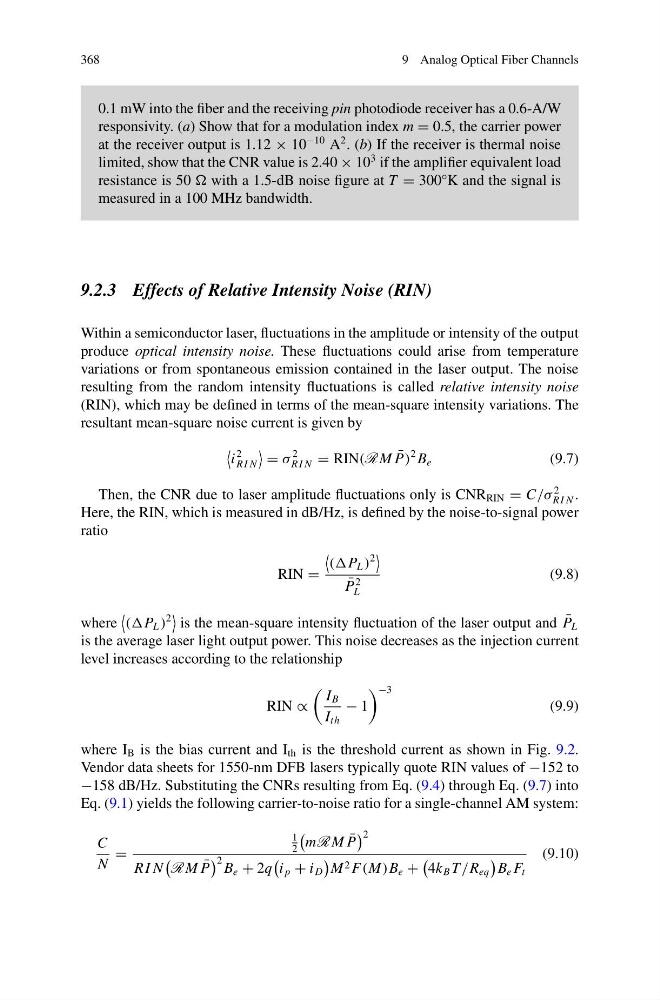
Eq. (9.1) yields the following carrier-to-noise ratio for a single-channel AM system:
C
N
=
1
2
mR M ¯
P
2
R I N
R M ¯
P
2 B e + 2q
i p + i D
M 2 F(M)B e +
4k B T /R eq
B e F t
(9.10)
9 Analog Optical Fiber Channels
0.1 mW into the fiber and the receiving pin photodiode receiver has a 0.6-A/W
responsivity. (a) Show that for a modulation index m = 0.5, the carrier power
at the receiver output is 1.12 × 10
−10 A
2 . (b) If the receiver is thermal noise
limited, show that the CNR value is 2.40 × 10
3 if the amplifier equivalent load
resistance is 50 with a 1.5-dB noise figure at T = 300°K and the signal is
measured in a 100 MHz bandwidth.
9.2.3 Effects of Relative Intensity Noise (RIN)
Within a semiconductor laser, fluctuations in the amplitude or intensity of the output
produce optical intensity noise. These fluctuations could arise from temperature
variations or from spontaneous emission contained in the laser output. The noise
resulting from the random intensity fluctuations is called relative intensity noise
(RIN), which may be defined in terms of the mean-square intensity variations. The
resultant mean-square noise current is given by
i
2
R I N
= σ
2
R I N = RIN(R M ¯
P)
2 B e
(9.7)
Then, the CNR due to laser amplitude fluctuations only is CNR RIN = C/σ
2
R I N .
Here, the RIN, which is measured in dB/Hz, is defined by the noise-to-signal power
ratio
RIN =
(P L )
2
¯
P
2
L
(9.8)
where
(P L )
2
is the mean-square intensity fluctuation of the laser output and ¯
P L
is the average laser light output power. This noise decreases as the injection current
level increases according to the relationship
RIN ∝
I B
I th
− 1
−3
(9.9)
where I B is the bias current and I th is the threshold current as shown in Fig. 9.2.
Vendor data sheets for 1550-nm DFB lasers typically quote RIN values of −152 to
−158 dB/Hz. Substituting the CNRs resulting from Eq. (9.4) through Eq. (9.7) into
Eq. (9.1) yields the following carrier-to-noise ratio for a single-channel AM system:
C
N
=
1
2
mR M ¯
P
2
R I N
R M ¯
P
2 B e + 2q
i p + i D
M 2 F(M)B e +
4k B T /R eq
B e F t
(9.10)