

9.1 Basic Elements of Analog Links
365
method is implemented, one must pay careful attention to signal impairments in
the optical source. These include harmonic distortions, intermodulation products,
relative intensity noise (RIN) in the laser, and laser clipping.
In addition, the frequency dependence of the amplitude, phase, and group delay in
the optical fiber must be taken into account. Thus the fiber should have a flat amplitude
and group-delay response within the passband required to send the signal free of linear
distortion. Because modal-distortion-limited bandwidth is difficult to equalize, it is
best to choose a single-mode fiber. The fiber attenuation is also important, because the
carrier-to-noise performance of the system will change as a function of the received
optical power.
The use of an optical amplifier in the link leads to additional noise, known as
amplified spontaneous emission (ASE), which is described in Chap. 11. In the optical
receiver, the principal impairments are shot noise, APD gain noise, and thermal noise.
9.2 Concept of Carrier-to-Noise Ratio
In analyzing the performance of analog systems, one usually calculates the ratio
of root-mean-square (rms) carrier power to rms noise power at the input of the RF
receiver following the photodetection process. This is known as the carrier-to-noise
ratio (CNR). For digital data, consider the use of frequency-shift keying (FSK). In
this modulation scheme, the amplitude of a sinusoidal carrier remains constant, but
the phase shifts from one frequency to another to represent binary signals. For FSK,
BERs of 10
−9 and 10
−15 translate into CNR values of 36 (15.6 dB) and 64 (18.0 dB),
respectively. The analysis for analog signal quality is more complex compared to
digital signals, because sometimes the signal quality depends on user perception of
images, such as in viewing a television picture. A widely used analog signal is a 525line studio-quality television signal. Using amplitude modulation (AM) for such a
signal requires a CNR of 56 dB, because the need for bandwidth efficiency leads
to a high signal-to-noise ratio. Frequency modulation (FM), on the other hand, only
needs CNR values of 15–18 dB.
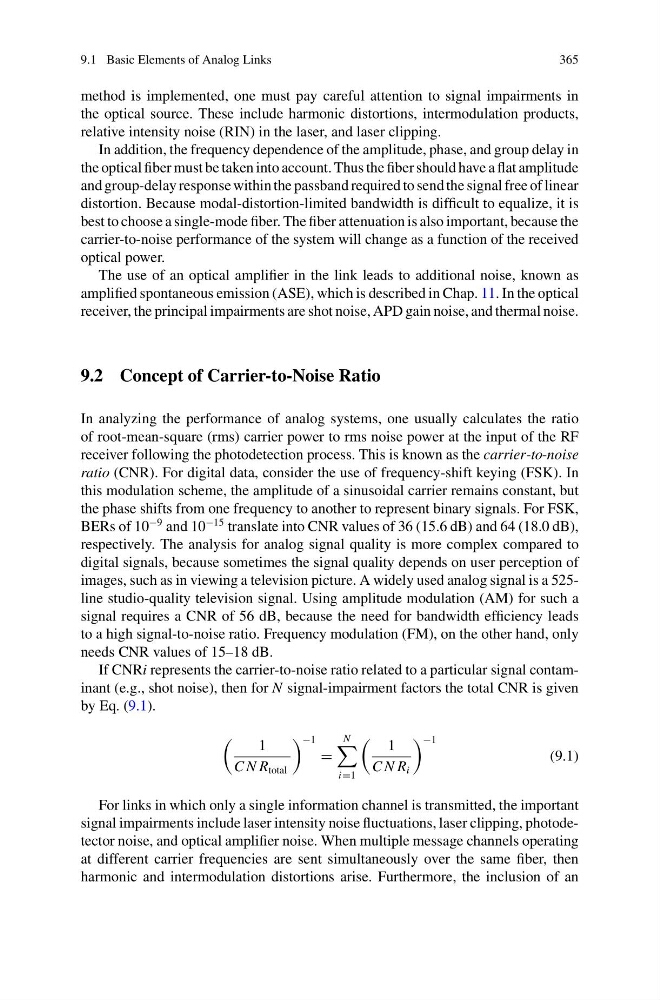
If CNRi represents the carrier-to-noise ratio related to a particular signal contaminant (e.g., shot noise), then for N signal-impairment factors the total CNR is given
by Eq. (9.1).
1
C N R total
−1
=
N
i=1
1
C N R i
−1
(9.1)
For links in which only a single information channel is transmitted, the important
signal impairments include laser intensity noise fluctuations, laser clipping, photodetector noise, and optical amplifier noise. When multiple message channels operating
at different carrier frequencies are sent simultaneously over the same fiber, then
harmonic and intermodulation distortions arise. Furthermore, the inclusion of an
365
method is implemented, one must pay careful attention to signal impairments in
the optical source. These include harmonic distortions, intermodulation products,
relative intensity noise (RIN) in the laser, and laser clipping.
In addition, the frequency dependence of the amplitude, phase, and group delay in
the optical fiber must be taken into account. Thus the fiber should have a flat amplitude
and group-delay response within the passband required to send the signal free of linear
distortion. Because modal-distortion-limited bandwidth is difficult to equalize, it is
best to choose a single-mode fiber. The fiber attenuation is also important, because the
carrier-to-noise performance of the system will change as a function of the received
optical power.
The use of an optical amplifier in the link leads to additional noise, known as
amplified spontaneous emission (ASE), which is described in Chap. 11. In the optical
receiver, the principal impairments are shot noise, APD gain noise, and thermal noise.
9.2 Concept of Carrier-to-Noise Ratio
In analyzing the performance of analog systems, one usually calculates the ratio
of root-mean-square (rms) carrier power to rms noise power at the input of the RF
receiver following the photodetection process. This is known as the carrier-to-noise
ratio (CNR). For digital data, consider the use of frequency-shift keying (FSK). In
this modulation scheme, the amplitude of a sinusoidal carrier remains constant, but
the phase shifts from one frequency to another to represent binary signals. For FSK,
BERs of 10
−9 and 10
−15 translate into CNR values of 36 (15.6 dB) and 64 (18.0 dB),
respectively. The analysis for analog signal quality is more complex compared to
digital signals, because sometimes the signal quality depends on user perception of
images, such as in viewing a television picture. A widely used analog signal is a 525line studio-quality television signal. Using amplitude modulation (AM) for such a
signal requires a CNR of 56 dB, because the need for bandwidth efficiency leads
to a high signal-to-noise ratio. Frequency modulation (FM), on the other hand, only
needs CNR values of 15–18 dB.
If CNRi represents the carrier-to-noise ratio related to a particular signal contaminant (e.g., shot noise), then for N signal-impairment factors the total CNR is given
by Eq. (9.1).
1
C N R total
−1
=
N
i=1
1
C N R i
−1
(9.1)
For links in which only a single information channel is transmitted, the important
signal impairments include laser intensity noise fluctuations, laser clipping, photodetector noise, and optical amplifier noise. When multiple message channels operating
at different carrier frequencies are sent simultaneously over the same fiber, then
harmonic and intermodulation distortions arise. Furthermore, the inclusion of an