

354
8 Digital Optical Fiber Links
8.5.4 Quadrature Amplitude Modulation (QAM)
The PSK concept can be extended to higher-order modulation formats by encoding
m = log 2 M data bits on M states per symbol. This method results in a reduction
of the spectral width and allows upgrading to higher data rates with lower-speed
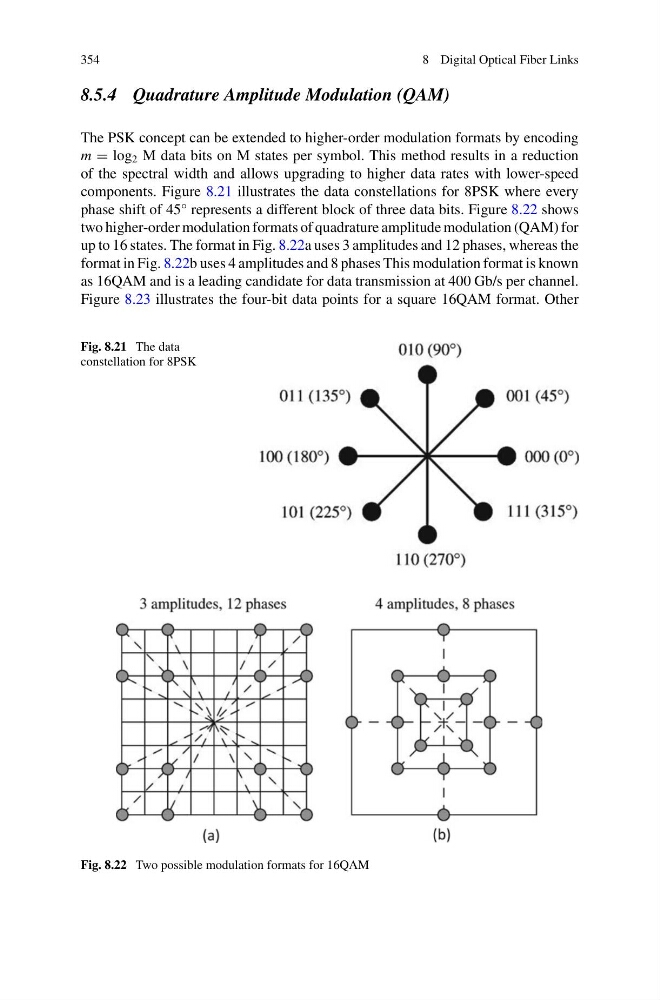
components. Figure 8.21 illustrates the data constellations for 8PSK where every
phase shift of 45° represents a different block of three data bits. Figure 8.22 shows
two higher-order modulation formats of quadrature amplitude modulation (QAM) for
up to 16 states. The format in Fig. 8.22a uses 3 amplitudes and 12 phases, whereas the
format in Fig. 8.22b uses 4 amplitudes and 8 phases This modulation format is known
as 16QAM and is a leading candidate for data transmission at 400 Gb/s per channel.
Figure 8.23 illustrates the four-bit data points for a square 16QAM format. Other
Fig. 8.21 The data
constellation for 8PSK
Fig. 8.22 Two possible modulation formats for 16QAM
8 Digital Optical Fiber Links
8.5.4 Quadrature Amplitude Modulation (QAM)
The PSK concept can be extended to higher-order modulation formats by encoding
m = log 2 M data bits on M states per symbol. This method results in a reduction
of the spectral width and allows upgrading to higher data rates with lower-speed
components. Figure 8.21 illustrates the data constellations for 8PSK where every
phase shift of 45° represents a different block of three data bits. Figure 8.22 shows
two higher-order modulation formats of quadrature amplitude modulation (QAM) for
up to 16 states. The format in Fig. 8.22a uses 3 amplitudes and 12 phases, whereas the
format in Fig. 8.22b uses 4 amplitudes and 8 phases This modulation format is known
as 16QAM and is a leading candidate for data transmission at 400 Gb/s per channel.
Figure 8.23 illustrates the four-bit data points for a square 16QAM format. Other
Fig. 8.21 The data
constellation for 8PSK
Fig. 8.22 Two possible modulation formats for 16QAM